| ||||||||||||||||||||||||||||||||||||||||
| ||||||||||||||||||||||||||||||||||||||||
All 70 seats in the National Assembly 35 seats needed for a majority | ||||||||||||||||||||||||||||||||||||||||
|---|---|---|---|---|---|---|---|---|---|---|---|---|---|---|---|---|---|---|---|---|---|---|---|---|---|---|---|---|---|---|---|---|---|---|---|---|---|---|---|---|
| ||||||||||||||||||||||||||||||||||||||||
| ||||||||||||||||||||||||||||||||||||||||
| This article is part of a series on the politics and government of Mauritius |
|---|
| Constitution |
Government
|
Judiciary |
|
Administrative divisions |
|
The 2000 Mauritian general elections took place on 11 September 2000 for the National Assembly of Mauritius with the votes counted on 12 September 2000.
The opposition Mauritian Militant Movement (MMM) party decisively won the elections in coalition with the Militant Socialist Movement (MSM), defeating the governing Mauritian Labour Party (MLP) led coalition. They formed together the MSM/MMM As a result, in a pre-election deal Anerood Jugnauth of the Militant Socialist Movement became Prime Minister of Mauritius before handing over to Paul Bérenger of the Mauritian Militant Movement in 2003; Bérenger would become the first non-Hindu Prime Minister of Mauritius. [1]

The Mouvement Militant Mauricien (MMM) is a left-wing socialist political party in Mauritius. The party was formed by a group of students in the late 1960s. The MMM advocates what it sees as a "fairer" society, without discrimination on the basis of social class, race, community, caste, religion, gender or sexual orientation.
The Militant Socialist Movement is a centre-left political party in Mauritius that adheres to the philosophies of socialism and political democracy. It is the largest single political party in the National Assembly of Mauritius, winning 34 of the 69 seats in the 2014 general elections. With political development, 6 MPs from the opposition joined officially the party making the current majority at 40. It also holds the largest number of seats in all city/town councils through the country with 60 councilors out of 120.
The Militant Socialist Movement/Mauritian Militant Movement (MSM/MMM) is coalition party that formed the government of the Republic of Mauritius from September 2000 to July 2005. The coalition has been reformed in April 2012 after an electoral agreement between the Militant Socialist Movement (MSM) and Mauritian Militant Movement (MMM) was made with Sir Anerood Jugnauth as leader. The agreements remain the same, 30 seats for the MMM and 30 seats for the MSM. It has also been conveyed that SAJ would be prime minister for 3 years and Paul Berenger would take over for the rest of the parliamentary term if the coalition wins the next general elections. It has also been agreed that Pravind Jugnauth who is leader of the MSM will not be in the Front Bench of the coalition in an eventual government of the MSM/MMM. This is because he has been provisionally charged with using office for gratification by the Independent Commission Against Corruption. He will therefore seat as a back-bencher until he is dismissed from all accusations.
The Mauritian Labour Party led by Navin Ramgoolam had governed Mauritius since winning the 1995 election. A new election had to be held by December 2000 and Ramgoolam dissolved parliament to call the election on 11 August 2000. He expected to be able to win the election in a three-way contest with the Mauritian Militant Movement and Militant Socialist Movement parties splitting the opposition vote between them. [2] However ten days after the election was called the two main opposition parties agreed a deal. [1] [2]
Navinchandra Ramgoolam, GCSK, FRCP is a Mauritian politician who was Prime Minister of Mauritius from 2005 to 2014 and leader of the Labour Party. He was Leader of the Opposition from 1991 to 1995. He served as Prime Minister for the first time from December 1995 until September 2000, and became Leader of the Opposition again from October 2000 to 4 July 2005. On 5 July 2005, he became prime minister for a second term after his Alliance Sociale won the general elections. He served again as Prime Minister from 2005 to 2014, when he was defeated afterwards.
The MSM led by Anerood Jugnauth and MMM led by Paul Bérenger agreed that if they won the election Jugnauth would become Prime Minister. They agreed that after three years he would step down as Prime Minister to become the President of Mauritius with enhanced powers, and that Bérenger would become Prime Minister, the first non-Hindu to do so. [2]
The President of Mauritius is the Head of State of the Republic of Mauritius. Mauritius is a parliamentary republic, and the President functions as a ceremonial figurehead, elected by the National Assembly as set out by the Constitution of Mauritius. The current office-holder is Barlen Vyapoory who is serving on an acting capacity following Ameenah Gurib-Fakim's resignation. The President's official residence is the State House.
The election was conducted under the first past the post system with three Members of parliament being elected from each of 20 mainland constituencies. A further two MPs were elected from the island of Rodrigues. Each voter was required to vote for three candidates. Once these 62 MPs were decided the Supervisory Electoral Commission chose the eight 'best losers' to prevent any ethnic community or political party from being underrepresented. The Commission chose four MPs to balance the ethnic groups (Hindus, Muslims, Chinese and general population) and another four to balance the political parties. The 'best losers' could only come from candidates who came fourth in the 20 mainland constituencies. [3] [4]
Chinese people are the various individuals or ethnic groups associated with China, usually through ancestry, ethnicity, nationality, citizenship or other affiliation. Han Chinese, the largest ethnic group in China, at about 92% of the population, are often referred to as "Chinese" or "ethnic Chinese" in English, however there are dozens of other related and unrelated ethnic groups in China.
There were 43 parties putting forth 535 candidates but the main contest was between the two main coalitions that campaigned on similar platforms with the economy being the dominate election issue. [5] The governing Mauritian Labour Party promised to raise civil servants' wages and reduce the prices of drinks while the main opposition attacked corruption. Both the government and opposition parties pledged to create 70,000 jobs. [6]
The campaign was peaceful and election day was quiet with the sale or serving of alcohol banned for two days during the election to prevent trouble. [7] Observers from the Southern African Development Community praised the election for its efficient and fair conduct and the high turnout. [8] The opposition Mauritian Militant Movement and Militant Socialist Movement parties won a decisive victory almost wiping out the governing party and the Prime Minister Navin Ramgoolam admitted defeat the day after the election. [9] Gender activists were disappointed with the results which saw only four seats won by women, a decline on the previous election in 1995. [10]
| Parties and alliances | Votes | % | Seats | Additional seats | total seats |
|---|---|---|---|---|---|
Alliance MSM-MMM
| 51.7 | 54 | 4 | 58 | |
Alliance MLP-PMXD
| 36.6 | 6 | 2 | 8 | |
| Rodrigues People's Organisation (Organisation du Peuple Rodriguais) | 2 | 0 | 2 | ||
| Rodrigues Movement (Mouvement Rodriguais) | 0 | 2 | 2 | ||
| Total (Turnout 80.9%) | 630,726 | 100.0 | 62 | 8 | 70 |
| Source: Elections in Mauritius | |||||
| Constituency | Elected MPs | Party Alliance | Religion |
|---|---|---|---|
| 1 | BARBIER, Jean Claude NAVARRE-MARIE, Marie Arianne ARMANCE, Jean- Claude Louis Desiré | MSM/MMM | Christians |
| 2 | LEUNG SHING, Emmanuel Jean BEEBEEJAUN, Ahmed Rashid MAUDARBOCUS, Sahid | MSM/MMM Labour Party-PMXD MSM/MMM | Chinese Muslim Muslim |
| 3 | LAUTHAN, Samioullah CHADY, Mohummud Siddick NANHUCK, Mohammad | MSM/MMM Labor Party-PMXD MSM/MMM | Muslim |
| 4 | CHUMROO, Meckduth GRIVON, Gérard Clifford LESJONGARD, Georges Pierre | MSM/MMM | Hindu Christian |
| 5 | Navin Ramgoolam JHURRY, Jyaneshwur HURNAM, Devendranath | Labor Party-PMXD MSM/MMM MSM/MSM | Hindu |
| 6 | JEEHA, Deelchand, GUNGAH, Ashit Kumar DULLOO, Madan Murlidhar | MSM/MMM MSM/MMM Labor-PMXD | Hindu |
| 7 | Sir Anerood Jugnauth HOOKOOM, Balkissoon MEENOWA, Jai Prakash | MSM/MMM Labor Party-PMXD MSM/MMM | Hindu |
| 8 | RAMLOLL, Parmessur Ashok Jugnauth NAGALINGUM, Darmarajen | MSM/MMM | Hindu |
| 9 | BACHOO, Anil Kumar Sangeet Fowdar KOONJOO, Premdut | MSM/MMM | Hindu |
| 10 | CHOONEE, Mookhesswur GUNNESS, Govindranath DAUREEAWOO, Rashad | MSM/MMM | Hindu Hindu Muslim |
| 11 | Pravind Jugnauth BOOLELL, Arvin BHOWON, Rajayswur | MSM/MMM Labor Party-PMXD MSM/MMM | Hindu |
| 12 | GAYAN, Anil Kumarsingh ROOPUN, Dharmaveersing COLLENDAVELLOO, Ivan Leslie | MSM/MMM | Hindu Hindu Christian |
| 13 | AUMEER, Hurreeprem ISSIMDAR, Abdool Nasser BALOOMOODY, Vedasingam Vasudevachariar | MSM/MMM | Hindu Muslims Hindu |
| 14 | Alan Ganoo ARUNASALON, José ROOPUN, Prithvirajsing, | MSM/MMM | Hindu Christian Hindu |
| 15 | DOOKUN LUCHOOMUN, Leela Devi OBEEGADOO, Louis Steven SOODHUN, Showkutally | MSM/MMM | Hindu Christian Muslim |
| 16 | BODHA, Nandcoomar SAKARAM, Sewram MICHEL, Louis Sylvio | MSM/MMM | Hindu Hindu Christian |
| 17 | GUIMBEAU, Eric Joseph Raoul PAYA, Marie José Gerard DOWARKASING, Mokshanand | MSM/MMM | Christian Hindu |
| 18 | KHUSHIRAM, Khushhal Chand, AUROOMOOGA PUTTEN, Prithviraj, PERRIER, Anne-Marie Danielle | MSM/MMM | Hindu Christian |
| 19 | Paul Berenger CUTTAREE, Jaya Krishna ABDOOLA, Mohamed Feroz | MSM/MMM | Christian Hindu Muslim |
| 20 | BHAGWAN, Rajesh Anand LABELLE, Marie Noëlle Françoise ALLET, Daniel Jean Maurice | MSM/MMM | Hindu Christian |
The known history of Mauritius begins with its discovery by Arabs, followed by Europeans and its appearance on maps in the early 16th century. Mauritius was successively colonized by the Dutch, the French and the British, and became independent in 1968.
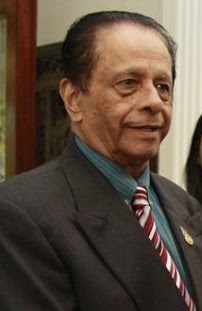
Sir Anerood Jugnauth GCSK, KCMG, QC, MP, PC is a Mauritian politician who has served as both President and Prime Minister of Mauritius. He is Member of Parliament for Piton & Riviere Du Rempart.
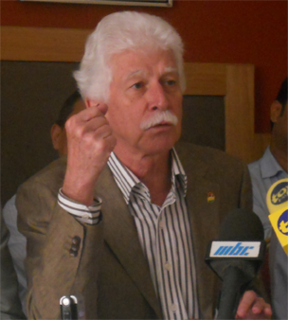
Paul Raymond Bérenger GCSK, MP is a Mauritian politician who was Prime Minister of Mauritius from 2003 to 2005. He has been Leader of the Opposition on several occasions — from 1983 to 1987, 1997 to 2000, 2005 to 2006, 2007 to 2013, October 2013 to 15 September 2014, and again since December 2014. Following his party's defeat in the 2014 general elections, he became Leader of the Opposition for the sixth time, making him the longest ever to serve in this constitutional position. He was also Deputy Prime Minister from 1995 to 1997 and again from 2000 to 2003, and he was a cabinet minister in the government of Anerood Jugnauth in 1982 and 1991. Bérenger, a Christian of Franco-Mauritian descent, has been the only non-Hindu Prime Minister of Mauritius.
Sir Seewoosagur Ramgoolam was a Mauritian politician, statesman and philanthropist. He was a leader in the Mauritian independence movement, and served as the first Chief Minister and Prime Minister of Mauritius, as well as its Governor-General. He was the Chairperson of the Organisation of African Unity from 1976 to 1977. As the leader of the Labour Party, Ramgoolam fought for the rights of labourers and led Mauritius to independence in 1968.
Elections in Mauritius gives information on elections and election results in Mauritius. Since 1967, Mauritius has experienced 11 free and fair democratic general elections to choose a government.
The Labour Party is a centre-left social-democratic political party in Mauritius, and one of the four main Mauritian political parties along with the Mauritian Militant Movement (MMM), the Militant Socialist Movement (MSM) and the Parti Mauricien Social Démocrate (PMSD). As a member of the Labour Party-MMM alliance, it had four Members of Parliament directly elected in the general election of 2014. The party is led by Navin Ramgoolam.
A general election was held in Mauritius on 5 May 2010. The coalition comprising Mauritius Labour Party under Navin Ramgoolam, the Militant Socialist Movement under Pravind Jugnauth and the Mauritian Social Democrat Party under Xavier Luc Duval, won a majority with 41 seats in the parliament. The Mauritian Militant Movement-led coalition under Paul Berenger finished second with 18 seats. The Mauritian Solidarity Front won one seat and the Rodrigues Movement won the two remaining seats. The elections were the ninth to be held since independence from the United Kingdom in 1968.
Pravind Kumar Jugnauth MP Esq. is a Mauritian politician who is Prime Minister of Mauritius, in office since 2017, and also holds another portfolio as Minister of Finance. He is currently leader of the Militant Socialist Movement (MSM), which has the majority seats Pravind Jugnauth previously served as Minister of Technology, Communication and Innovation following the victory of their alliance LEPEP in the 2014 general elections from December 2014 to July 2015. He has occupied various positions in both government and opposition since 2000. He was Minister of Agriculture from 2000 to 2003, Deputy Prime Minister & Minister of Finance from 2003 to 2005. While he served in Navin Ramgoolam's cabinet from 2010 to 2011 as Vice Prime Minister and Minister of Finance He is also Member of Parliament for the 8th constituency Quartier Militaire and Moka. He left the coalition government and was appointed Leader of the Opposition in September 2014 until he was named as minister in his father's cabinet following their victory.
Arvin Boolell GOSK, MP is a former foreign minister of Mauritius. He was appointed by President Sir Anerood Jugnauth and took office in September 2008 in the cabinet of Navin Ramgoolam. He belongs to the Boolell dynasty and his father was former Foreign Minister Sir Satcam Boolell and he is a cousin of former foreign minister Anil Gayan. Before serving as Foreign Minister, he was the minister of Agro-Industry and Fisheries of Mauritius, and was involved in negotiations with the European Union over economic issues.
General elections were held in Mauritius on 15 September 1991. Three main parties gained seats in this election: the Militant Socialist Movement, Mauritian Militant Movement and the Labour Party. The MSM formed an alliance with the MMM and the Labour party formed an alliance with the Mauritian Social Democrat Party (PMSD). On 17 September 1991, results showed that MSM-MMM won 57 seats out of 60 elected seats. This gave 95% of seats to MSM-MMM leader Anerood Jugnauth and 5% to Labour Party-PMSD leader Navin Ramgoolam.

General elections were held in Mauritius on 20 November 1995. The result was a victory for the Labour Party-Mauritian Militant Movement alliance led by Navin Ramgoolam, which won all 60 constituency seats on Mauritius. Along with 1982, it was one of two elections in which a party won every seat. The Militant Socialist Movement (MSM) led by Anerood Jugnauth lost power after 13 years, with Jugnauth resigning two days after the results were announced. Navin Ramgoolam became Prime Minister and appointed Paul Berenger as Deputy Prime Minister.
The L'Alliance de L'avenir was a political alliance in Mauritius which was formed in 2010 in respect for the next parliamentary elections which were held on 5 May 2010. It is an alliance of the Labour Party, Mouvement Socialiste Militant and Parti Mauricien Social Démocrate. It was formed by the prime minister Dr. Navin Ramgoolam and is led by three other people, namely Rashid Beebeejaun, Xavier-Luc Duval and Pravind Jugnauth.
General elections were held in Mauritius on 21 August 1983. The result was a victory for an alliance of the Militant Socialist Movement, the Labour Party and the Mauritian Social Democrat Party, which between them won 46 seats. The Militant Socialist Movement (MSM) won 32 seats, whilst the Labour Party secured 9 seats and PMSD five. This alliance allowed Jugnauth to continue as Prime Minister while bringing Seewoosagur Ramgoolam and Gaetan Duval back into the government after their severe defeat in the 1982 elections. Shortly after, Ramgoolam was appointed as Governor General, Duval became Deputy Prime Minister and Satcam Boolell became Minister of Foreign Affairs.
Nandcoomar Bodha MP is the former Minister of Tourism & Leisure of Mauritius. He has been holding the office since 11 May 2010 to 26 July 2011. He held the same office from 2000 to 2003 in the MSM/MMM coalition government. When Pravind Jugnauth was sworn as Deputy Prime Minister, he took the office of Minister of Agriculture in 2003 up to 2005.He was appointed 8th position in the Cabinet of Navin Ramgoolam.
Leela Devi Dookhun Luchoomun MP is the former Minister of Social Security of Mauritius serving in the cabinet of Navin Ramgoolam having been appointed on 11 May 2010 by President Anerood Jugnauth. She is Member of Parliament representing Constituency No 8, Moka & Quartier Militaire. She is a former Minister of Arts & Culture serving in the cabinet of Paul Berenger for a short period of 6 months.

General elections were held in Mauritius on 10 December 2014 and resulted in a victory for the Alliance Lepep coalition, which secured 47 of the elected seats under the leadership of Sir Anerood Jugnauth, while the PTR–MMM alliance under Navin Ramgoolam only got 13 seats.