
Scilla luciliae is a species of flowering plant in the family Asparagaceae. It is referred to by the common names Bossier's glory-of-the-snow or Lucile's glory-of-the-snow, and is a bulbous perennial from western Turkey that flowers in early spring. After flowering, it goes into dormancy until the next spring. The specific epithet is in honour of Lucile, the wife of the Swiss botanist Pierre Edmond Boissier (1810-1885). It belongs to a group of Scilla species that were formerly put in a separate genus, Chionodoxa, and may now be treated as Scilla sect. Chionodoxa.
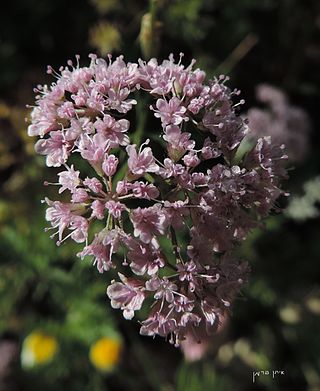
Chaetosciadium is a monotypic genus of flowering plants in the family Apiaceae. Its only species is Chaetosciadium trichospermum. the only species of the genus Chaetosciadium. It is native to Iraq, Lebanon, Syria, Palestine and Saudi Arabia. It is common in Israel.
Trigonosciadium is a genus in the family Apiaceae. Trigonosciadium brachytaenium is endemic to Iran, whereas T. tuberosum and T. viscidulum grow in Iran, Anatolia and Iraq.

Wulfenia is a plant genus in the family Plantaginaceae. The genus was named after Franz Xaver von Wulfen (1728–1805), an Austrian botanist, zoologist, mineralogist, alpinist, and Jesuit priest. It was first described in 1781 by Nikolaus Joseph von Jacquin in. It is also in Tribe Veroniceae.
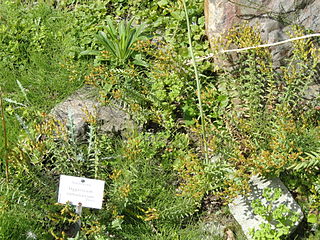
Hypericum rumeliacum is a species of flowering plant in the family Hypericaceae, native to southeastern Europe.

Allium libani is a species of wild bulbous plant geophyte of the genus Allium, belonging to the family of Amaryllidaceae. Allium libani is endemic to the Middle East in Lebanon and Syria.
Cyclotrichium is a genus of plants in the Lamiaceae, first described as a genus in 1953. The entire genus is endemic to southwestern Asia.
- Cyclotrichium depauperatum(Bunge) Manden. & Scheng. - western Iran
- Cyclotrichium glabrescens(Boiss. ex Rech.f.) Leblebici - southeastern Turkey
- Cyclotrichium haussknechtii(Bunge) Manden. & Scheng. - western Iran
- Cyclotrichium leucotrichum(Stapf ex Rech.f.) Leblebici - Iran, Iraq, Turkey
- Cyclotrichium longiflorumLeblebici - Iran, Iraq, Turkey
- Cyclotrichium niveum(Boiss.) Manden. & Scheng - eastern Turkey
- Cyclotrichium origanifolium(Labill.) Manden. & Scheng. - Lebanon, Syria, southern Turkey
- Cyclotrichium stamineum(Boiss. & Hohen.) Manden. & Scheng. - Iraq, Turkey
- Cyclotrichium straussii(Bornm.) Rech.f. - western Iran

Tordylium is a genus of flowering plants in the carrot family (Apiaceae). Members of the genus are known as hartworts.

Fritillaria gibbosa is a species of herbaceous perennial plant in the lily family Liliaceae. It is native to Afghanistan, Iran, Pakistan, Turkmenistan, and Transcaucasia.
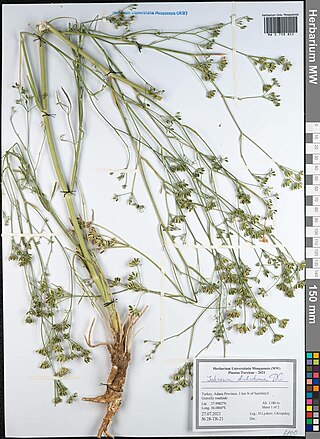
Johrenia is a genus of herbaceous plants of the family Apiaceae.

Fritillaria reuteri is a perennial herbaceous bulbous plant, distributed in Turkey and Iran. It is a species in the genus Fritillaria, in the family Liliaceae. It is placed in the subgenus Fritillaria.
Tordylium trachycarpum is a species of flowering plant in the family Apiaceae, native to Western Asia and European Turkey. It was first described by Pierre Edmond Boissier in 1849 as Ainsworthia trachycarpa.
Hypericum minutum is a species of flowering plant in the St John's wort family Hypericaceae. It is a small perennial herb that grows in tufts. It has slender and brittle stems, flowers in clusters of one to three, yellow petals with black and amber glands, few stamens, and a seed capsule with narrow grooves. H. minutum is closely related to H. huber-morathii and H. sechmenii and resembles a smaller form of the latter plant. The plant is endemic to Turkey, and is found among limestone rocks in a limited region of southwestern Anatolia. Originally excluded from a comprehensive monograph of Hypericum, the species' placement within the genus is unclear. It has been placed in both section Adenosepalum and section Origanifolium.
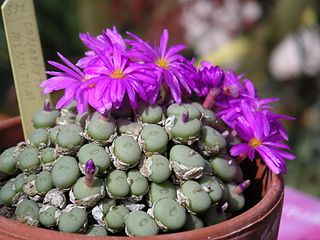
Conophytum minutum, called the lesser dumpling, is a species of flowering plant in the genus Conophytum, native to the western Cape Provinces of South Africa. It has gained the Royal Horticultural Society's Award of Garden Merit.
Petiniotia is a monotypic genus of flowering plants belonging to the family Brassicaceae. It only contains one known species, Petiniotia purpurascens(Boiss.) J.Léonard
Petroedmondia is a monotypic genus of flowering plants belonging to the family Apiaceae. It only contains one known species, Petroedmondia syriaca.
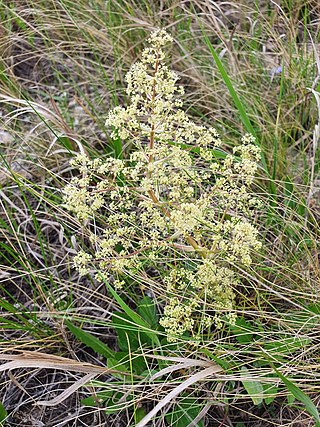
Trinia is a genus of flowering plants in the family Apiaceae, native from Europe to Iran and western Siberia. The genus was first described by Georg Franz Hoffmann in 1814.
Lisaea is a genus of flowering plant in the family Apiaceae, native to from the eastern Mediterranean to the western Himalayas. The genus was first described by Pierre Edmond Boissier in 1844.

Sison is a genus of flowering plant in the family Apiaceae, native to western and southern Europe and north Africa. The genus was first described by Carl Linnaeus in 1753, in his book Species Plantarum.
Deverra is a genus of flowering plant in the family Apiaceae, native from northern Africa to the Arabian Peninsula and Iraq, and to south tropical and southern Africa. The genus was first described by Augustin de Candolle in 1829.

