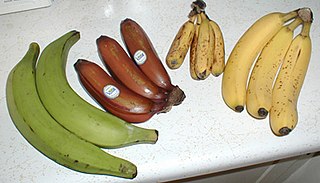
A banana is an elongated, edible fruit – botanically a berry – produced by several kinds of large herbaceous flowering plants in the genus Musa. In some countries, cooking bananas are called plantains, distinguishing them from dessert bananas. The fruit is variable in size, color and firmness, but is usually elongated and curved, with soft flesh rich in starch covered with a peel, which may have a variety of colors when ripe. It grows upward in clusters near the top of the plant. Almost all modern edible seedless (parthenocarp) cultivated bananas come from two wild species – Musa acuminata and Musa balbisiana, or hybrids of them.

Musaceae is a family of flowering plants composed of three genera with about 91 known species, placed in the order Zingiberales. The family is native to the tropics of Africa and Asia. The plants have a large herbaceous growth habit with leaves with overlapping basal sheaths that form a pseudostem making some members appear to be woody trees. In most treatments, the family has three genera, Musa, Musella and Ensete. Cultivated bananas are commercially important members of the family, and many others are grown as ornamental plants.

The blood banana, is a variety of the wild banana Musa acuminata native to Sumatra, Indonesia. The blood banana is an ornamental plant, named for the dark red patches on its leaves, though its small-seeded fruits are also edible. It grows 6' to 8' tall in the wild, but is well-adapted to container growing and can be maintained at 3' to 5'. It grows best in full or partial sun and is hardy in zones 9 - 11.

Musa is one of three genera in the family Musaceae. The genus includes 83 species of flowering plants producing edible bananas and plantains. Though they grow as high as trees, banana and plantain plants are not woody and their apparent "stem" is made up of the bases of the huge leaf stalks. Thus, they are technically gigantic herbaceous plants.

Gros Michel, often translated and known as "Big Mike", is an export cultivar of banana and was, until the 1950s, the main variety grown. The physical properties of the Gros Michel make it an excellent export produce; its thick peel makes it resilient to bruising during transport and the dense bunches that it grows in make it easy to ship.
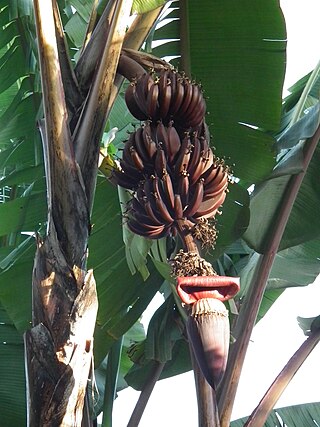
Red bananas are a group of varieties of bananas with reddish-purple skin. Some are smaller and plumper than the common Cavendish banana, others much larger. Ripe, raw red bananas have a flesh that is creamy to light pink. They are also softer and sweeter than the yellow Cavendish varieties, some with a slight tangy raspberry flavor and others with an earthy one. Many red bananas are exported by producers in East Africa, Asia, South America, and the United Arab Emirates. They are a favorite in Central America, but are sold throughout the world.

Ensete superbum is a species of banana from India.
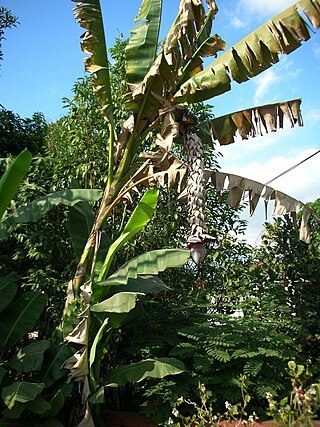
Musa balbisiana, also known simply as plantain, is a wild-type species of banana. It is one of the ancestors of modern cultivated bananas, along with Musa acuminata.

The Grand Nain banana is a banana cultivar of Musa acuminata. It is one of the most commonly cultivated bananas and a member of the commercial Cavendish banana cultivar group. It is also known as the Chiquita banana because it is the main product of Chiquita Brands International.

Musa acuminata, also known as banana, is a species of banana native to Southern Asia, its range comprising the Indian Subcontinent and Southeast Asia. Many of the modern edible dessert bananas are from this species, although some are hybrids with Musa balbisiana. First cultivated by humans around 8000 BCE, it is one of the early examples of domesticated plants.

Ensete ventricosum, commonly known as enset or ensete, Ethiopian banana, Abyssinian banana, pseudo-banana, false banana and wild banana, is a species of flowering plant in the banana family Musaceae. The domesticated form of the plant is cultivated only in Ethiopia, where it provides the staple food for approximately 20 million people. The name Ensete ventricosum was first published in the Kew Bulletin 1947, p. 101. Its synonyms include Musa arnoldiana De Wild., Musa ventricosa Welw. and Musa ensete J. F. Gmelin. In its wild form, it is native to the eastern edge of the Great African Plateau, extending northwards from South Africa through Mozambique, Zimbabwe, Malawi, Kenya, Uganda and Tanzania to Ethiopia, and west to the Congo, being found in high-rainfall forests on mountains, and along forested ravines and streams.

Saba banana is a triploid hybrid (ABB) banana cultivar originating from the Philippines. It is primarily a cooking banana, though it can also be eaten raw. It is one of the most important banana varieties in Philippine cuisine. It is also sometimes known as the "cardaba banana", though the latter name is more correctly applied to the cardava, a very similar cultivar also classified within the saba subgroup.

Fe'i bananas are cultivated plants in the genus Musa, used mainly for their fruit. They are very distinct in appearance and origin from the majority of bananas and plantains currently grown. Found mainly in the islands of the Pacific, particularly French Polynesia, Fe'i bananas have skins which are brilliant orange to red in colour with yellow or orange flesh inside. They are usually eaten cooked and have been an important food for Pacific Islanders, moving with them as they migrated across the ocean. Most are high in beta-carotene.

Lady finger bananas are diploid banana cultivars originating in Malaysia or Indonesia, belonging to the Sucrier subgroup of the AA banana cultivar group. Lady finger bananas are the most widely cultivated AA cultivar and are one of the world’s most popular local bananas. Its fruits are finger-sized, sweet, and thin-skinned.

Matoke, locally also known as matooke, amatooke in Buganda, ekitookye in southwestern Uganda, ekitooke in western Uganda, kamatore in Lugisu, ebitooke in northwestern Tanzania, igitoki in Rwanda, Burundi and by the cultivar name East African Highland banana, are a group of starchy triploid banana cultivars, originating from the African Great Lakes. The fruit is harvested green, carefully peeled, and then cooked and often mashed or pounded into a meal. In Uganda and Rwanda, the fruit is steam-cooked, and the mashed meal is considered a national dish in both countries.

Ernest Entwistle Cheesman, was an English botanist noted for his work on the family Musaceae. He was the son of Charles Cheesman and Grace Lizzie Davies. About August 1936 he married Ellen Elizabeth B. Weston (1892-1966).
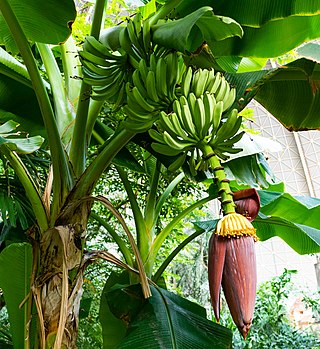
Musa × paradisiaca is a species as well as a cultivar, originating as the hybrid between Musa acuminata and Musa balbisiana, cultivated and domesticated by human very early. Most cultivated bananas and plantains are polyploid cultivars either of this hybrid or of M. acuminata alone. Linnaeus originally used the name M. paradisiaca only for plantains or cooking bananas, but the modern usage includes hybrid cultivars used both for cooking and as dessert bananas. Linnaeus's name for dessert bananas, Musa sapientum, is thus a synonym of Musa × paradisiaca.

Musa jackeyi, commonly called the erect banana or wild banana, is a species of wild banana in the plant family Musaceae. It is placed in section Callimusa. It has a very small native range in northeast Queensland, Australia. It grows up to 10 m (33 ft) in height, with leaf blades usually about 2 m long by 60 cm (24 in) wide. It resembles the cultivated bananas called "fe'i" or "fehi", having an upright rather than a drooping fruit stalk, with the green terminal bud pointing upwards, and sap which is reddish in colour.
MusaNet is a global network of scientists and other stakeholders working on banana genetic resources. Founded in 2011 and coordinated by Bioversity International, it has over 100 individual members representing various banana research institutes and organizations.