OTS 44

Last updated

OTS 44
OTS 44.jpg
OTS 44 (orange crosshair) and surrounding nebulae
Observation data
Epoch J2000.0        Equinox J2000.0
Constellation Chamaeleon
Right ascension 11h 10m 11.5s
Declination −76° 32 13
Characteristics
Spectral type M9.5±1.0 [1] [2]
Astrometry
Distance 522–544 or 626  ly
(160–170 or 192  pc) [3] [4]
Details
Mass 6–17  MJ , average 11.5 [3]   MJup
Radius 3.2 or 3.6 [2]   RJup
Luminosity 0.00126±0.00023 [a]  0.0024 [3]   L
Temperature 1700±100 [2] [3]   K
Age 1–6 [2]   Myr
Other designations
2MASS J11100934–7632178, CHSM 16658, [5] SSTgbs J1110093–763218, [5] TIC 454329342, [GMM2009]Cha I 27 [5]
Database references
SIMBAD data

OTS 44 is a young, free-floating planetary-mass brown dwarf or rogue planet, located 520 to 630 light-years (160 to 192 parsecs ) away in the star-forming molecular cloud Chamaeleon I in the constellation Chamaeleon. It is surrounded by a circumstellar disk of gas and dust, from which it is actively accreting mass at an approximate rate of 500 billion kilograms per second (or equivalently, 7.6×10⁻¹² solar masses per year). [3] With an estimated age between 1 and 6 million years, OTS 44 has not existed long enough to cool down, so it glows red with a temperature of around 1,700 K (1,430 °C; 2,600 °F) and a stellar spectral type of M9.5. [2] It likely formed from the gravitational collapse of gas and dust, a similar process to how stars typically form. [6]

Contents

The disk of OTS 44 is estimated to span at least several astronomical units in radius with a flared shape—decreasing in density but increasing in vertical thickness at farther distances from the object. [3] :2–3 OTS 44's disk contains a total estimated mass of approximately 0.1 Jupiter masses or 30 Earth masses, [3] with a small fraction of this mass constituting dust in the disk. [7] OTS 44's disk will eventually coalesce to form a planetary system, with enough mass to potentially create one small gas giant planet and several Earth-sized rocky planets. [8] [9]

Discovery

OTS 44 was discovered in images taken on 1–3 March 1996 by Japanese astronomers Yumiko Oasa, Motohide Tamura, and Koji Sugitani, during a search for young stellar objects and brown dwarfs in the core of the Chamaeleon I molecular cloud. [10] :338 The discovery images were taken with the Cerro Tololo Inter-American Observatory's 1.5-metre (4.9 ft) telescope in Chile, which was equipped with the J, H, and K filters to measure the near-infrared colors of these objects. [11] :1095 [10] :338–339 The discoverers found 61 near-infrared-emitting objects and included them in their own catalogue, [10] :339 which became known as the Oasa–Tamura–Sugitani (OTS) catalogue. [12] [1] :565

OTS 44 was the 44th object and one of the dimmest objects listed in the OTS catalogue. [10] :337 [1] :565 The discoverers identified OTS 44 as a brown dwarf candidate because it appeared much dimmer and redder than other young stars in Chameleon I, which meant that it should have a very low mass if it shared the same age as these stars. [11] :1046 [10] :341 The discoverers published their analysis and identification of OTS 44 as a brown dwarf candidate in the journal Science in November 1998. [11]

In November 2004, Kevin L. Luhman, Dawn E. Peterson, and S. Thomas Megeath announced the confirmation of OTS 44 as a low-mass brown dwarf. [13] Using spectroscopic observations by the Gemini South telescope from March 2004, the researchers determined that OTS 44's mass lay close to the ~0.012  solar mass (13 Jupiter mass) boundary between giant planets and brown dwarfs, which made OTS 44 one of the least massive free-floating brown dwarfs confirmed at the time. [1] [14] :L53

Location and age

The Chamaeleon complex photographed in far infrared by the IRAS satellite. OTS 44 is located in the Chamaeleon I region. Cha complex labelled.png
The Chamaeleon complex photographed in far infrared by the IRAS satellite. OTS 44 is located in the Chamaeleon I region.

OTS 44 is located in the constellation Chamaeleon at a declination of approximately 76.5° south of the celestial equator. [5] It is situated within the core of Chamaeleon I, one of the three major star-forming molecular clouds of the Chamaeleon complex. [11] [10] Chamaeleon I is one of the nearest star-forming regions to the Sun, [10] :336 at an estimated distance of either 160–170 parsecs (520–550 light-years ) (according to 1999 parallax measurements by the Hipparcos satellite [15] :580 [1] :565) or 192 pc (630 ly) (according to 2018 parallax measurements by the Gaia satellite [4] :565). Astronomers assume that OTS 44 lies at the same distance as Chamaeleon I. [7] :2 [4] :565

As a member of Chamaeleon I, OTS 44 is inferred to share the same age as other young stellar objects in the region, which are known to be between 1 and 6 million years old. [2] :13,19 At this age, substellar objects like OTS 44 would remain hot and luminous. [2] :1–2 Observations of active accretion around OTS 44 indicate that it formed in a similar process to how stars form—via direct gravitational collapse of concentrated gas and dust. [6] :1019–1020 OTS 44 will gradually cool and contract over time—becoming an L-type brown dwarf at about 10 million years of age, and then a Y dwarf after 1 billion years of age. [6] :1024

Physical characteristics

The near-infrared spectrum of OTS 44 (black) shows deep absorption bands due to steam (H
2O vapor) in its atmosphere. The spectrum of the M8-type brown dwarf CHSM 17173 (red) is shown for comparison. OTS 44 spectrum colorized.png
The near-infrared spectrum of OTS 44 (black) shows deep absorption bands due to steam (H
2
O
vapor) in its atmosphere. The spectrum of the M8-type brown dwarf CHSM 17173 (red) is shown for comparison.

The near-infrared spectrum of OTS 44 exhibits deep absorption bands caused by steam (water vapor) in its atmosphere, indicating a relatively cool temperature corresponding to a late spectral type of M9.5±1.0. [1] Additional substances including elemental sodium (Na), potassium (K), iron hydride (FeH), and carbon monoxide (CO) have been spectroscopically detected in OTS 44's atmosphere. [2] :4,7,10 OTS 44 is estimated to have an effective temperature of 1,700 ± 100 K (1,427 ± 100 °C; 2,600 ± 180 °F), based on spectral energy distribution modeling with the object's atmospheric dust taken into account. [3] :2 [2] :17 OTS 44 stands out from cool main-sequence stars and red giants because it is much redder and brighter in near-infrared. [10] :339–340 Extinction by foreground dust has been observed to cause additional reddening in OTS 44's near-infrared colors (0.3±0.3-magnitude dimming in J-band), [1] :567 but not in its optical colors. [2] :3

OTS 44 is a dim object with a luminosity between 0.001 and 0.002 times that of the Sun. [3] :2 [a] As a young and hot object, OTS 44 is expected to have a radius larger than that of Jupiter. [2] :1,19,23 A Stefan–Boltzmann law calculation using OTS 44's luminosity and temperature suggests a "semi-empirical" radius of 3.5+0.6
−0.5
  RJ
, whereas a spectral energy distribution fit with OTS 44's disk taken into account suggests a radius between 3.2 and 3.6 RJ. [2] :15,17,19 OTS 44 is estimated to be 6–17 times more massive than Jupiter, [7] though it is more likely below 13 Jupiter masses—in the planetary mass range, where it cannot fuse deuterium unlike brown dwarfs. [2] Hence, astronomers have categorized OTS 44 as a free-floating planet. [6] [7]

Circumstellar disk

Cross-section diagram of the OTS 44's flared disk model proposed by Joergens et al. (2013) OTS44 disk cross section.svg
Cross-section diagram of the OTS 44's flared disk model proposed by Joergens et al. (2013)
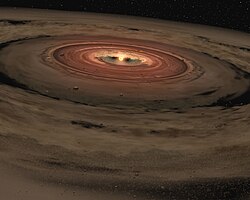
An artist's concept of OTS 44's dust disk Brown dwarf OTS 44 with disc.jpg
An artist's concept of OTS 44's dust disk

In February 2005, a team of astronomers led by Kevin Luhman announced the discovery of a circumstellar disk around OTS 44. [9] [8] Their discovery was based on the Spitzer Space Telescope's detection of excess mid-infrared thermal emission from OTS 44, which indicated the presence of warm dust surrounding the object. [14] As one of the least massive free-floating objects known at the time, OTS 44 claimed the record for the least massive known circumstellar disk host and demonstrated that such disks could exist around planetary-mass objects. [14]

Estimates based on OTS 44's spectral energy distribution (SED) suggests that its disk contains a total mass of about 30 Earth masses. [3] Observations with the SINFONI spectrograph at the Very Large Telescope show that OTS 44 is accreting matter from its disk at the rate of approximately 10−11 of the mass of the Sun per year. [3] It could eventually develop into a planetary system. [16]

Observations with ALMA detected OTS 44's disk in millimeter wavelengths. The observations constrained the dust mass of the disk between 0.07 and 0.63 M🜨, but these mass estimates are limited by assumptions on poorly constrained parameters. [7] Another work estimates the dust mass to 0.064 M🜨 (5.2 M) for dust particles of 1 mm in size and 0.295 M🜨 (24 M) for dust particles of 1 μm in size. [4]

See also

Other free-floating rogue planets and brown dwarfs with protoplanetary disks:

Notes

  1. 1 2 In Table of 8 of Bonnefoy et al. (2014), OTS 44's effective luminosity is given as a base 10 logarithm: −2.90±0.08. The luminosity of 0.00126±0.00023  L can be obtained by taking 10 to the power of the aforementioned logarithm value; the uncertainty is calculated via propagation of error. [2] :19

References

  1. 1 2 3 4 5 6 7 8 Luhmann, K. L.; Peterson, D. E.; Megeath, S. T. (2004). "Spectroscopic Confirmation of the Least Massive Known Brown Dwarf in Chamaeleon". The Astrophysical Journal. 617 (1): 565–568. arXiv: astro-ph/0411445 . Bibcode:2004ApJ...617..565L. doi:10.1086/425228. S2CID   18157277.
  2. 1 2 3 4 5 6 7 8 9 10 11 12 13 14 Bonnefoy, M.; Chauvin, G.; Lagrange, A.-M.; Rojo, P.; Allard, F.; Pinte, C.; Dumas, C.; Homeier, D. (2014). "A library of near-infrared integral field spectra of young M-L dwarfs". Astronomy & Astrophysics. 562 (127): A127. arXiv: 1306.3709 . Bibcode:2014A&A...562A.127B. doi:10.1051/0004-6361/201118270. S2CID   53064211.
  3. 1 2 3 4 5 6 7 8 9 10 11 12 Joergens, V.; Bonnefoy, M.; Liu, Y.; Bayo, A.; Wolf, S.; Chauvin, G.; Rojo, P. (1 October 2013). "OTS 44: Disk and accretion at the planetary border". Astronomy and Astrophysics. 558: L7. arXiv: 1310.1936 . Bibcode:2013A&A...558L...7J. doi:10.1051/0004-6361/201322432. ISSN   0004-6361.
  4. 1 2 3 4 Wu, Ya-Lin; Bowler, Brendan P.; Sheehan, Patrick D.; Close, Laird M.; Eisner, Joshua A.; Best, William M. J.; Ward-Duong, Kimberly; Zhu, Zhaohuan; Kraus, Adam L. (1 May 2022). "ALMA Discovery of a Disk around the Planetary-mass Companion SR 12 c". The Astrophysical Journal. 930 (1): L3. arXiv: 2204.06013 . Bibcode:2022ApJ...930L...3W. doi: 10.3847/2041-8213/ac6420 . ISSN   0004-637X.
  5. 1 2 3 4 "OTS 44". SIMBAD . Centre de données astronomiques de Strasbourg . Retrieved 23 December 2025.
  6. 1 2 3 4 Joergens, V.; Bonnefoy, M.; Liu, Y.; Bayo, A.; Wolf, S. (January 2015). The Coolest 'Stars' are Free-Floating Planets (PDF). 18th Cambridge Workshop on Cool Stars, Stellar Systems, and the Sun. Vol. 18. Lowell Observatory. pp. 1019–1026. arXiv: 1407.7864 . Bibcode:2015csss...18.1019J.
  7. 1 2 3 4 5 Bayo, Amelia; Joergens, Viki; Liu, Yao; Brauer, Robert; Olofsson, Johan; Arancibia, Javier; Pinilla, Paola; Wolf, Sebastian; Ruge, Jan Philipp; Henning, Thomas; Natta, Antonella (May 2017). "First Millimeter Detection of the Disk around a Young, Isolated, Planetary-mass Object". Astrophysical Journal Letters. 841 (1): L11. arXiv: 1705.06378 . Bibcode:2017ApJ...841L..11B. doi: 10.3847/2041-8213/aa7046 . hdl: 10150/624481 . ISSN   0004-637X. S2CID   73605838.
  8. 1 2 "Tiny Brown Dwarf's Disk May Form Miniature Solar System". Center for Astrophysics. Harvard University. 7 February 2005. Retrieved 7 December 2025.
  9. 1 2 "Astronomers Discover Beginnings of 'Mini' Solar System". Spitzer Space Telescope. Jet Propulsion Laboratory. 7 February 2005. Retrieved 7 December 2025.
  10. 1 2 3 4 5 6 7 8 Oasa, Yumiko; Tamura, Motohide; Sugitani, Koji (November 1999). "A Deep Near-Infrared Survey of the Chamaeleon I Dark Cloud Core". The Astrophysical Journal. 526 (1): 336–343. Bibcode:1999ApJ...526..336O. doi: 10.1086/307964 . S2CID   120597899.
  11. 1 2 3 4 Tamura, Motohide; Itoh, Yoichi; Oasa, Yurniko; Nakajima, Tadashi (November 1998). "Isolated and Companion Young Brown Dwarfs in the Taurus and Chamaeleon Molecular Clouds". Science. 282 (5391): 1095–1097. Bibcode:1998Sci...282.1095T. doi:10.1126/science.282.5391.1095. PMID   9804541. S2CID   46703803.
  12. "Dictionary of Nomenclature of Celestial Objects". SIMBAD . Centre de Données astronomiques de Strasbourg. 19 December 2025. Archived from the original on 23 December 2025.
  13. "Strong spectral signatures of steam betray low mass brown dwarf using GNIRS at Gemini South". NOIRLab. 30 November 2004. Retrieved 23 December 2025.
  14. 1 2 3 Luhman, K. L.; et al. (February 2005), "Spitzer Identification of the Least Massive Known Brown Dwarf with a Circumstellar Disk", The Astrophysical Journal, 620 (1): L51 –L54, arXiv: astro-ph/0502100 , Bibcode:2005ApJ...620L..51L, doi: 10.1086/428613 , S2CID   15340083
  15. Bertout, C.; Robichon, N.; Arenou, F. (December 1999). "Revisiting Hipparcos data for pre-main sequence stars". Astronomy & Astrophysics. 352: 574–586. arXiv: astro-ph/9909438 . Bibcode:1999A&A...352..574B. doi:10.48550/arXiv.astro-ph/9909438.
  16. "Blurring the lines between stars and planets: Lonely planets offer clues to star formation". Max Planck Institute for Astronomy. 9 October 2013. Archived from the original on 10 October 2013. Retrieved 1 September 2014.