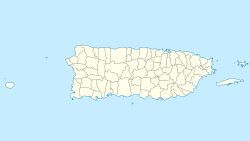
Guayanilla is a town and municipality of Puerto Rico located on the southern coast of the island, bordering the Caribbean Sea, south of Adjuntas, east of Yauco; and west of Peñuelas and about 12 miles (19 km) west of Ponce. Guayanilla is spread over 16 barrios and Guayanilla Pueblo. It is part of the Yauco Metropolitan Statistical Area.

Santa Isabel is a town and municipality of Puerto Rico located in the southern coast of the island, south of Coamo; east of Juana Díaz; and west of Salinas. Santa Isabel is spread over 7 barrios and Santa Isabel Pueblo. It is the principal city of the Santa Isabel Micropolitan Statistical Area and is part of the Ponce-Yauco-Coamo Combined Statistical Area.
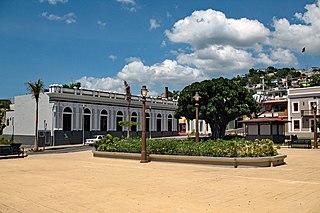
Yauco is a town and municipality in southern Puerto Rico. Although the downtown is inland, the municipality stretches to a southern coast facing the Caribbean Sea. Yauco is located south of Maricao, Lares and Adjuntas; east of Sabana Grande and Guánica; and west of Guayanilla. The municipality consists of 20 barrios and Yauco Pueblo. It is both a principal town of the Yauco Metropolitan Statistical Area and the Ponce-Yauco-Coamo Combined Statistical Area.

Puerto Rico Highway 2 (PR-2) is a road in Puerto Rico that connects the cities of San Juan and Ponce. At 156 miles (230 km) long, it is Puerto Rico's longest singled-signed highway.
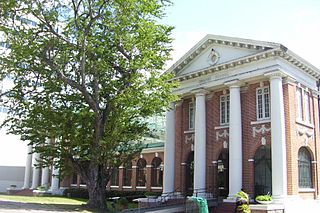
The Puerto Rico Museum of Contemporary Art, often abbreviated to MAC, is a contemporary art museum in Santurce, Puerto Rico.

This is a list of properties and districts in the southern municipalities of Puerto Rico that are listed on the National Register of Historic Places. It includes places along the southern coast of the island, and on the south slope of Puerto Rico's Cordillera Central.

This is a list of properties and districts in the western municipalities of Puerto Rico that are listed on the National Register of Historic Places. It includes places along the western coast, and on islands, and on the western slope of Puerto Rico's Cordillera Central.
Pedro Adolfo de Castro (1895–1936) was a twentieth-century architect from San Juan, Puerto Rico.
The Nazario Collection, also known as Agüeybaná's Library, Father Nazario's Rocks, and the Phoenician Rocks, are a cache of carved stones that originated at Guayanilla, Puerto Rico. According to contemporary accounts, the statuettes made of local serpentine rocks were first discovered by Catholic priest José María Nazario y Cancel during the 19th century, and feature unidentified petroglyphs that have been speculated to be connected to the Old World for over 130 years. Their original site was not far from Yauco and was underground, where it was hidden under a slate that concealed a tunnel. Overwhelmed with the quantity and difficulty of transporting a trove that totaled more than a ton, he opted to abandon his individual approach and recruited locals to aid in the moving of the rocks to his house, where he conducted the first research on them by comparing them to similar objects from other countries. Nazario would combine his research with his religious background, leading to the hypothesis that there might be some connection between them and the Ten Lost Tribes.

The Biblioteca Carnegie on Avenida Juan Ponce de León in Puerta de Tierra, San Juan, Puerto Rico is a NRHP-listed Carnegie library funded through a $100,000 donation from the Carnegie Foundation, becoming Puerto Rico's first purpose-built library when it was completed in 1915.

Guayanilla barrio-pueblo is an urban barrio and the administrative center (seat) of Guayanilla, a municipality of Puerto Rico. Its population in 2010 was 3,757.

The Eleuterio Derkes Grammar School is a historic school building in Guayama, Puerto Rico. It was built in 1908, during a period when schools were gaining importance as civic institutions in Puerto Rico. Its simplified Neoclassical design emphasized this shift, and it became a prototype for a generation of school construction on the island. It additionally signifies a transition in construction technologies from wood to concrete. In 1987, architect Jorge Rigau observed that the building had survived in a nearly unaltered state, a rarity among schools of its era.
Starting on December 28, 2019, and progressing into 2020, the southwestern part of the island of Puerto Rico was struck by an earthquake swarm, including 11 that were of magnitude 5 or greater. The largest and most damaging of this sequence was a magnitude 6.4 , which occurred on January 7 at 04:24 AST (08:24 UTC), with a maximum felt intensity of VIII (Severe) on the Modified Mercalli intensity scale. At least one person was killed, and several others were injured.

The Aguayo Aldea Vocational High School, popularly known as La Vocacional, is a historic school in Caguas, Puerto Rico, named after Nicolás Aguayo Aldea, a Puerto Rican writer and politician from the 19th century. The Art Deco building dates to 1939 and was designed by architects Lizardi & Díaz Diez.
Luis Muñoz Rivera School is a historic 1926 public school located in Lajas, Puerto Rico. It was added to the United States National Register of Historic Places in 2012.

Eugenio María de Hostos School is a historic early 20th century school located in Las Marías, Puerto Rico.
The Escuela Hemeterio Colón y Warens, also widely referred to as La Hemeterio or La Colón, is a public, intermediate school serving the city of Ponce, Puerto Rico. Its original, main building, built in 1913, is architecturally significant as a well-preserved example of the Puerto Rican school buildings of the early 20th century, a period of great transformation in Puerto Rico under the American administration. It was designed by insular architect Albert B. McCulloch using the California Mission Revival and Classical Revival styles, as well as some Modernist elements associated with the work of Antonin Nechodoma.

The José Fontán School is a historic early 20th-century school located in Morovis Pueblo, the administrative and historic center of the municipality of Morovis, Puerto Rico. The school building was added to the National Register of Historic Places in August 2012 due to its architectural importance as a prime example of the Late 19th and Early 20th Century American Movements architecture, particularly the Mission/Spanish Revival style, under the Early Twentieth Century Schools in Puerto Rico TR. The building was designed by Puerto Rican architect Rafael Carmoega and by Joseph O'Kelly from the Puerto Rico & American Insurance Co.

Brambaugh School, officially the Dr. Martin Grove Brumbaugh School but better known today as Puerta de Tierra Public School, is an early 20th-century historic school building located in the Puerta de Tierra historic district in the city of San Juan, Puerto Rico. The school was built in 1913 by Frank B. Hatch based on designs by architect G.R. Gilmour and named after the first Education Commissioner of Puerto Rico Martin Grove Brumbaugh. It was the first modern school to be built in the Puerta de Tierra area of San Juan Antiguo and, until the construction of the neighboring José Celso Barbosa Graded School, it was the only school in the area. Brambaugh School continues to be an important public education center for the local community today.