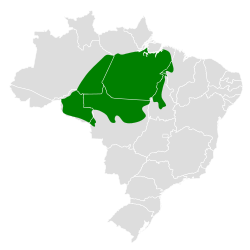
The Para gnatcatcher was formally described in 1937 as Polioptila paraensis by the American ornithologist W. E. Clyde Todd based on a specimen that had been collected by Samuel M. Klages near Benevides in the state of Pará of northern Brazil.[1][2] The Para gnatcatcher was formerly considered as a subspecies of the Guianan gnatcatcher (Polioptila guianensis).[3]
P. p. facilisZimmer, JT, 1942 – eastern Colombia (Vaupés and Guainía) and southern Venezuela (Amazonas) to far northern Brazil (northern Amazonas and west-central Roraima)
P. p. attenboroughi Whittaker, A, Aleixo, ALP, Whitney, BM, Smith, BT & Klicka, J, 2013 – western Amazonian Brazil south of the Amazon River and west of the Rio Madeira
P. p. paraensisTodd, WEC, 1937 – eastern Amazonian Brazil south of the Amazon River and east of the Rio Madeira
The subspecies P. p. attenboroughi and P. p. facilis have sometimes been recognised as separate species, the Inambari gnatcatcher and the Rio Negro gnatcatcher.[5]
Description
The Para gnatcatcher is 10 to 11cm (3.9 to 4.3in) long and weighs approximately 6g (0.21oz). The male's head, back, and breast are mouse gray and the rest of its underparts white. There is minimal contrast between the throat, breast, and belly. The innermost feathers of its tail are black and the outermost white, with those between intergrading. The female is similar but has a paler face.[6]
Distribution and habitat
The Para gnatcatcher is found only in Brazil, in a broad band south of the Amazon River from its mouth southwest almost to northern Bolivia. It inhabits the borders and canopy of humid primary forest, mostly below 500m (1,600ft) elevation.[6]
Behavior
Feeding
The Para gnatcatcher's diet is little known but is assumed to be arthropods like that of other Polioptila gnatcatchers. It actively forages in the canopy and sub-canopy.[6]
Breeding
The Para gnatcatcher's breeding phenology has not been documented.[6]
Vocalization
The Para gnatcatcher's song is "repeated high...notes, evenly delivered" .[6]
Status
The IUCN has not assessed the Para gnatcatcher. "Of the ecoregions occupied by this species, only one (Tocantins/Pindare moist forest) is considered to be at serious risk."[6]
123456Atwood, J. L., S. B. Lerman, G. M. Kirwan, and H. F. Greeney (2020). Klage's Gnatcatcher (Polioptila paraensis), version 1.0. In Birds of the World (S. M. Billerman, B. K. Keeney, P. G. Rodewald, and T. S. Schulenberg, Editors). Cornell Lab of Ornithology, Ithaca, NY, USA. https://doi.org/10.2173/bow.guigna4.01 retrieved May 29, 2021
This page is based on this Wikipedia article Text is available under the CC BY-SA 4.0 license; additional terms may apply. Images, videos and audio are available under their respective licenses.