Related Research Articles

The Transvaal Colony was the name used to refer to the Transvaal region during the period of direct British rule and military occupation between the end of the Second Boer War in 1902 when the South African Republic was dissolved, and the establishment of the Union of South Africa in 1910. The borders of the Transvaal Colony were larger than the defeated South African Republic. In 1910 the entire territory became the Transvaal Province of the Union of South Africa.

The Orange River Colony was the British colony created after Britain first occupied (1900) and then annexed (1902) the independent Orange Free State in the Second Boer War. The colony ceased to exist in 1910, when it was absorbed into the Union of South Africa as the Orange Free State Province.

Sir Patrick Duncan, was the sixth Governor-General of the Union of South Africa, holding office from 1937 until his death in 1943.

Alfred Milner, 1st Viscount Milner, was a British statesman and colonial administrator who played a very important role in the formulation of British foreign and domestic policy between the mid-1890s and early 1920s. From December 1916 to November 1918, he was one of the most important members of Prime Minister David Lloyd George's War cabinet.
The National Democratic and Labour Party, usually abbreviated to National Democratic Party (NDP), was a short-lived political party in the United Kingdom. Its predecessors were the British Workers' National League, and the Socialist National Defence Committee.
George Geoffrey Dawson was editor of The Times from 1912 to 1919 and again from 1923 until 1941. His original last name was Robinson, but he changed it in 1917. He married Hon. Margaret Cecilia Lawley, daughter of Arthur Lawley, 6th Baron Wenlock, in 1919.

Arthur Lawley, 6th Baron Wenlock, was a British colonial administrator who served variously as Administrator of Matabeleland, Governor of Western Australia, Lieutenant-Governor of the Transvaal, and Governor of Madras. The fourth and youngest son of the 2nd Baron Wenlock, he attended Eton College and Trinity College, Cambridge, before joining the military. Serving in the Mahdist War, he reached the rank of captain before resigning his commission to pursue other interests. Lawley was then private secretary to his uncle, the 1st Duke of Westminster, and subsequently to the 4th Earl Grey, who he followed to Rhodesia.

Milner's Kindergarten is the informal name of a group of Britons who served in the South African civil service under High Commissioner Alfred, Lord Milner, between the Second Boer War and the founding of the Union of South Africa in 1910. It is possible that the kindergarten was Colonial Secretary Joseph Chamberlain's idea, for in his diary dated 14 August 1901, Chamberlain's assistant secretary Geoffrey Robinson wrote, "Another long day occupied chiefly in getting together a list of South African candidates for Lord Milner – from people already in the (Civil) Service". They were in favour of the unification of South Africa and, ultimately, an Imperial Federation with the British Empire itself. On Milner's retirement, most continued in the service under Lord Selborne, who was Milner's successor, and the number two-man at the Colonial Office. The Kindergarten started off with 12 men, most of whom were Oxford graduates and English civil servants, who made the trip to South Africa in 1901 to help Lord Milner rebuild the war torn economy. Quite young and inexperienced, one of them brought with him a biography written by F.S. Oliver on Alexander Hamilton. He read the book, and the plan for rebuilding the new government of South Africa was based along the lines of the book, Hamilton's federalist philosophy, and his knowledge of treasury operations. The name, "Milner's Kindergarten", although first used derisively by Sir William Thackeray Marriott, was adopted by the group as its name.
Robert Henry Brand, 1st Baron Brand, was a British civil servant and businessman.
Jan Christiaan Smuts, OM was a prominent South African and Commonwealth statesman and military leader. He served as a Boer General duning the Boer War, a British General during the First World War and was appointed Field Marshal during the Second World War. In addition to various Cabinet appointments, he served as Prime Minister of the Union of South Africa from 1919 to 1924 and from 1939 to 1948. He played a leading part in the post war settlements at the end of both world wars, making significant contributions towards the creation of both the League of Nations and the United Nations.
The Round Table movement, founded in 1909, was an association of organisations promoting closer union between Britain and its self-governing colonies.

The Bloemfontein Conference was a meeting that took place at the railway station of Bloemfontein, capital of the Orange Free State from 31 May until 5 June 1899. The main issue dealt with the status of British migrant workers called "Uitlanders", who mined the gold fields in Transvaal.

The Rand Rebellion was an armed uprising of white miners in the Witwatersrand region of South Africa, in March 1922. Jimmy Green, a prominent politician in the Labour Party, was one of the leaders of the strike.

Sir George Herbert Farrar, 1st Baronet, was a South African mining magnate, politician and soldier – Colonel and assistant Quartermaster General – Central Force, Union Defence Force, Hon. Colonel South African Light Horse.
The Socialist National Defence Committee also known as the Socialist National Defence League was a pro First World War socialist faction.
Lieutenant-Colonel Sir Marshal James Clarke was a British colonial administrator and an officer of the Royal Artillery. He was the first Resident Commissioner in Basutoland from 1884 to 1893; Resident Commissioner in Zululand from 1893 to 1898; and, following the botched Jameson Raid, the first Resident Commissioner in Southern Rhodesia from 1898 to 1905.

The RMS Norham Castle was a Royal Mail Ship and passenger liner of the Union-Castle Line in service between London, England and Cape Town, South Africa between 1883 and 1903, named after Norham Castle.
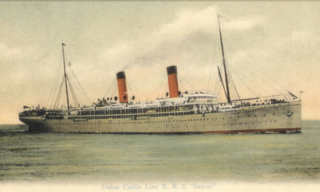
The RMS Saxon was a Royal Mail Ship that went into service with Castle Line in 1900 on the passenger and mail service run between Britain and South Africa. She was the 4th ship by this name, the first being a coal carrier dating back to the Crimean War. After the Boer War, the Saxon was one of nine ships that made up the Southampton-Cape Town Mail Run. In May 1901, the High Commissioner of South Africa, Lord Alfred Milner, traveled aboard the Saxon on his way back to Southampton, England. He traveled on the same route aboard the Saxon in 1925, shortly before his death.

The RMS Kildonan Castle was a Royal Mail Ship and passenger liner that went into service with Castle Line, and its successor, the Union-Castle Line. She was built to run the mail route from Southampton, England to Cape Town, South Africa starting in 1900. However, she began her life early, in December 1899, being requisitioned by the government to carry 3,000 troops to Cape Town at the start of the Boer War, and was temporarily used in South Africa to house POW's. She returned to England in 1901 for an outfitting to carry passengers and mail. She was one of nine ships on the England-South Africa run. At the outbreak of World War I, she replenished the South African Army with arms and ammunition. She also served as a hospital ship during the Dardanelles Campaign, outfitted with 603 beds, and converted in March 1916 to an armed merchant cruiser. In January 1917, she took Lord Milner and 51 VIP delegates from England, France and Italy to Murmansk, Russia, on the Petrograd Mission. She then undertook convoy duties in the North Atlantic, returning to her normal South African mail run after the war.

The RMS Walmer Castle was a Royal Mail Ship of the Union-Castle Line in service between London, England and Cape Town, South Africa between 1902 and 1930. She was the second of three ships by this name. Her service was interrupted in 1917 when she was requisitioned by the government to serve as a troop transport, transporting troops from South Africa and later in the North Atlantic, painted in a camouflaged dazzle scheme. In 1919, she made two voyages between Liverpool and New York before returning to her mail run.
References

- Marlowe, John, Milner, Apostle of Empire, London: Hamish Hamilton, 1976
- O'Brien, Terence, "Milner: Viscount Milner of St James's and Cape Town", London: Constable, 1979
