
Botrytis cinerea is a necrotrophic fungus that affects many plant species, although its most notable hosts may be wine grapes. In viticulture, it is commonly known as "botrytis bunch rot"; in horticulture, it is usually called "grey mould" or "gray mold".

Armillaria mellea, commonly known as honey fungus, is an edible basidiomycete fungus in the genus Armillaria. It is a plant pathogen and part of a cryptic species complex of closely related and morphologically similar species. It causes Armillaria root rot in many plant species and produces mushrooms around the base of trees it has infected. The symptoms of infection appear in the crowns of infected trees as discoloured foliage, reduced growth, dieback of the branches and death. The mushrooms are edible but some people may be intolerant to them. This species is capable of producing light via bioluminescence in its mycelium.

Aspergillus flavus is a saprotrophic and pathogenic fungus with a cosmopolitan distribution. It is best known for its colonization of cereal grains, legumes, and tree nuts. Postharvest rot typically develops during harvest, storage, and/or transit. Its specific name flavus derives from the Latin meaning yellow, a reference to the frequently observed colour of the spores. A. flavus infections can occur while hosts are still in the field (preharvest), but often show no symptoms (dormancy) until postharvest storage or transport.

Beauveria bassiana is a fungus that grows naturally in soils throughout the world and acts as a parasite on various arthropod species, causing white muscardine disease; it thus belongs to the group of entomopathogenic fungi. It is used as a biological insecticide to control a number of pests, including termites, thrips, whiteflies, aphids and various beetles. Its use in the control of bed bugs and malaria-transmitting mosquitos is under investigation.

Diplodia tip blight, also known as Sphaeropsis blight, is a widespread disease affecting conifers caused by an opportunistic fungal pathogen, Diplodia sapinea. It is found in “both hemispheres between the latitudes 30° and 50° north and south". The diseases symptoms include: damping off and collar rot of seedlings, stem canker, root disease, and, most commonly, shoot blight. These symptoms have caused significant economic loss to nurseries and pine plantations. In a nursery in the north-central United States, losses of 35% have been reported. Shoot blight and eventual die back can cause a reduction of marketable volume in timber by 63%. Infection of terminal shoots can result in dead-top which significantly limits the usable length of the tree trunk. The presence of the pathogen in concert with severe weather conditions can lead to extreme loss. Following a severe hailstorm in South Africa, nearly 5,000 acres of pine plantation were infected with Diplodia tip blight. It was necessary to prematurely harvest large swaths of the plantations resulting in a loss of 45%. Areas that were not harvested prematurely still suffered an average timber loss of 11%.

Batrachochytrium dendrobatidis, also known as Bd or the amphibian chytrid fungus, is a fungus that causes the disease chytridiomycosis in amphibians.

Rhizoctonia solani is a species of fungus in the order Cantharellales. Basidiocarps are thin, effused, and web-like, but the fungus is more typically encountered in its anamorphic state, as hyphae and sclerotia. The name Rhizoctonia solani is currently applied to a complex of related species that await further research. In its wide sense, Rhizoctonia solani is a facultative plant pathogen with a wide host range and worldwide distribution. It causes various plant diseases such as root rot, damping off, and wire stem. It can also form mycorrhizal associations with orchids.

Rhabdocline pseudotsugae is a fungal plant pathogen. The pathogen, along with Rhabdocline weirii causes Rhabdocline needlecast; R. weirii only affects Douglas-fir trees. The disease causes the needles of the tree to discolor and eventually fall from the tree. It was originally common to the Rocky Mountain states of the United States but has since spread to Europe. Infections usually start in the spring or early summer and can change the color of the foliage to a variety of hues. The fungus produces apothecia that are normally found on the underside of needles but they also occur on the topside as well.
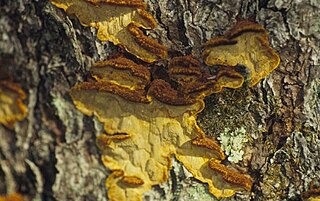
Porodaedalea pini, commonly known as the pine conk, is a species of fungus in the family Hymenochaetaceae. It is a plant pathogen that causes tree disease commonly known as "red ring rot" or "white speck". This disease, extremely common in the conifers of North America, decays tree trunks, rendering them useless for lumber. It is a rot of the heartwood. Signs of the fungus include shelf-shaped conks protruding from the trunks of trees. Spores produced on these conks are blown by the wind and infect other trees. Formal management of this disease is limited, and the disease is controlled primarily by cultural practices. Red ring rot is an important forest disturbance agent and plays a key role in habitat formation for several forest animals.

Bridgeoporus is a fungal genus in the family Polyporaceae. A monotypic genus, it contains the single polypore species Bridgeoporus nobilissimus, first described to science in 1949. Commonly known both as the noble polypore and the fuzzy Sandozi, this fungus produces large fruit bodies that have been found to weigh up to 130 kilograms (290 lb). The upper surface of the fruit body has a fuzzy or fibrous texture that often supports the growth of algae, bryophytes, or vascular plants.

Armillaria gallica is a species of honey mushroom in the family Physalacriaceae of the order Agaricales. The species is a common and ecologically important wood-decay fungus that can live as a saprobe, or as an opportunistic parasite in weakened tree hosts to cause root or butt rot. It is found in temperate regions of Asia, North America, and Europe. The species forms fruit bodies singly or in groups in soil or rotting wood. The fungus has been inadvertently introduced to South Africa. Armillaria gallica has had a confusing taxonomy, due in part to historical difficulties encountered in distinguishing between similar Armillaria species. The fungus received international attention in the early 1990s when an individual colony living in a Michigan forest was reported to cover an area of 15 hectares, weigh at least 9.5 tonnes, and be 1,500 years old. This individual is popularly known as the "humongous fungus", and is a tourist attraction and inspiration for an annual mushroom-themed festival in Crystal Falls. Recent studies have revised the fungus's age to 2,500 years and its size to about 400 tonnes, four times the original estimate.

Fusarium circinatum is a fungal plant pathogen that causes the serious disease pitch canker on pine trees and Douglas firs. The most common hosts of the pathogen include slash pine, loblolly pine, Monterey pine, Mexican weeping pine, and Douglas fir. Like other Fusarium species in the phylum Ascomycota, it is the asexual reproductive state of the fungus and has a teleomorph, Gibberella circinata.

Heterobasidion irregulare is a tree root rotting pathogenic fungus that belongs to the genus Heterobasidion, which includes important pathogens of conifers and other woody plants. It has a wide host and geographic range throughout North America and causes considerable economic damage in pine plantations in the United States. This fungus is also a serious worry in eastern Canada. Heterobasidion irregulare has been introduced to Italy (Lazio)(modifica) where it has been responsible for extensive tree mortality of stone pine. Due to the ecology, disease type, host range/preference, interfertility group, and genetic information, H. irregulare was designated a new species and distinguished from Heterobasidion occidentale.
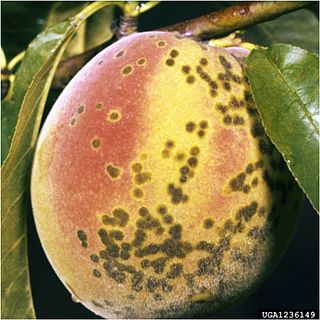
Peach scab, also known as peach freckles, is a disease of stone fruits caused by the fungi Cladosporium carpophilum. The disease is most prevalent in wet and warm areas especially southern part of the U.S. as the fungi require rain and wind for dispersal. The fungus causes scabbing, lesions, and defoliating on twig, fruit, and leaf resulting in downgrade of peach quality or loss of fruits due to rotting in severe cases.
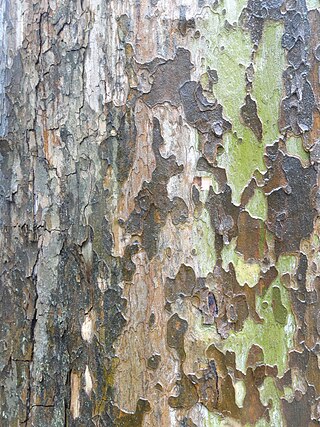
Ceratocystis platani is a fungus that causes a disease on plane trees in the genus Platanus, mostly in North America and Southern Europe.
Ceratocystis cacaofunesta is an ascomycete fungus that causes a wilt disease in cacao trees. It has led to significant economic losses in Latin America.

Spruce broom rust or yellow witches' broom rust is a fungal plant disease caused by the basidiomycete fungus known as Chrysomyxa arctostaphyli. It occurs exclusively in North America, with the most concentrated outbreaks occurring in northern Arizona and southern Colorado on blue and Engelmann spruce, as well as in Alaska on black and white spruce. This disease alternates its life cycle between two hosts, with the spruce serving as the primary host and bearberry serving as the secondary or alternate host. The name for the disease comes from the distinctive “witches broom”, commonly yellow in color, which forms on the spruce after young needles have been infected. Management must be carried out through physical or mechanical methods, such as the pruning of brooms or the removal of the secondary host from the area, because no chemical control measures have yet been determined to be economically effective. Generally, spruce broom rust is seen as a mostly cosmetic issue, and it is very rarely the direct cause of tree death; however, research has shown a reduction in overall productivity and health of infected trees, making it an important issue for logging and timber companies.

Heterobasidion occidentale is a tree root-rotting pathogenic fungus in the family Bondarzewiaceae. It is endemic in western North America west of the Rocky Mountains from Alaska to southern Mexico. While a natural agent of forest turnover, H. occidentale has become of increased concern due to forest management processes such as pre-commercial thinning, altered site density and species composition, and carbon sequestration. H. occidentale forms part of the genus that includes other species forming the important forest pest Heterobasidion annosumsensu lato that is spread across the Northern Hemisphere. H. occidentale is part of the S-type intersterility group differing from the other North American species, Heterobasidion irregulare.

Phacidiopycnis washingtonensis, is a species of fungus in the family Phacidiaceae, first described by C.L. Xiao & J.D. Rogers in 2005. It is a weak orchard pathogen and a cause of rubbery rot, also known as speck rot, in postharvest apples. First described in North Germany, it affects several apple varieties, including commercially important Jonagold and Elstar. Losses caused by P. washingtonensis during storage are usually below 1% but can reach 5–10% of apples.
Rhabdocline laricis, also known as Meria laricis, is a hyphomycete fungus in the family Cenangiaceae. In larch conifer trees (Larix), it causes the plant disease larch needle cast, also known as meria needle blight. It is generally harmless in older trees. However, it causes browning of needles, which can slow growth, weaken overall resistance to opportunistic pathogens, and can sometimes outright kill seedlings, making Rhabdocline laricis a threat in tree nurseries.

