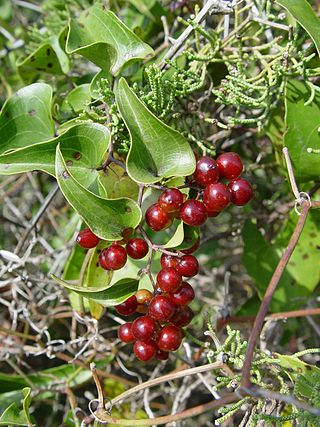
Smilax is a genus of about 300–350 species, found in the tropics and subtropics worldwide. They are climbing flowering plants, many of which are woody and/or thorny, in the monocotyledon family Smilacaceae, native throughout the tropical and subtropical regions of the world. Common names include catbriers, greenbriers, prickly-ivys and smilaxes. Sarsaparilla is a name used specifically for the Neotropical S. ornata as well as a catch-all term in particular for American species. Occasionally, the non-woody species such as the smooth herbaceous greenbrier are separated as genus Nemexia; they are commonly known by the rather ambiguous name carrion flowers.
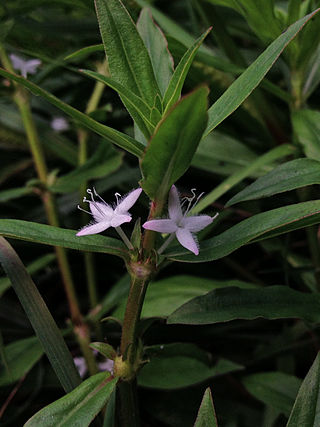
Diodia is a genus of flowering plants in the family Rubiaceae. It was described by Carl Linnaeus in 1753. The genus is found from southern and eastern United States, South America, Central America, Mexico, the West Indies and tropical Africa.
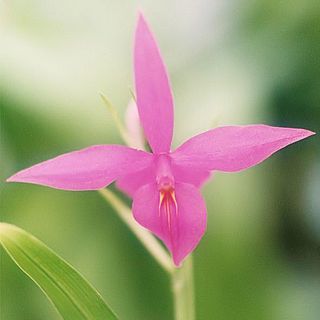
Barkeria, abbreviated Bark in horticultural trade, is a genus of orchids. It consists of about 17 currently recognized species native to Mexico and Central America. This genus was once considered part of Epidendrum. Type species is Barkeria elegans; this is now considered a synonym of B. uniflora yet retains its status as type per ICN.
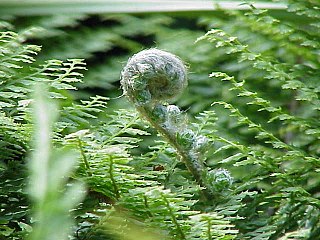
Polystichum is a genus of ferns in the family Dryopteridaceae, subfamily Dryopteridoideae, according to the Pteridophyte Phylogeny Group classification of 2016. The genus has about 500 species and has a cosmopolitan distribution. The highest diversity is in eastern Asia, with about 208 species in China alone; the region from Mexico to Brazil has at least 100 additional species; Africa, North America, and Europe have much lower diversity. Polystichum species are terrestrial or rock-dwelling ferns of warm-temperate and montane-tropical regions. They are often found in disturbed habitats such as road cuts, talus slopes, and stream banks.

Microchilus is a neotropical genus of about 261 species belonging to the orchid family (Orchidaceae). The native range of this genus is tropical & subtropical America.

Weinmannia is a genus of trees and shrubs in the family Cunoniaceae. It contains 90 species, which range from Mexico through Central and South America including the Caribbean, and to the Mascarene Islands in the western Indian Ocean. It is absent from mainland Africa and Australia, but some fossils have been attributed to Weinmannia in Australia.
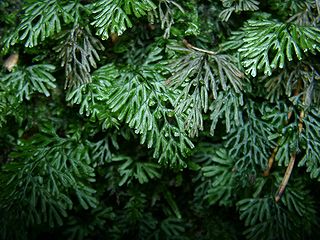
The Hymenophyllaceae, the filmy ferns and bristle ferns, are a family of two to nine genera and about 650 known species of ferns, with a subcosmopolitan distribution, but generally restricted to very damp places or to locations where they are wetted by spray from waterfalls or springs. A recent fossil find shows that ferns of Hymenophyllaceae have existed since at least the Upper Triassic.

The Datiscaceae are a family of dicotyledonous plants, containing two species of the genus Datisca. Two other genera, Octomeles and Tetrameles, are now classified in the family Tetramelaceae.
Adenopodia is a genus of legume in the family Fabaceae, that occurs in the northern Neotropics and Africa. They may grow as lianas, shrubs or trees. The petioles have a distinct gland above their base, hence the Greek name which is a combination of "gland-" and "foot".
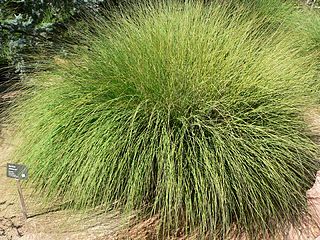
Muhlenbergia is a genus of plants in the grass family.

Microgramma is a genus of ferns in the family Polypodiaceae, subfamily Polypodioideae, according to the Pteridophyte Phylogeny Group classification of 2016 (PPG I). They are commonly known as vine ferns or snakeferns.
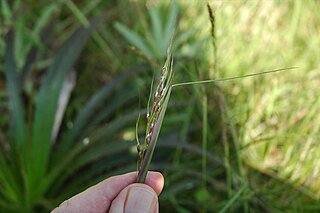
Piptochaetium, or speargrass, is a genus of plants in the grass family, native to North and South America. Piptochaetium is a bunchgrass genus in the tribe Stipeae.
Salicifolia, a Latin word meaning willow-leaved, may refer to:

Hernandia is a genus of flowering plants in the family Hernandiaceae. It was named after the Spanish botanist Francisco Hernández de Toledo.

Cathestecum is a genus of the North American plants in the grass family.
The Pteridophyte Phylogeny Group (PPG) is an informal international group of systematic botanists who collaborate to establish a consensus on the classification of pteridophytes that reflects knowledge about plant relationships discovered through phylogenetic studies. In 2016, the group published a classification for extant pteridophytes, termed "PPG I". The paper had 94 authors.

Cephalomanes atrovirens is a species of fern in the family Hymenophyllaceae. The genus Cephalomanes is accepted in the Pteridophyte Phylogeny Group classification of 2016, but not by some other sources. As of October 2019, Plants of the World Online sank the genus into a broadly defined Trichomanes, while treating the subtaxa of this species as the separate species Trichomanes acrosorum, Trichomanes atrovirens, Trichomanes boryanum and Trichomanes kingii.

Myriopteris aurea, the golden lip fern or Bonaire lip fern, is a moderately-sized fern native to the Americas, a member of the family Pteridaceae. Unlike many members of its genus, its leaf is only modestly dissected into lobed leaflets (pinnae), which are hairy both above and below. One of the cheilanthoid ferns, until 2013 it was classified in the genus Cheilanthes as Cheilanthes bonariensis, when the genus Myriopteris was again recognized as separate from Cheilanthes. It typically grows on dry, rocky slopes, and ranges from Mexico, where it is common and widespread, and the southwestern United States south and east through Central and South America as far as Chile and Argentina.

Pseudalcantarea is a genus of flowering plants belonging to the family Bromeliaceae. Its native range is Mexico to Central America. It was first described as the subgenus Pseudalcantarea of Tillandsia before being raised to a full genus in 2016.
