| Polistinae | |
|---|---|
 | |
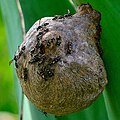
| Polistes africanus with nest | |
Scientific classification  | |
| Kingdom: | Animalia |
| Phylum: | Arthropoda |
| Class: | Insecta |
| Order: | Hymenoptera |
| Family: | Vespidae |
| Subfamily: | Polistinae |
| Tribes | |
 | This article's lead section may be too long.(January 2026) |
The Polistinae is a subfamily of eusocial wasps belonging to the family Vespidae. They are closely related to the yellowjackets and true hornets of the subfamily Vespinae and are divided into four tribes. With about 1,100 species total, it is the second-most diverse subfamily within the Vespidae, and while most species are tropical or subtropical, they include some of the most frequently encountered large wasps in temperate regions.[ citation needed ]
Contents
- Characteristics
- Colony life cycle
- Genera
- Tribe Epiponini Lucas, 1867
- Tribe Mischocyttarini Carpenter, 1993
- Tribe Polistini Lepeletier, 1836
- Tribe Ropalidiini Bequaert, 1918
- Tribe incertae sedis
- Gallery
- References
- External links
The English common name for Polistinae is paper wasp. Many polistines, such as Polistes fuscatus, Polistes annularis , and Polistes exclamans , make their nests out of paper.[ citation needed ] Despite being called paper wasps, other wasps (including the wasps in the subfamily Vespinae) also build nests out of paper.[ citation needed ] Additionally, epiponine wasps in the subgenus Polybia (Pedothoeca), such as Polybia emaciata , build their nests out of mud despite being Polistinae. [1]
Polistes annularis suspends its paper nests from cliff overhangs via a pedicel, whose free fatty acids induce the necrophobic response in ants and causes them to avoid the pedicel rather than cross and prey on the nest's inhabitants. [2] Polistes metricus foragers take off from their nests as if they already know how long their trip is. For short flights, they exit the nest flying horizontally, while for long flights they exit the nest flying straight up into a high altitude before pursuing their direction. [3] Polistine brood cells are arranged in a hexagonal array, similar to the comb structure in a honey bee nest. Some species[ which? ] of the epiponine genera Polybia and Brachygastra store honey in the comb, among the few insects other than bees to store honey (also some ants store honey in their bodies).[ citation needed ]