Potentilla bolanderi, also known as border horkelia and Bolander's horkelia, is a rare species of flowering plant in the family Rosaceae. It is endemic to northern California where it is known from only a few occurrences in two or three counties. It grows in the mountain forests of the North Coast Ranges.

Potentilla californica, also known as California horkelia, is a species of flowering plant in the rose family.

Potentilla lindleyi, commonly known as wedgeleaf horkelia, is a species of flowering plant in the rose family. It is endemic to California, where it grows in coastal chaparral communities and sandy areas.

Potentilla daucifolia, commonly known as carrotleaf horkelia, is a species of flowering plant in the rose family. It is native to the Klamath Mountains and surrounding ranges in northern California and southern Oregon. It grows on mountain slopes and fields, often on serpentine soils.

Potentilla douglasii is a species of flowering plant in the rose family known by several common names, including pinewoods horkelia and dusky horkelia. It is native to the western United States from California to Wyoming, where it is generally found in mountain forests and meadows.

Potentilla marinensis, commonly known as Point Reyes horkelia, is a rare species of flowering plant in the rose family. It is endemic to the California coastline, where it is known from about Fort Bragg to near Santa Cruz. It grows on beaches and in other sandy coastal areas.
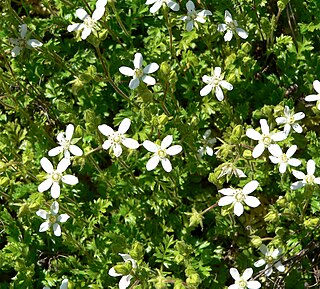
Potentilla parryi, commonly known as Parry's horkelia, is a species of flowering plant in the rose family. It is endemic to California, where it grows in the chaparral of the Sierra Nevada foothills.
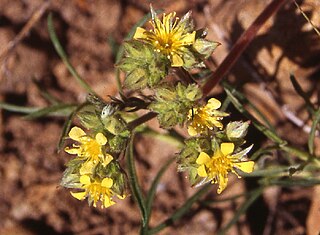
Potentilla aperta, commonly known as Sierra Valley mousetail, is a species of flowering plant in the rose family.
Potentilla argyrocoma, commonly known as silverhair mousetail, is a species of flowering plant in the rose family. It is native to the San Bernardino Mountains of southwestern San Bernardino County, California. A population of Potentilla argyrocoma is also found in Baja California in Mexico; this population may or may not be distinct and further study is required.

Potentilla jaegeri, also known as Jaeger's mousetail and Jaeger's ivesia, is an uncommon species of flowering plant in the rose family.

Ivesia lycopodioides is a species of flowering plant in the rose family known by the common name clubmoss mousetail, or clubmoss ivesia. It is native to the Sierra Nevada and to regions east of the range in California. It may also be found beyond the state line into Nevada. This is a perennial herb which grows in the crevices of rock ledges in the mountains and in wet high-elevation meadows. It produces a rosette of flat to cylindrical leaves up to 15 centimeters long, each of which is made up of many tiny, lobed leaflets. The stems may grow erect or drooping to 30 centimeters long and each holds an inflorescence of clustered flowers. Each flower has hairy, greenish triangular sepals and much larger oval-shaped petals of bright yellow. In the center of the flower are usually five stamens and several pistils. There are three subspecies.

Ivesia muirii is a species of flowering plant in the rose family known by the common name granite mousetail. It is endemic to the High Sierra Nevada of California, where it grows on rocky slopes and cliffs.
Ivesia saxosa is a species of flowering plant in the rose family known by the common name rock mousetail, or rock ivesia. It is native to the mountains and deserts of central and southern California and northern Baja California, where it grows in cracks and crevices in rock faces and slopes. This is a clumpy perennial herb with hanging leaves and stems. Each leaf is a flat strip or cluster of rounded, lobed leaflets. The green to reddish stem is up to 30 centimeters long and bears an inflorescence of clustered flowers. Each flower is almost a centimeter wide and has hairy pointed sepals and smaller rounded to spoon-shaped yellow petals. In the center of the flower are up to 40 stamens and many pistils. The fruit is a tiny pale achene.
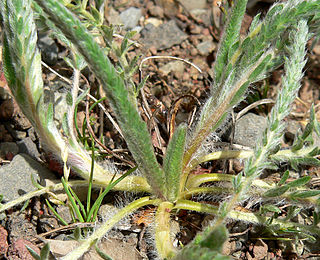
Ivesia sericoleuca is a species of flowering plant in the rose family known by the common name Plumas mousetail, or Plumas ivesia.

Ivesia webberi is a species of flowering plant in the rose family known by the common names wire mousetail and Webber's ivesia. It is native to the United States, where it occurs in the northernmost part of the Sierra Nevada and the adjacent Modoc Plateau in California, its range extending just into Nevada.

Astragalus albens is a species of milkvetch known by the common names Cushenbury milkvetch and silvery-white milkvetch.

Potentilla hispidula, commonly known as White Mountains horkelia, is a species of flowering plant in the rose family. It is endemic to the White Mountains, a small range of mountains that straddles the border between California and Nevada east of the Sierra Nevada. It is a resident of dry scrub and alpine and subalpine forest habitat.
Potentilla yadonii, commonly known as Santa Lucia horkelia, is a rare species of flowering plant in the rose family. It is endemic to California, where it is known from the Central Coast Ranges from Monterey to Santa Barbara Counties. It occupies chaparral and woodland habitat, often in meadows and dry riverbeds. Easily confused with related species, this plant was not recognized as a species of its own until 1993.
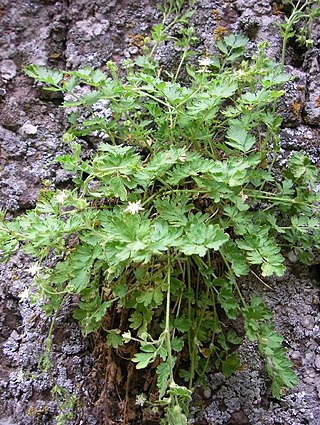
Potentilla baileyi, commonly known as Bailey's ivesia, is a species of flowering plant in the rose family.

Potentilla flabellifolia is a species of cinquefoil known by the common names high mountain cinquefoil, fanleaf cinquefoil and fan-foil.