Rafael was established in 1948 as the Science Corps (Hebrew: חיל המדע, known by the acronym HEMED, Hebrew: חמד) under the leadership of Shlomo Gur. It was renamed the Research and Design Directorate (אגף הפיתוח והתיכנון) in 1952. In 1952 David Ben-Gurion decided to split the activities of HEMED into two agencies. The pure scientific research was left with HEMED, while the development of weapons was placed into the new EMET agency.[3]
In 1954 Ben-Gurion decided to change the name of EMET to RAFAEL (Hebrew: רשות לפיתוח אמצעי לחימה, lit.'Armament Development Authority').[4] It was reorganized as Rafael in 1958.[5]
In 1995, Yitzhak Rabin asked Amos Horev to become chairman of the board of Rafael, following many years in which Horev had served as chairman of Rafael's advisory committee.[6] Horev served as chairman until January 2001.[6]
Restructuring as a limited company
During the early 1990s Rafael was operating at a loss (peaking in 1995, with a loss of $120 million on a turnover of $460 million). Therefore, it was decided to restructure the organization and start operating Rafael as a company. Initially the new company had three discrete divisions, each operating as a profit center, with a separate balance sheet presented to the newly formed management board.[7]
The restructuring was completed in 2002 when Rafael was formally incorporated as a limited company (although still as a government-owned corporation), while maintaining its technological capabilities through an investment of about 10% of turnover in R&D programs. In its first year as a limited company, Rafael earned a $37 million profit on $830 million in sales.[8] By 2016, Rafael reported annual net profits of 473 million ILS (roughly 130 million dollars), up 3%, compared with ILS 459 million in 2015. New orders in 2016 totaled ILS 10.7 billion, and sales amounted to ILS 8.32 billion, 6% more than in 2015. The company's orders backlog as of the end of 2016 was ILS 21.72 billion, 12% more than at the end of 2015.[9]
On October 14, 2007, the company changed its name from Rafael Armament Development Authority Ltd. to Rafael Advanced Defense Systems Ltd.
In 1993, Rafael Development Corporation (RDC), a technology transfer company, was established as a joint venture with Elron Electronic Industries; in order to commercialize applications based on defense technologies for medical devices, telecommunications, and semiconductor industries.[16] The company established and developed several companies including:
SELA Semiconductor Engineering Laboratories – a provider of automated sample preparation tools for semiconductor manufacturers, sold to Camtek Intelligent Imaging.[21]
Medingo – developer of a micro pump insulin delivery system consists of two parts: a semi-disposable insulin dispensing patch and a remote control, which allows for discreet personalized insulin delivery. The company was sold to Hoffmann-La Roche's subsidiary Roche Diagnostics for $160 million as well as up to $40 million in milestone payments.[23]
The long-standing debate over the state’s role in Israel’s defense industry reached a turning point in January 2026, when the government formalized a timeline to partially privatize Rafael Advanced Defense Systems through an initial public offering (IPO) on the Tel Aviv Stock Exchange.[27] This transition represents a significant evolution for this company, as it began as a national laboratory, and was only incorporated as a state-owned enterprise in 2002. The decision follows years of internal pressure from Rafael’s leadership, who argued that its fully state-owned status created a "bureaucratic glass ceiling," making it harder to compete for elite engineering talent and respond to global market shifts as nimbly as its publicly traded rivals, Elbit Systems and IAI.[28]
Implementation and Valuation Challenges
The roadmap for this transition became clear on January 12, 2026, when Roi Kahlon, director of the Government Companies Authority, confirmed that the government would seek to float a 25% to 30% minority stake as early as the second quarter of 2026.[29]
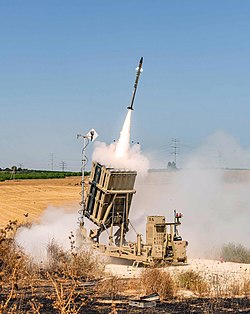
Unlike other defense firms, Rafael’s path to the stock market is uniquely complicated by its deep integration with the Ministry of Defense and the highly classified nature of its flagship technologies. Establishing a public valuation has historically been stalled by the difficulty of sharing detailed financial data for "proprietary" systems, such as the Iron Dome and the newly deployed Iron Beam laser interceptor, without compromising national security.[30]
Supported by a record-high order backlog of $18 billion, Rafael’s valuation at the time of the announcement was estimated at approximately $10 billion.[31] This financial strength is largely a result of the global "battle-proven" reputation of its air defense portfolio, which has seen increased demand from international partners like Germany and Finland.[32] To balance the needs of private investors with the imperatives of the state, the Israeli government intends to retain a controlling interest and release shares in a series of small, staggered tranches through 2027, ensuring that Rafael remains a strategic asset while gaining the operational flexibility of a public company.[30]
↑Merdor, Monaya M. (1982). "Science Corps (Hemed)". IDF in Its Corps: Army and Security Encyclopedia (in Hebrew). Vol.17. Revivim Publishing. pp.17–19.
12"Amos Horev". MIT Enterprise Forum. 1 January 2001. Archived from the original on 21 July 2011. Retrieved 17 June 2010.
↑Shelah, Shmulik (22 June 2009). "Microsoft confirms 3DV acquisition". Globes. Tel Aviv: Globes Publisher Itonut. Archived from the original on 26 June 2009. Retrieved 23 June 2009. [Microsoft corporate vice president of Israel Research & Development Moshe Lichtman] said, for the first time officially, that "the R&D center helped Microsoft in buying the intellectual property of 3DV Systems, and in the wake of that dozens of the company's employees were recruited to work at the development center."Alt URLArchived 18 February 2012 at the Wayback Machine
This page is based on this Wikipedia article Text is available under the CC BY-SA 4.0 license; additional terms may apply. Images, videos and audio are available under their respective licenses.

 $4.850 billion USD (2024) [1]