
Sempervivum is a genus of about 40 species of flowering plants in the family Crassulaceae, commonly known as houseleeks. Other common names include liveforever and hen and chicks, a name shared with plants of other genera as well. They are succulent perennials forming mats composed of tufted leaves in rosettes. In favourable conditions they spread rapidly via offsets, and several species are valued in cultivation as groundcover for dry, sunny locations.

Aichryson is a genus of about 15 species of succulent, subtropical plants, mostly native to the Canary Islands, with a few in the Azores, Madeira and Morocco, and one in Portugal.

Impatiens walleriana, also known as busy Lizzie, balsam, sultana, or simply impatiens, is a species of the genus Impatiens, native to eastern Africa from Kenya to Mozambique. The Latin specific epithet walleriana honours a British missionary, Horace Waller (1833–1896).
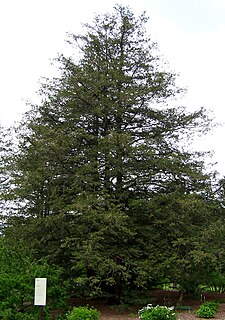
Chamaecyparis pisifera is a species of false cypress, native to central and southern Japan, on the islands of Honshū and Kyūshū.
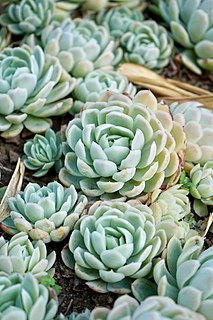
Echeveria is a large genus of flowering plants in the family Crassulaceae, native to semi-desert areas of Central America, Mexico and northwestern South America.

Saxifraga is the largest genus in the family Saxifragaceae, containing about 440 species of holarctic perennial plants, known as saxifrages or rockfoils. The Latin word saxifraga means literally "stone-breaker", from Latin saxum + frangere. It is usually thought to indicate a medicinal use for treatment of urinary calculi, rather than breaking rocks apart.

Hyacinthus orientalis, the common hyacinth, garden hyacinth or Dutch hyacinth, is a species of flowering plant in the family Asparagaceae, subfamily Scilloidiae, native to southwestern Asia, southern and central Turkey, northwestern Syria, Lebanon and northern Israel. It was introduced to Europe in the 16th century. It is widely cultivated everywhere in the temperate world for its strongly fragrant flowers which appear exceptionally early in the season, and frequently forced to flower at Christmas time.

Dryopteris filix-mas, the male fern, is a common fern of the temperate Northern Hemisphere, native to much of Europe, Asia, and North America. It favours damp shaded areas in the understory of woodlands, but also shady places on hedge-banks, rocks, and screes. Near the northern limit of its distribution it prefers sunny, well-drained sites. It is much less abundant in North America than in Europe. The plant is sometimes referred to in ancient literature as worm fern, reflecting its former use against tapeworm.

Celosia argentea, commonly known as the plumed cockscomb or silver cock's comb, is a herbaceous plant of tropical origin, and is known for its very bright colors. In India and China it is known as a troublesome weed.

Berberis thunbergii, the Japanese barberry, Thunberg's barberry, or red barberry, is a species of flowering plant in the barberry family Berberidaceae, native to Japan and eastern Asia, though widely naturalized in China and North America. Growing to 1 m (3.3 ft) tall by 2.5 m (8.2 ft) broad, it is a small deciduous shrub with green leaves turning red in the autumn, brilliant red fruits in autumn and pale yellow flowers in spring. Numerous cultivars are available as ornamental plants suitable for hedging.

Sempervivum arachnoideum, the cobweb house-leek, is a species of flowering plant in the family Crassulaceae, native to the Alps, Apennines and Carpathians. Growing to 8 cm (3 in) tall by 30 cm (12 in) wide, it is a rosette-forming succulent perennial, valued in cultivation for its ability to colonise hot, dry areas via offsets.

Frithia pulchra, fairy elephant's feet, is a species of flowering plant in the fig‑marigold family Aizoaceae, endemic to Gauteng Province, South Africa. Its natural habitat is temperate grassland with high summer rainfall. A tiny stemless succulent growing to just 10 cm (3.9 in) tall and 20 cm (7.9 in) broad, it has bulbous oblong leaves with leaf windows at the tip; and magenta and white daisy-like flowers in winter. During periods of drought it has the ability to shrink beneath the soil surface, thus avoiding excessive desiccation, but making it extremely difficult to find.

Gasteria baylissiana, Suurberg gasteria, is a species of succulent flowering plant in the family Asphodelaceae, native to the Eastern Cape, South Africa.
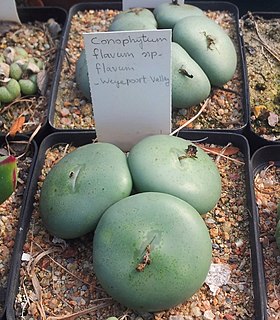
Conophytum flavum, the yellow cone plant, is a small South African species of succulent flowering plant of the family Aizoaceae.

Plectranthus oertendahlii is a species of flowering plant in the sage and mint family, Lamiaceae. Common names include silverleaf spurflower, Swedish ivy, Oertendahl's spurflower, November lights, and Brazilian coleus though it is native to eastern South Africa rather than Brazil. Plectranthus oertendahlii and the cultivar ‘Uvongo’ have gained the Royal Horticultural Society’s Award of Garden Merit.
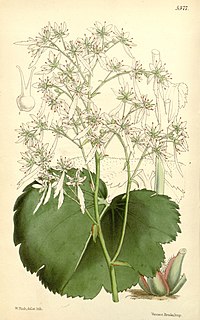
Saxifraga fortunei (齿瓣虎耳草), the fortune saxifrage, is a species of flowering plant in the family Saxifragaceae, native to China, Japan and Korea. Growing to just 40 cm (16 in) tall and broad, it is a shade-loving herbaceous perennial with large round fleshy leaves. Slender branched stalks bear panicles of small white starry flowers in summer. The two lower petals of each bloom are significantly longer than the others. Both the flowers and the leaves are sometimes flushed red or pink.

Sempervivum ciliosum, the Teneriffe houseleek, is a species of flowering plant in the stonecrop family Crassulaceae, native to Southeastern Europe. Growing to just 10 cm (3.9 in) high by 50 cm (20 in) wide, it is a spreading evergreen perennial. It forms spheres of pointed, succulent, hairy grey-green leaves. Mature rosettes may produce yellowish flowers on stalks up to 10 cm (3.9 in) in summer. Despite a superficial resemblance, houseleeks are not closely related to cacti.
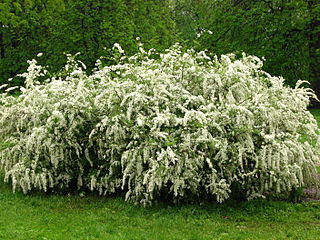
Spiraea × cinerea is a species of flowering plant in the rose family. It is a hybrid of garden origin. Growing to 1.5 m (4.9 ft) tall and wide, this compact deciduous shrub bears small, lanceolate leaves and multiple white blooms along its arching stems in spring.

Stachys macrantha, known as big betony, is a species of flowering plant in the mint family, Lamiaceae. It is native to the Caucasus, northeastern Turkey, and northwestern Iran. Growing to 60 cm (24 in) tall by 30 cm (12 in) broad, it is an erect herbaceous perennial with scalloped cordate leaves. Spikes of hooded purplish-pink flowers are borne throughout summer.

Stachyurus chinensis (中国旌节花), Chinese stachyurus, is a species of flowering plant in the family Stachyuraceae, native to China and Taiwan. It is a spreading deciduous shrub growing to 2.5 m (8 ft) tall by 4 m (13 ft) wide. Stiff, pendent racemes of bell-shaped, greenish-yellow flowers are borne on glossy, dark brown branches in winter and spring. It flowers two weeks later than the related S. praecox. The flowers are followed by simple ovate leaves which colour to pink and red before falling in autumn.


