
Empress Kōgyoku, also known as Empress Saimei, was the 35th and 37th monarch of Japan, according to the traditional order of succession. Both her reigns were within the Asuka period.
Emperor Tenji, known first as Prince Katsuragi and later as Prince Nakano Ōe until his accession, was the 38th emperor of Japan who reigned from 668 to 671. He was the son of Emperor Jomei and Empress Kōgyoku, and his children included Empress Jitō, Empress Genmei, and Emperor Kōbun.
Emperor Kōbun was the 39th emperor of Japan, according to the traditional order of succession.

Emperor Tenmu was the 40th Emperor of Japan, according to the traditional order of succession. He ascended to the throne following the Jinshin War, during which his army defeated that of Emperor Kōbun. Tenmu reigned from 673 until his death in 686, amid Hakuhō period or the late Asuka period.
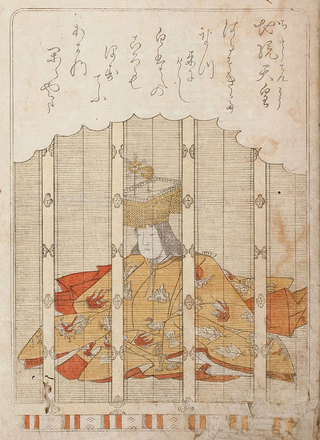
Empress Jitō was the 41st monarch of Japan, according to the traditional order of succession.

Emperor Monmu was the 42nd emperor of Japan, according to the traditional order of succession.

The Japanese era name or nengō, is the first of the two elements that identify years in the Japanese era calendar scheme. The second element is a number which indicates the year number within the era meaning "origin, basis", followed by the literal "nen (年)" meaning "year".

Tokuji (徳治) was a Japanese era name after Kagen and before Enkyō. This period spanned the years from December 1306 through October 1308. The reigning emperor was Go-Nijō-tennō (後二条天皇).

Taihō (大宝) was a Japanese era name after a late 7th century interruption in the sequence of nengō after Shuchō and before Keiun. This period spanned the years from March 701 through May 704. The reigning emperor was Monmu-tennō (文武天皇).
Chōgen (長元) was a Japanese era name after Manju and before Chōryaku. This period spanned the years from July 1028 through April 1037. The reigning emperors were Go-Ichijō-tennō (後一条天皇) and Go-Suzaku-tennō (後朱雀天皇).
Shuchō (朱鳥), alternatively read as Suchō or Akamitori, was a Japanese era name after a gap following Hakuchi (650–654) and before another gap lasting until Taihō (701–704). This Shuchō period briefly spanned a period of mere months, June through September 686. The reigning sovereigns were Tenmu-tennō (天武天皇) and Jitō-tennō (持統天皇).
Taika (大化) was a Japanese era name during the reign of Kōtoku. The Taika era immediately preceded the Hakuchi era. This period spanned the years from August 645 through February 650.
Hakuchi (白雉) was a Japanese era name after the Taika era and before Shuchō. This period spanned the years from February 650 through December 654. The reigning emperor was Kōtoku-tennō (孝徳天皇).
The Saimei period is a chronological timeframe during the Asuka period of Japanese history. The Saimei period describes a span of years which were considered to have begun in the 1315th year of the imperial dynasty.
The Kōbun period is a chronological timeframe during the Asuka period of Japanese history. The Kōbun period describes a span of years which were considered to have begun in the 1332nd year of the imperial dynasty.
The Temmu period is a chronological timeframe during the Asuka period of Japanese history. The Temmu period describes a span of years which were considered to have begun in the 1333rd year of the imperial dynasty.
The Jitō period is a chronological timeframe during the Asuka period of Japanese history. The Jitō period describes a span of years which were considered to have begun in the 1347th year of the imperial dynasty.
The Monmu period is a chronological timeframe during the Asuka period of Japanese history. The Mommu period describes a span of years which were considered to have begun in the 1357th year of the imperial dynasty.
Ten'ō (天応) was a Japanese era name after Hōki and before Enryaku. This period lasted from January 781 through August 782. The reigning emperor was Kōnin-tennō (光仁天皇).
Hōan (保安) was a Japanese era name after Gen'ei and before Tenji. This period spanned the years from April 1120 through April 1124. The reigning emperors were Toba-tennō (鳥羽天皇) and Sutoku-tennō (崇徳天皇).
