Vedanta, also known as Uttara Mīmāṃsā, is one of the six orthodox (āstika) traditions of textual exegesis and Hindu philosophy. The word "Vedanta" means "conclusion of the Vedas", and encompasses the ideas that emerged from, or aligned and reinterpreted, the speculations and enumerations contained in the Upanishads, focusing, with varying emphasis on devotion and knowledge, and liberation. Vedanta developed into many traditions, all of which give their specific interpretations of a common group of texts called the Prasthānatrayī, translated as "the three sources": the Upanishads, the Brahma Sutras and the Bhagavad Gita.

Dvaita Vedanta ;, is a sub-school in the Vedanta tradition of Hindu philosophy. The term Tattvavada literally means "arguments from a realist viewpoint". The Tattvavada (Dvaita) Vedanta sub-school was founded by the 13th-century Indian philosopher-saint Madhvacharya. Madhvacharya believed in three entities: God, jiva (soul), and jada. The Dvaita Vedanta school believes that God and the individual souls (jīvātman) exist as independent realities, and these are distinct, being said that Vishnu (Narayana) is independent (svatantra), and souls are dependent (paratantra) on him.
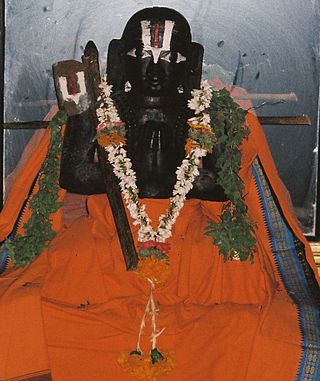
Ramanuja, also known as Ramanujacharya, was an Indian Hindu philosopher, guru and a social reformer. He is noted to be one of the most important exponents of the Sri Vaishnavism tradition within Hinduism. His philosophical foundations for devotionalism were influential to the Bhakti movement.

Madhvacharya, also known as Purna Prajna and Ānanda Tīrtha, was an Indian philosopher, theologian and the chief proponent of the Dvaita (dualism) school of Vedanta. Madhva called his philosophy Tattvavāda meaning "arguments from a realist viewpoint".
The Brahma Sūtras, also known as the Vedanta Sūtra, Shariraka Sūtra, and Bhikshu-sūtra, are a Sanskrit text which synthesizes and harmonizes Upanishadic ideas and practices. It is attributed to the sages Bādarāyaṇa, who is also called Vyāsa (arranger), but probably an accumulation of incremental additions and changes by various authors to an earlier work, completed in its surviving form in approx. 400–450 CE. The oldest version may be composed between 500 BCE and 200 BCE, with 200 BCE being the most likely date.
The standard problem of evil found in monotheistic religions does not apply to almost all traditions of Hinduism because it does not posit an omniscient, omnipotent, omnibenevolent creator.
Jagadguru, literally meaning "guru of the universe", is a title used in Sanātana Dharma. Traditionally, it has been bestowed upon or used for ācāryas belonging to the Vedānta school who have written Sanskrit commentaries on the Prasthānatrayī – the Brahma sūtras, the Bhagavad-gītā and the principal Upaniṣads. Historically, jagadgurus have established a lineage and an institution to spread dharma which has been based in Varanasi, the centre of Sanskrit study.

A matha, also written as math, muth, mutth, mutt, or mut, is a Sanskrit word that means 'institute or college', and it also refers to a monastery in Hinduism. An alternative term for such a monastery is adheenam. The earliest epigraphical evidence for mathas related to Hindu-temples comes from the 7th to 10th century CE.
Principal Upanishads, also known as Mukhya Upanishads, are the most ancient and widely studied Upanishads of Hinduism. Composed between 800 BCE to the start of common era, these texts are connected to the Vedic tradition.
Narahari Tirtha was a Dvaita philosopher, scholar, statesman and one of the disciples of Madhvacharya. He is considered to be the progenitor of the Haridasa movement along with Sripadaraja. Though only two of his scholarly works are extant, they are characterised by their verbosity and lack of digressions. A few songs of his survive under the pen name Raghukulatilaka. As a minister of considerable influence to the Eastern Ganga rulers and later as the pontiff of the Madhvacharya matha, Narahari converted the Simhachalam temple into an educational establishment of renown and a religious centre for Vaishnavism.
Prasthanatrayi, literally, three sources , refers to the three canonical texts of theology having epistemic authority, especially of the Vedanta schools. It consists of:
- The Upanishads, known as Upadeśa Prasthāna, and the Śruti Prasthāna, especially the Principal Upanishads.
- The Bhagavad Gita, known as Sādhana Prasthāna, and the Smṛti Prasthāna
- The Brahma Sutras, known as Sūtra Prasthāna or Nyāya Prasthāna or Yukti Prasthāna

Bannanje Govindacharya was an Indian philosopher and Sanskrit scholar versed in Veda Bhashya, Upanishad Bhashya, Mahabharata, Puranas and Ramayana. He wrote Bhashyas (commentaries) on Veda Suktas, Upanishads, Shata Rudriya, Brahma Sutra Bhashya, Gita Bhashya and was an orator. He was awarded the Padma Shri by the Government of India in 2009.

Sri Vaishnavism is a denomination within the Vaishnavism tradition of Hinduism, predominantly practiced in South India. The name refers to goddess Lakshmi, as well as a prefix that means "sacred, revered", and the god Vishnu, who are together revered in this tradition.

The Nimbarka Sampradaya, also known as the Kumāra Sampradāya, Hamsa Sampradāya, and Sanakādi Sampradāya, is one of the four Vaiṣṇava Sampradāyas. It was founded by Nimbarka, a Telugu Brahmin yogi and philosopher. It propounds the Vaishnava Bhedabheda theology of Dvaitadvaita (dvaita-advaita) or dualistic non-dualism. Dvaitadvaita states that humans are both different and non-different from Isvara, God or Supreme Being. Specifically, this Sampradaya is a part of Krishnaism—Krishna-centric traditions.
In Hinduism, the Brahma Sampradaya is the disciplic succession (sampradaya) of gurus starting with Brahma. The term is most often used to refer to the beliefs and teachings of Madhvacharya, his Dvaita Vedanta philosophy, and Sadh Vaishnavism, a tradition of Vaishnavism founded by Madhvacharya.

Sad Vaishnavism, , is a denomination within the Vaishnavism—Bhagavata tradition of Hinduism. Sad Vaishnavism was founded by thirteenth century philosopher-saint Madhvacharya, who developed the Tattvavada (dvaita) Vedanta sub-school of Hindu philosophy.

Adi Shankaracharya is a 1983 Indian film in Sanskrit language directed by G. V. Iyer. The film depicts the life and times of the Hindu philosopher, Adi Shankaracharya, who consolidated the doctrine of Advaita Vedanta (nondualism) in Hindu philosophy. This movie is prime example of experimental movie era of Kannada film industry. It was the first film in India to be made in Sanskrit. At the 31st National Film Awards, it won four awards, including Best Film, Best Screenplay, Best Cinematography and Best Audiography.
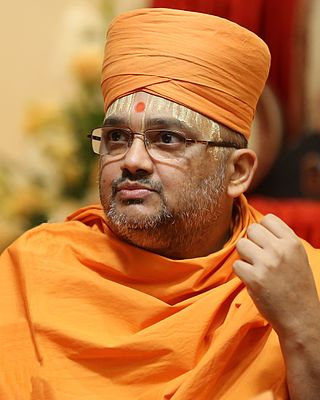
Bhadreshdas Swami is a Sanskrit scholar and an ordained monk of the Bochasanwasi Akshar Purushottam Swaminarayan Sanstha (BAPS). In 2007 he completed the Swaminarayan Bhashyam, a five-volume classical Sanskrit commentary on the Prasthanatrayi. This commentary on three of Hinduism's most notable texts: the Upanishads, Bhagavad Gita, and the Brahma sutras, forms the interpretive foundation of the philosophy of Akshar Purushottam darshana, also known as Swaminarayan darshana, illuminating the Vedic roots of the Akshar Purushottama philosophy, which was propagated by the 19th-century Hindu leader, Swaminarayan and later by Shastriji Maharaj.
Kannada Brahmins are Kannada-speaking Brahmins, primarily living in Karnataka, and also present in the states of Telangana, Andhra Pradesh, Kerala, and Tamil Nadu. They belong to one of three traditions: Smartism, Sadh Vaishnavism, and Sri Vaishnavism, and are followers of Adi Shankara, Madhvacharya, and Ramanuja respectively.

Bhavani Narayanrao Krishnamurti Sharma, commonly known as B. N. K. Sharma or B. N. Krishnamurti Sharma, was an Indian writer, scholar, professor, and Indologist. Sharma was a professor and Head of the Department of Sanskrit in Ruparel College, Bombay from (1953–1969). Sharma was one of the foremost exponents of Madhvacharya's school of Dvaita Vedanta. B. N. K. Sharma learned the art of debates under Satyadhyana Tirtha of Uttaradi Math. Sharma travelled along with Satyadhyana Tirtha from, learned all philosophical knowledge from him and also used to rectify his doubts from Satyadhyana Tirtha.


