
Trillium is a genus of about fifty flowering plant species in the family Melanthiaceae. Trillium species are native to temperate regions of North America and Asia, with the greatest diversity of species found in the southern Appalachian Mountains in the southeastern United States.

Erythronium, the fawn lily, trout lily, dog's-tooth violet or adder's tongue, is a genus of Eurasian and North American plants in the lily family, most closely related to tulips. The name Erythronium derives from Ancient Greek ἐρυθρός (eruthrós) "red" in Greek, referring to the red flowers of E. dens-canis.

Hepatica is a genus of herbaceous perennials in the buttercup family, native to central and northern Europe, Asia and eastern North America. Some botanists include Hepatica within a wider interpretation of Anemone.
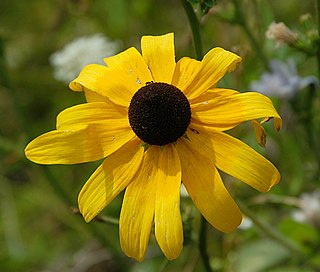
Rudbeckia hirta, commonly called black-eyed Susan, is a North American flowering plant in the family Asteraceae, native to Eastern and Central North America and naturalized in the Western part of the continent as well as in China. It has now been found in all 10 Canadian Provinces and all 48 of the states in the contiguous United States.

Uvularia is a genus of flowering plants in the family Colchicaceae, which is closely related to the lily family (Liliaceae). They are commonly called bellworts, bellflowers or merrybells. The genus name is derived from the Latin ūvula meaning "little grape," likely because of the way the flowers hang downward. For the same reason Uvularia may also refer to the similarly derived palatine uvula, which hangs down from the soft palate in the mouth. The plants are often found growing on wooded slopes or in ravines and they spread by stolons, or stoloniferous rhizomes. The plants are usually 45–60 cm (18–24 in) in height and bear one or two flowers per stem in April and May, that hang downward from the axils of the leaves.

Uvularia grandiflora, the large-flowered bellwort or merrybells, is a species of flowering plant in the family Colchicaceae, native to eastern and central North America.
Hartwrightia is a genus of North American flowering plants in the tribe Eupatorieae of the sunflower family. The genus contains a single species, Hartwrightia floridana, native to the US states of Georgia and Florida. The species is sometimes referred to by the common name Florida hartwrightia.

Quercus chapmanii, commonly referred to as the Chapman oak, is a species of oak that grows in the southeastern United States.

Streptopus lanceolatus, is an understory perennial plant native to the forests of North America, from Alaska to Labrador, south through the Great Lakes and Appalachian Mountain regions of the United States, as well as Montana, Washington state, Oregon, and St. Pierre & Miquelon. It grows primarily in mixed-wood forests, and throughout a wide range of soil and site conditions, preferring cool, acidic soils.
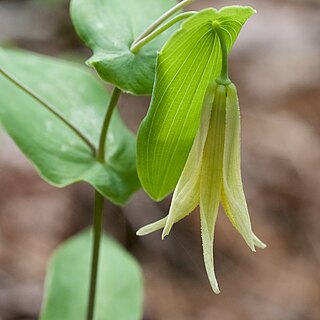
Uvularia perfoliata, the perfoliate bellwort, is a perennial forb native to the eastern United States and Canada, which produces pale yellow flowers in spring.
Parietaria praetermissa, the clustered pellitory, is a plant species native to the coastal plains of the southeastern United States, i.e., Georgia, Florida, Louisiana, North Carolina and South Carolina. It grows in hammocks, waste places, calcareous outcrops, etc., at elevations of 10 m.
Parietaria floridana, common name Florida pellitory, is a plant species native to the southeastern United States, the West Indies, and much of Latin America. In the US, the heart of its range extends from Florida, to Georgia and North and South Carolina, with isolated populations reported in Mississippi, Louisiana, Texas, New Hampshire, Kentucky and Delaware. Some populations in California have in the past been referred to as P. floridana but are now regarded as a separate species, P. hespera.
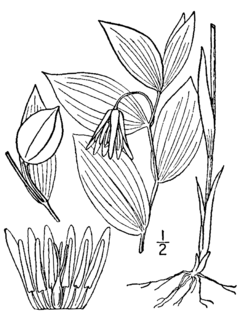
Uvularia puberula, the mountain bellwort, is a plant species native to the eastern United States. It is common across Virginia, North and South Carolina, West Virginia, and adjacent parts of northern Georgia, eastern Tennessee, eastern Kentucky and southern Pennsylvania. Isolated populations have been found in southern Georgia, northern Alabama, southern New Jersey, and Long Island in New York State.
Ageratina jucunda, called the Hammock snakeroot, is a North American species of plants in the sunflower family. It is found only in the southeastern United States, in the states of Georgia and Florida.
Flaveria floridana, Florida yellowtops, is a North American plant species of yellowtops within the sunflower family. It has been found only along the Gulf Coast of Florida between Clearwater and Marco Island, mostly in the Tampa Bay region.

Zamia integrifolia is a small, tough, woody cycad native to the southeast United States, the Bahamas, Cuba, the Cayman Islands, Hispaniola, and Puerto Rico. The species is possibly extinct in Puerto Rico and Haiti.

Hypericum tenuifolium, known as Atlantic St. John's-wort and sandhill St. John's-wort, is a species of flowering plant in the St. John's wort family, Hypericaceae. It is native to the Southeastern United States.

Hypericum suffruticosum, known as pineland St. John's-wort, is a species of flowering plant in the St. John's wort family, Hypericaceae. It is native to the Southeastern United States.
Hypericum erythreae, the Georgia St. John's-wort, sparse-leaved St. John's-wort, or grit St. Johnswort, is a species of flowering plant in the St. John's wort family, Hypericaceae. It is native to the southeastern United States in seepage bogs and roadside ditches. Its name grit St. Johnswort comes from its limited distribution, within the Altamaha Grit region of the Georgia coastal plain.

Hypericum fasciculatum, known as peelbark St. Johnswort or sandweed, is a species of flowering plant in the St. Johnswort family, Hypericaceae, native to the southeastern United States. It is found from eastern North Carolina, south to southern Florida, west to eastern Louisiana. Kew's Plants of the World Online database also notes that it occurs in Cuba, though Cuba is not listed in several other sources. It was first described in 1797 by Jean-Baptiste Lamarck.

