Coordinates: 22°44′57″N120°15′17″E / 22.749114°N 120.254604°E

A geographic coordinate system is a coordinate system that enables every location on Earth to be specified by a set of numbers, letters or symbols. The coordinates are often chosen such that one of the numbers represents a vertical position and two or three of the numbers represent a horizontal position; alternatively, a geographic position may be expressed in a combined three-dimensional Cartesian vector. A common choice of coordinates is latitude, longitude and elevation. To specify a location on a plane requires a map projection.
Zihguan 梓官區 Ziguan | |
|---|---|
| Zihguan District [1] | |
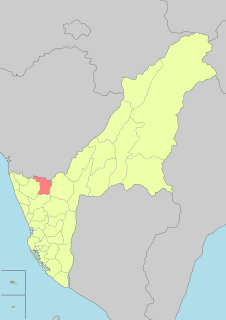
Ziguan District in Kaohsiung City | |
| Country | Taiwan |
| Region | Southern Taiwan |
| Population (January 2016) | |
| • Total | 36,417 |
| Website | Official Website (in Chinese) |
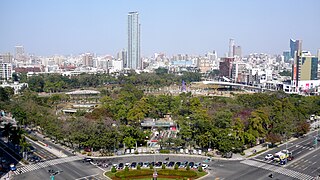
Zihguan District (Chinese :梓官區; Hanyu Pinyin :Zǐguān Qū; Tongyong Pinyin :Zǐhguan Cyu; Wade–Giles :Tzŭ3-kuan1 Ch'ü1) is a coastal suburban district of Kaohsiung City in southern Taiwan. [2]
Traditional Chinese characters are Chinese characters in any character set that does not contain newly created characters or character substitutions performed after 1946. They are most commonly the characters in the standardized character sets of Taiwan, of Hong Kong and Macau, and in the Kangxi Dictionary. The modern shapes of traditional Chinese characters first appeared with the emergence of the clerical script during the Han Dynasty, and have been more or less stable since the 5th century.
Hanyu Pinyin, often abbreviated to pinyin, is the official romanization system for Standard Chinese in mainland China and to some extent in Taiwan. It is often used to teach Standard Mandarin Chinese, which is normally written using Chinese characters. The system includes four diacritics denoting tones. Pinyin without tone marks is used to spell Chinese names and words in languages written with the Latin alphabet, and also in certain computer input methods to enter Chinese characters.
Tongyong Pinyin was the official romanization of Mandarin Chinese in Taiwan between 2002 and 2008. The system was unofficially used between 2000 and 2002, when a new romanization system for Taiwan was being evaluated for adoption. Taiwan's Ministry of Education approved the system in 2002, but its use was optional. Since January 1, 2009, Tongyong Pinyin has no longer been official because of the Ministry of Education's approval of Hanyu Pinyin on September 16, 2008.
Ziguan District is divided into 15 villages and 286 neighborhoods.
Villages are the basic level administrative subdivisions of Taiwan, under townships, county-administered cities or districts. There are two types of villages depending on the divisions it belongs to.
Northern Zihguan consists mostly on agriculture, while in the South consists mostly about fishery.
Cishan District is a suburban district in northeastern Kaohsiung, Taiwan.
Cianjhen District is a district in Kaohsiung City, Taiwan. It covers an area of 19.1207 km² and is subdivided into 59 basic units of city administration. Moreover, Qianzhen District which has a population is 192,484, as of 2016.
Nanzih District is a district located in Kaohsiung City, Taiwan. It was the northernmost district of Kaohsiung City until Kaohsiung County was merged into the municipality in 2010. Nanzi offers convenient access to transportation, including a train and bus station and an interchange on the Sun Yat-sen Freeway. Moreover, it also contains the Nanzi Industrial Zone.
Alian District (Chinese: 阿蓮區; pinyin: Ālián Qū; Wade–Giles: A1-lien2 Ch'ü1; Pe̍h-ōe-jī: A-lian-khu) is a rural district in Kaohsiung, Taiwan.
Ciaotou District is a rural district in Kaohsiung City, Taiwan.
Gangshan District, is a suburban district in Kaohsiung City in southern Taiwan. It has 97,843 inhabitants in 2016. The township is part of the suburbs of Kaohsiung City which encompass 10 cities out of 18 in the official Kaohsiung Metro Area.
Hunei District is a rural district in Kaohsiung City, Taiwan.
Cieding District is a coastal suburban district in Kaohsiung, Taiwan.
Linyuan District is a suburban district of Kaohsiung, Taiwan. It has 70,423 inhabitants in 2016. It is the southernmost district of the city.
Lujhu District (Chinese: 路竹區; Hanyu Pinyin: Lùzhú Qū; Tongyong Pinyin: Lùjhú Cyu; Wade–Giles: Lu4-chu2 Ch'ü1) is a suburban district of Kaohsiung City, Taiwan.
Maolin District is a mountain indigenous district of Kaohsiung, Taiwan. Maolin is one of the least populated districts in Taiwan, since it is located just to the south of the Central Mountain Range. The height ranges from 230 meters to 2700 meters above sea level, with a hot tropical and humid weather. The main population of Maolin district is the Rukai people of the Taiwanese aborigines. Maolin is well suited for tourism due to its unique scenery and ecology. In 2001 December, it was officially made the Maolin National Park of Taiwan.
Neimen District is a rural district of Kaohsiung in southern Taiwan. Neimen is located in the mountainous area with very little flat land. Qishan River passes through the Neimen district. The whole district is under water reserve protection. The climate of Neimen belongs to the tropical monsoon climate. The major occupation in Neimen District is farming. However, the district is also famous for its roadside banquet culture.
Niaosong District is a rural district of Kaohsiung City, Taiwan.
Renwu District or Jenwu District is a suburban district of Kaohsiung City in southern Taiwan.
Tianliao District is a suburban district of Kaohsiung City, Taiwan.
Yanchao District is a suburban district of Kaohsiung City, Taiwan.
Yong'an District is a coastal suburban district of Kaohsiung City in southern Taiwan.
Cianjin District is a downtown district of Kaohsiung City, Taiwan. It is the third smallest district in Kaohsiung City.
Xinxing District is a downtown district of Kaohsiung City, Taiwan.
Gushan District (Chinese: 鼓山區; pinyin: Gǔshān Qū; Wade–Giles: Ku3-shan1 Ch'ü1) is district of Kaohsiung City, Taiwan.
| Wikimedia Commons has media related to Zihguan District, Kaohsiung . |