
The Great Siege of Malta occurred in 1565 when the Ottoman Empire attempted to conquer the island of Malta, then held by the Knights Hospitaller. The siege lasted nearly four months, from 18 May to 8 September 1565.
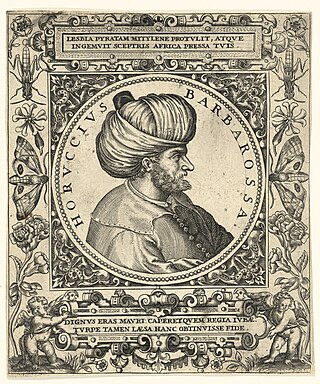
Aruj Barbarossa, known as Oruç Reis to the Turks, was an Ottoman corsair who became Sultan of Algiers. The elder brother of the famous Ottoman admiral Hayreddin Barbarossa, he was born on the Ottoman island of Midilli and died in battle against the Spanish at Tlemcen.

Portrait of Alof de Wignacourt with his Page is a painting by the Italian master Caravaggio, in the Louvre of Paris.

The Battle of Djerba took place in May 1560 near the island of Djerba, Tunisia. The Ottomans under Piyale Pasha's command overwhelmed a large joint Christian alliance fleet, composed chiefly of Spanish, Papal, Genoese, Maltese, and Neapolitan forces. The allies lost 27 galleys and some smaller vessels as well as the fortified island of Djerba. This victory marked perhaps the high point of Ottoman power in the Mediterranean Sea.

Hayreddin Barbarossa, also known as Hayreddin Pasha, Hızır Hayrettin Pasha, and simply Hızır Reis, was an Ottoman corsair and later admiral of the Ottoman Navy. Barbarossa's naval victories secured Ottoman dominance over the Mediterranean during the mid-16th century.

The conquest of Tunis occurred in 1535 when the Habsburg Emperor Charles V and his allies wrestled the city away from the control of the Ottoman Empire.

The siege of Tripoli occurred in 1551 when the Ottoman Turks and Barbary pirates besieged and vanquished the Knights of Malta in the Red Castle of Tripoli, modern Libya. The Spanish had established an outpost in Tripoli in 1510, and Charles V remitted it to the Knights in 1530. The siege culminated in a six-day bombardment and the surrender of the city on 15 August.

Dragut was an Ottoman corsair, naval commander, governor, and noble. Under his command, the Ottoman Empire's maritime power was extended across North Africa. Recognized for his military genius, and as being among "the most dangerous" of corsairs, Dragut has been referred to as "the greatest pirate warrior of all time", "undoubtedly the most able of all the Turkish leaders", and "the uncrowned king of the Mediterranean". He was nicknamed "the Drawn Sword of Islam". He was described by a French admiral as "a living chart of the Mediterranean, skillful enough on land to be compared to the finest generals of the time" and that "no one was more worthy than he to bear the name of king". Hayreddin Barbarossa, who was his mentor, stated that Dragut was ahead of him "both in fishing and bravery".

Hospitaller Malta, known in Maltese history as the Knights' Period, was a de facto state which existed between 1530 and 1798 when the Mediterranean islands of Malta and Gozo were ruled by the Order of St. John of Jerusalem. It was formally a vassal state of the Kingdom of Sicily, and it came into being when Emperor Charles V granted the islands as well as the city of Tripoli in modern Libya to the Order, following the latter's loss of Rhodes in 1522. Hospitaller Tripoli was lost to the Ottoman Empire in 1551, but an Ottoman attempt to take Malta in 1565 failed.

The Raid on Żejtun, also known as The Last Attack, was the last major attack made by the Ottoman Empire against Hospitaller-ruled Malta. The attack took place in July 1614, when raiders pillaged the town of Żejtun and the surrounding area before being beaten back to their ships by the Order's cavalry and by the inhabitants of the south-eastern towns and villages.

Garzes Tower, also known as Saint Martin's Tower, was a watchtower built in Mġarr, Gozo by the Order of Saint John in 1605. It was named after Martin Garzez, the Grand Master who financed its construction, even though it was eventually built after his death during the Magistry of Alof de Wignacourt. The tower was demolished in the 19th century; some remains were reused for the building of a bridge, and the site was developed with a hotel.
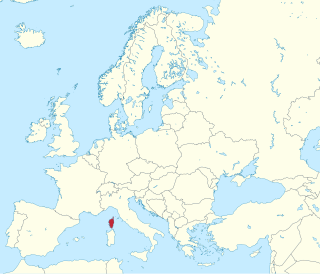
The Battle of Girolata was a naval action fought between Genoese, Spanish, and Ottoman ships on 15 June 1540 in the Gulf of Girolata, on the west coast of the island of Corsica, amidst the war between Charles V of Spain and Suleiman the Magnificent. A Spanish squadron of 21 galleys led by the Genoese Gianettino Doria and the Spaniard Berenguer de Requesens surprised an Ottoman squadron of 11 galleys, anchored at Girolata, led by the Ottoman admiral Dragut, whom the commander of the Ottoman Navy, Hayreddin Barbarossa, had committed to raid the Italian coast after his victories in the Adriatic Sea the year before. As the crews of the Ottoman warships were ashore, distributing the booty from recent raids, the Spanish-Genoese fleet easily overtook them, taking all 11 Ottoman galleys and making 1,200 prisoners, among them Dragut, who was carried to Genoa and put, together with his captains, to row in Andrea Doria's galleys.
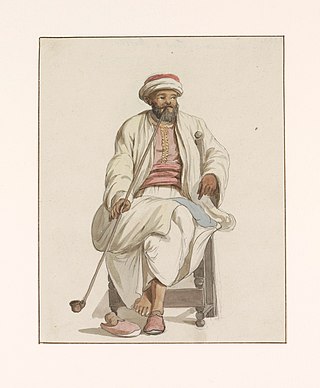
Slavery was practiced in Malta from classical antiquity to the early modern period, as was the case in many countries around the Mediterranean Sea. Sources dating back to when the islands were under Arab rule during the Middle Ages attest to the presence of slavery but lack details regarding the slaves' ethnic and religious backgrounds. When the islands were part of the Kingdom of Sicily during the late medieval period, it is apparent that many black Africans were domestic slaves on the islands.

The Wignacourt Museum is a museum in Rabat, Malta. It is housed in an 18th-century Baroque building which housed the Chaplains of the Order of St. John, and it is named after Grand Master Alof de Wignacourt, who ruled over the Maltese Islands between 1601 and 1622.
Tripoli, today the capital city of Libya, was ruled by the Knights Hospitaller between 1530 and 1551. The city had been under Spanish rule for two decades before it was granted as a fief to the Hospitallers in 1530 along with the islands of Malta and Gozo. The Hospitallers found it difficult to control both the city and the islands, and at times they proposed to either move their headquarters to Tripoli or to abandon and raze the city. Hospitaller rule over Tripoli ended in 1551 when the city was captured by the Ottoman Empire following a siege.

The Raid on Constantinople of 1616 was a Spanish raid on Constantinople, the capital city of the Ottoman Empire. It was performed by Ottavio d'Aragona on the orders of Viceroy of Naples Pedro Téllez-Girón, Duke of Osuna.
The raid on the Kerkennah Islands of 1611 was a naval attack by Spanish commander Álvaro de Bazán y Benavides against the Kerkennah Islands, in Ottoman Tunisia. It resulted in a victory of the Spanish and its Italian allies over the local Ottomans and Barbary corsairs.
The Constantinople slave rebellion of 1618 was an uprising of Christian slaves in the capital of the Ottoman Empire, Constantinople, headed by enslaved Spanish soldiers. The revolt concluded with parts of the city damaged in a fire started by the Spanish, who escaped the city in captured galleys at the head of 2,000 insurgents after burning the Ottoman armada in port. They became an unofficial privateer fleet on their way back to Christian territories in Italy, ultimately dismebarking in Malta and scattering in the Spanish viceroyalties of Sicily and Naples.
The Battle of Chios of 1621 was a naval battle between a Spanish and Italian fleet and an Ottoman-Barbary fleet near the island of Chios. It concluded with a Christian victory.
The attack on Sousse was launched by a joint Christian armada in 1619 against the Tunisian city of Sousse. The attack ended in Fiasco for the Christians.

 Knights Hospitaller
  Ottoman Tunis