
Redfish is a common name for several species of fish. It is most commonly applied to certain deep-sea rockfish in the genus Sebastes, red drum from the genus Sciaenops or the reef dwelling snappers in the genus Lutjanus. It is also applied to the slimeheads or roughies, and the alfonsinos (Berycidae).

The Squaliformes are an order of sharks that includes about 126 species in seven families.

The beardfishes consist of a single extant genus, Polymixia, of deep-sea marine ray-finned fish named for their pair of long hyoid barbels. They are classified in their own order Polymixiiformes. But as Nelson says, "few groups have been shifted back and forth as frequently as this one, and they were recently added to Paracanthoptergii". For instance, they have previously been classified as belonging to the Beryciformes. They are of little economic importance.
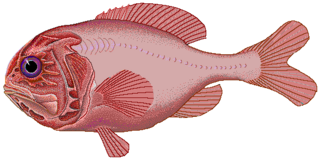
The orange roughy, also known as the red roughy, slimehead and deep sea perch, is a relatively large deep-sea fish belonging to the slimehead family (Trachichthyidae). The UK Marine Conservation Society has categorized orange roughy as "vulnerable to exploitation". It is found in 3 to 9 °C, deep waters of the Western Pacific Ocean, eastern Atlantic Ocean, Indo-Pacific, and in the eastern Pacific off Chile. The orange roughy is notable for its extraordinary lifespan, attaining over 200 years. It is important to commercial deep-trawl fisheries. The fish is a bright, brick-red color, fading to a yellowish-orange after death.
Slimeheads, also known as roughies and redfish, are mostly small, exceptionally long-lived, deep-sea beryciform fish constituting the family Trachichthyidae. Found in temperate to tropical waters of the Atlantic, Indian, and Pacific Oceans, the family comprises about 50 species in eight genera. Slimeheads are named for the network of muciferous canals riddling their heads.
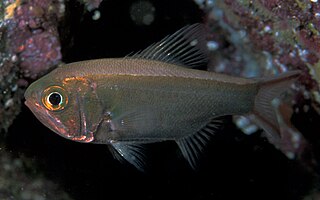
The slender roughy is a fish of the family Trachichthyidae. Until 2004 when two new species were described, the slender roughy was believed to be the only species in the genus Optivus. The slender roughy is found in the southwestern Pacific Ocean around New Zealand at depths between 10 and 100 m. Its length is up to 102 mm (4.0 in) standard length or 120 mm (4.7 in) overall total length.
Optivus is a fish genus from the family Trachichthyidae found from near the surface to depths of 320 m (1,050 ft) in the southwest Pacific Ocean off Australia and New Zealand.

Sargocentron is a genus of squirrelfish found in tropical parts of the Indian, Pacific and Atlantic Oceans, with the greatest species diversity near reefs in the Indo-Pacific. Being largely or entirely nocturnal, they have relatively large eyes. Red and silvery colours dominate. The preopercle spines are venomous and can give painful wounds. Most have a maximum length of 15–25 cm (6–10 in), but S. iota barely reaches 8 cm (3 in), and S. spiniferum can reach more than 50 cm (20 in).
Polymixia is the only extant genus of the order Polymixiiformes and the only genus in Polymixiidae. It contains 10 species, all of which live in deepwater marine environments. They are found in tropical and subtropical waters of the Atlantic, Indian and western Pacific Oceans. They are bottom-dwelling fish, found down to about 800 m (2,600 ft). Most are relatively small fish, although one species is over 40 cm (16 in) in length.

Melamphaes is a genus of fish in the family Melamphaidae found in Atlantic, Indian and Pacific Ocean.

Poromitra is a genus of ridgeheads. The 22 known species of Poromitra have been divided into five species groups according to variation in preopercle anatomy.

Scopeloberyx is a genus of ridgeheads.
Diretmoides is a genus of spinyfins with one species (pauciradiatus) known from the eastern Atlantic Ocean and the other (veriginae) known from the eastern Indian Ocean.

Hoplostethus is a genus of fish in the slimehead family.
Parinoberyx horridus is a species of marine slimehead only known from the Western Pacific and the Coral Sea at depths around 300 m (980 ft). This species is the only known member of its genus.
The Philippine luminous roughy is a slimehead native to the Western Pacific around Indonesia and the Philippines. It is a deep-water species, ranging from 164 to 723 metres beneath the surface.
The Western luminous roughy is a slimehead from the family Trachichthyidae. It is found in the southwest Atlantic, off the Amazon River mouth in northern Brazil. It can be found as deep as 229 metres (751 ft) and can reach lengths of up to 7.5 centimetres (3.0 in) SL.

Aulotrachichthys prosthemius, also known as the West Pacific luminous roughy, is a species of slimehead native to the Northern Pacific from Hawaii to Japan. It can be found at depths ranging from 90 to 198 metres, either in open water or near crevices and caves. It has a maximum length of 6.1 centimetres (2.4 in).
Aulotrachichthys heptalepis, also known as the Hawaiian luminous roughy, is a slimehead fish found in the Hawaiian Islands south of Niihau, the westernmost island. It has a depth range of 50 to 100 metres. They reach a maximum total length of about 6.7 centimetres (2.6 in). It was first described in 1984 after 33 individuals were caught by the U.S. National Marine Fisheries Service in a series of cruises of the Hawaiian Islands.
The Saya de Malha luminous roughy is a species of slimehead that is native to Saya de Malha in the Indian Ocean, the Kyushu–Palau Ridge in the Pacific Ocean, and the Nazareth Banks in the Mediterranean. Found at depths ranging from 143 to 274 m, it can reach up to 9.6 cm (3.8 in) in size.


