Aurangabad, West Bengal

Last updated

Aurangabad
Census town
West Bengal location map.svg
Red pog.svg
Aurangabad
Location in West Bengal, India
India location map 3.png
Red pog.svg
Aurangabad
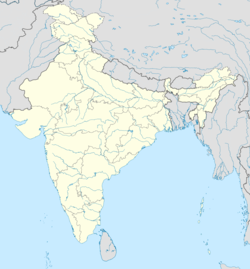
Aurangabad (India)
Coordinates: 24°36′04″N88°02′01″E / 24.6012°N 88.0336°E / 24.6012; 88.0336
CountryFlag of India.svg India
State West Bengal
District Murshidabad
Named after Emperor Aurangzeb
Government
  Type Federal democracy
Area
  Total
2.77 km2 (1.07 sq mi)
Population
 (2011)
  Total
39,261
  Density14,200/km2 (36,700/sq mi)
Languages
  Official Bengali, English
Time zone UTC+5:30 (IST)
PIN
742201,742224
Telephone/ STD code+913485
ISO 3166 code IN-WB
Vehicle registration WB-57, WB-58, WB-94, WB-93
Lok Sabha constituency Jangipur
Vidhan Sabha constituency Suti
Website murshidabad.nic.in

Aurangabad is a census town in the Suti II CD block in the Jangipur subdivision of the Murshidabad district in the Indian state of West Bengal. [1] [2] The town lies between The Ganga and the feeder canal.

Contents

Geography

Aurangabad, West Bengal
Transparent.svg
Transparent.svg
4km
2.5miles
B
A
N
G
L
A
D
E
S
H
J
H
A
R
K
H
A
N
D
R
Tarapur
Transparent square.svg
k
Farakka
Feeder Canal
j
Padma River
i
Ganges River
R
Nabarun
Transparent square.svg
R
Suti
Transparent square.svg
R
Nimtita
Transparent square.svg
R
Mahesail
Transparent square.svg
R
Farakka
Transparent square.svg
F
Farakka Super TPS
Transparent square.svg
F
Farakka Barrage
Transparent square.svg
M
Dhuliyan
Transparent square.svg
CT
Bhabki
Transparent square.svg
CT
Khidirpur
Transparent square.svg
CT
Khanpur
Transparent square.svg
CT
Kakramari
Transparent square.svg
CT
Chakmeghoan
Transparent square.svg
CT
Ichhlampur
Transparent square.svg
CT
Paschim Punropara
Transparent square.svg
CT
Dafahat
Transparent square.svg
CT
Hafania
Transparent square.svg
CT
Mahendrapur
Transparent square.svg
CT
Aurangabad
CT
Debipur
Transparent square.svg
CT
Jagtaj
Transparent square.svg
CT
Basudebpur
Transparent square.svg
CT
Jaykrishnapur
Transparent square.svg
CT
Bhasaipaikar
Transparent square.svg
CT
Kohetpur
Transparent square.svg
CT
Serpur
Transparent square.svg
CT
Dhusaripara
Transparent square.svg
CT
Chachanda
Transparent square.svg
CT
Uttar Mahammadpur
Transparent square.svg
CT
Kankuria
Transparent square.svg
CT
Jafrabad
Transparent square.svg
CT
Anup Nagar
Transparent square.svg
CT
Mahadeb Nagar
Transparent square.svg
CT
Pranpara
Transparent square.svg
CT
Mamrejpur
Transparent square.svg
CT
Sibnagar
Transparent square.svg
CT
Arjunpur
Transparent square.svg
CT
Farakka Barrage
Township
Transparent square.svg
CT
Benia Gram
Transparent square.svg
CT
Srimantapur
Transparent square.svg
Cities, towns and locations in the northern portion of Jangipur subdivision, Murshidabad district (including Farakka, Samserganj, Suti II CD blocks)
M: municipal town, CT: census town, R: rural/ urban centre, F: Facility
Abbreviation- TPS: Thermal Power Station
Owing to space constraints in the small map, the actual locations in a larger map may vary slightly

Location

Aurangabad is located at 24°36′04″N88°02′01″E / 24.6012°N 88.0336°E / 24.6012; 88.0336 .

According to the map of Suti II CD block in the District Census Handbook, Murshidabad, Dafahat, Jagtaj, Debipur, Aurangabad, Hafania, Mahendrapur, Paschim Punropara, Bhabki, Khidirpur, Khanpur, Ichhlampur, Chakmeghoan and Kakramari, form a cluster of census towns. [3]

Area overview

Jangipur subdivision is crowded with 52 census towns and as such it had to be presented in two location maps. One of the maps can be seen alongside. The subdivision is located in the Rarh region that is spread over from adjoining Santhal Pargana division of Jharkhand. The land is slightly higher in altitude than the surrounding plains and is gently undulating. [4] [5] The river Ganges, along with its distributaries, is prominent in both the maps. At the head of the subdivision is the 2,245 m long Farakka Barrage, one of the largest projects of its kind in the country. [6] Murshidabad district shares with Bangladesh a porous international border which is notoriously crime prone (partly shown in this map). [7] The subdivision has two large power plants - the 2,100 MW Farakka Super Thermal Power Station and the 1,600 MW Sagardighi Thermal Power Station. [8] [9] According to a 2016 report, there are around 1,000,000 (1 million/ ten lakh) workers engaged in the beedi industry in Jangipur subdivision. 90% are home-based and 70% of the home-based workers are women. [10] [11] [12] As of 2013, an estimated 2.4 million people reside along the banks of the Ganges alone in Murshidabad district. Severe erosion occurs along the banks. [13]

Note: The two maps present some of the notable locations in the subdivision. All places marked in the maps are linked in the larger full screen maps.

History

Origin of the Name “Aurangabad”

The name Aurangabad is found in several states of India, including Bihar, Maharashtra, Uttar Pradesh and West Bengal. The widespread use of this name is generally linked to the Mughal emperor Aurangzeb, also known by his regal title Aurangzeb Alamgir. During the expansion of Mughal administration across northern and eastern India, newly organised settlements, military outposts and administrative centres were often named after members of the imperial family. As a result, several regions came to be known as Aurangabad, literally meaning “the city of Aurangzeb.”

In the case of West Bengal, local accounts suggest that Alamgir (Aurangzeb) may have travelled through or temporarily camped near this region during a royal journey or military movement. Although documentary evidence is limited, the tradition has persisted for generations. According to this popular belief, the area gained significance during the Mughal period, and the name Aurangabad became established as a marker of that historical association.

Demographics

According to the 2021 Census of India, Aurangabad had a total population of approx 278,922 Rural Population: 110,767 Children (0-6 yrs): 52,382 (22,148 rural)Scheduled Castes: 20,461 (4,438 rural)Scheduled Tribes: 493 http://censusindia.gov.in/pca/cdb_pca_census/Houselisting-housing-WB.html |title = C.D. Block Wise Primary Census Abstract Data(PCA) | work= West Bengal – District-wise CD Blocks|publisher= Registrar General and Census Commissioner, India | access-date = 27 August 2017}}</ref> [14] Aurangabad had a population of 32,134. Males constitute 50% of the population and females 50%. Aurangabad has an average literacy rate of 44%, lower than the national average of 59.5%: male literacy is 52%, and female literacy is 36%. In Aurangabad, 19% of the population is under 6 years of. Aurangabad also includes Mahendrapur village which has a population of 6979.

Infrastructure

According to the District Census Handbook, Murshidabad, 2011, Aurangabad covered an area of 2.77 km2. The protected water-supply involved overhead tank, tube well, borwell. It had 3099 domestic electric connections. Among the medical facilities it had 5 dispensaries/ health centres, 11 medicine shops. Among the educational facilities, it had 18 primary schools, 1 middle school, 2 secondary schools, 2 senior secondary schools, 1 general degree college. It had 1 recognised shorthand, typewriting, vocational training institution. Among the social cultural and recreational facilities it had 1 stadium, 1 auditorium/ community hall. It produced beedi, spices, handloom. It had branches of 2 nationalised banks, 1 private commercial bank. [15]

Education

College

Dukhulal Nibaran Chandra College of Aurangabad is recognized by UGC. [16]

Schools

Aurangabad High School (H. S) of Aurangabad is maintained by the 'National University of Educational Planning and Administration' under the program 'District Information System for Education 2013–2014.[ clarification needed ]

Aurangabad Balika Vidyalaya

Chhabghati K.D. Vidyalaya (H.S.)

English Oriental Academy, CBSE Board

Aurangabad High Madrasah (H.S)

Ideal Education Mission School

Nimtita G. D Institution

Panchagram I. S. A High School

Aurangabad PTTI

Aurangabad Public School

Altab Hossain PTTI

As Sabin Mission

ARTM Public School

Prabananda Vidyapith

Gurukul Sikhsha Niketan

Aurangabad Public School

Other institutions

Jakir Hossain Institute of Polytechnic

Aurangabad B.Ed. College

Nathulal Das B.Ed. College

Am Teacher's Training college

Aurangabad B.Ed. Training College

J.S B.Ed. College

Aurangabad (West Bengal) as a Beedi and Homecraft Industries Hub

Aurangabad, located in Murshidabad district of West Bengal, is widely recognised as a major hub of beedi and home-based craft industries. The region hosts a large number of small and medium-scale manufacturers, providing employment to thousands of local workers.

Among the industrial establishments in the area, Pataka Industry Private Limited is considered one of the largest and most prominent. Alongside it, several well-known beedi brands operate from Aurangabad, including Kalpana Biri, Shiv Bidi, Howrah Bidi, and Mrinalini Bidi. These industries play a significant role in the local economy and have contributed to Aurangabad’s reputation as a centre of traditional home-craft production.

The beedi sector in Aurangabad supports a wide network of workers, particularly women, who are engaged in rolling, processing, and packaging. As a result, the region is regarded as an important source of livelihood for many families and is often described as a homecraft industries hub of national significance.

Healthcare

Aurangabad has a Primary Health Centre (PHC). [17]

Suti II CD block is one of the areas of Murshidabad district where ground water is affected by a high level of arsenic contamination. The WHO guideline for arsenic in drinking water is 10 mg/ litre, and the Indian Standard value is 50 mg/ litre. The maximum concentration in Suti II CD block is 1,852 mg/litre. [18]

Electoral constituencies

Aurangabad was assembly constituency No. 51 of West Bengal; later as recommendations of Delimitation Commission were implemented,& demolished the Aurangabad assembly constituency now this area was part of new assembly constituency No. 57, Suti, which will contain the whole area under Suti I and Suti II CD Blocks.

Chairpersons: The following individuals have served as Chairpersons of the Aurangabad local administrative body:

Abu Taher Ali – Block President/Chairman (1993–1998)Indian National Congress.

Hossain Ali – Chairman (subsequent term) Communist party of India.

Alfajuddin Biswas – Chairman (subsequent term) INC.

References

  1. "Population, Decadal Growth Rate, Density and General Sex Ratio by Residence and Sex, West Bengal/ District/ Sub District, 1991 and 2001". West Bengal. Directorate of census operations. Archived from the original on 28 September 2011. Retrieved 13 November 2008.
  2. "Census of India 2001, Final Population Totals, West Bengal, Rural Frame". West Bengal. Directorate of census operations. Archived from the original on 19 July 2011. Retrieved 13 November 2008.
  3. "District Census Handbook Murshidabad, Census of India 2011, Series 20, Part XII A" (PDF). Page 195, Map of Suti II CD block. Directorate of Census Operations, West Bengal. Retrieved 1 July 2021.
  4. "District Census Handbook: Murshidabad, Series 20 Part XII A" (PDF). Physiography, Page 13. Directorate of Census Operations, West Bengal, 2011. Retrieved 24 July 2017.
  5. "Murshidabad". Geography. Murshidabad district authorities. Archived from the original on 29 August 2017. Retrieved 24 July 2017.
  6. "Farakka Barrage Project". FBP. Retrieved 12 September 2017.
  7. "Child labour, illness & lost childhoods, India's tobacco industry". Edge of Humanity Magazine, 27 December 2020. Retrieved 13 July 2021.
  8. "Power Generation". Farakka. NTPC. Archived from the original on 30 October 2016. Retrieved 7 August 2016.
  9. "The West Bengal Power Development Corporation Limited". Sagardighi Thermal Power Project. WBPDCL. Archived from the original on 23 August 2017. Retrieved 15 August 2017.
  10. Kar, Sunirmal. "Child workers in household industry: a study of beedi industry in Murshidabad district of West Bengal" (PDF). Viswa Bharati University thesis, page 5. Shodhganga. Retrieved 28 August 2017.
  11. "The 'Poor man's cigarette'". Gurvinder Singh. The Statesman, 22 January 2017. Retrieved 28 August 2017.
  12. "Beedi workers of Jangipur hold key". Indrani Dutta. The Hindu, 1 May 2009. Retrieved 28 August 2017.
  13. "Types and sources of floods in Murshidabad, West Bengal" (PDF). Swati Mollah. Indian Journal of Applied Research, February 2013. Archived from the original (PDF) on 20 August 2017. Retrieved 5 September 2017.
  14. "Census of India 2001: Data from the 2001 Census, including cities, villages and towns (Provisional)". Census Commission of India. Archived from the original on 16 June 2004. Retrieved 1 November 2008.
  15. "District Census Handbook Murshidabad, Census of India 2011, Series 20, Part XII A" (PDF). Section II Town Directory, Pages 981-987: Statement I: Growth History, Pages 990-993: Statement III: Civic & Other Amenities, Pages 993-995: Statement IV: Medical Facilities 2009, Pages 995-1001 Section V: Educational, Recreational and Cultural Facilities; Pages 1001- 1002: Statement VI: Industry & Banking. Directorate of Census Operations, West Bengal. Retrieved 26 June 2021.
  16. "List of Colleges in West Bengal". University Grants Commission (India). Archived from the original on 16 July 2011. Retrieved 13 November 2008.
  17. "Staff particulars of MO in the district of Murshidabad: Government Hospitals Details" (PDF). Official website of Murshidabad district. Archived from the original (PDF) on 27 July 2011. Retrieved 13 November 2008.
  18. "Groundwater Arsenic contamination in West Bengal-India (20 years study )". Murshidabad. SOES. Archived from the original on 22 July 2011. Retrieved 4 August 2017.