
The Polyporaceae are a family of poroid fungi belonging to the Basidiomycota. The flesh of their fruit bodies varies from soft to very tough. Most members of this family have their hymenium in vertical pores on the underside of the caps, but some of them have gills or gill-like structures. Many species are brackets, but others have a definite stipe – for example, Polyporus badius.
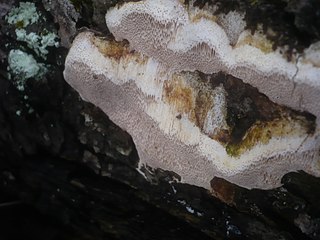
Perenniporia is a cosmopolitan genus of bracket-forming or crust-like polypores in the family Polyporaceae. They are dimitic or trimitic with smooth, thick-walled basidiospores and cause a white rot in affected wood.

Oxyporus is a genus of polypore fungi in the family Schizoporaceae. An individual family Oxyporaceae was described for the genus. A number of species in this genus are plant pathogens, causing a white rot. The genus is widely distributed.

Rigidoporus is a genus of fungi in the family Meripilaceae. Many of the species in this genus are plant pathogens. The widespread genus, which contains about forty species, was originally circumscribed by American mycologist William Alphonso Murrill in 1905. The generic name combines the Latin word rigidus ("rigid") with the Ancient Greek word πόρος ("pore").

Antrodiella citrea is a bracket fungus native to Australia, and New Zealand.

Postia is a genus of brown rot fungi in the family Fomitopsidaceae.
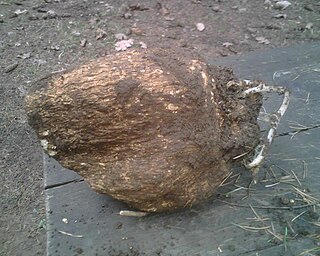
Wolfiporia is a genus of fungi in the family Polyporaceae. The genus was circumscribed by Leif Ryvarden and Robert Lee Gilbertson in 1984 to contain the type species Wolfiporia cocos and W. dilatohypha. The genus is named in honor of mycologist Frederick Adolph Wolf, who was the first to officially describe the type species.

Ceriporia is a widely distributed genus of crust fungi.

Antrodiella is a genus of fungi in the family Steccherinaceae of the order Polyporales.

Ischnoderma is a genus of polypore fungi. Species in the genus have dark brown and tomentose fruit bodies that become darker brown to black and smooth when mature. The genus, widespread in temperate regions, contains an estimated 10 species.
Austrolentinus is a fungal genus in the family Polyporaceae. Segregated from the genus Lentinus, it is monotypic, containing the single species Austrolentinus tenebrosus, which was first described by E.J.H. Corner in 1981 as Panus tenebrosus. Austrolentinus was circumscribed by Norwegian mycologist Leif Ryvarden in 1991. The fungus occurs in Queensland, Solomon Islands and Papua New Guinea, and the Malay Peninsula.

Datronia is a genus of poroid crust fungi in the family Polyporaceae. The genus was circumscribed by Marinus Anton Donk in 1966, with Datronia mollis as the type species. Datronia fungi cause a white rot in hardwoods. Datronia contains six species found in northern temperate areas. The most recent addition, Datronia ustulatiligna, was described in 2015 from Himachal Pradesh in India.

Dichomitus is a genus of poroid crust fungi in the family Polyporaceae. It was circumscribed by English mycologist Derek Reid in 1965.

Diplomitoporus is a genus of fungi in the family Polyporaceae. The Dictionary of the Fungi estimated the widespread genus to contain 11 species; since then, the genus has grown with the additional of several newly described species, and some transfers from other genera. Diplomitoporus has been described as a wastebasket taxon, containing "species that share common macroscopic and microscopic characteristics, but are not necessarily related."

Spongipellis is a genus of fungi in the family Polyporaceae. The genus is widely distributed and contains ten species. The genus was circumscribed by French mycologist Narcisse Théophile Patouillard in 1887. The genus name combines the Latin words spongia ("sponge") and pellis ("skin").

Skeletocutis is a genus of about 40 species of poroid fungi in the family Polyporaceae. The genus has a cosmopolitan distribution, although most species are found in the Northern Hemisphere. It causes a white rot in a diverse array of woody substrates, and the fruit bodies grow as a crust on the surface of the decaying wood. Sometimes the edges of the crust are turned outward to form rudimentary bracket-like caps.
Wrightoporia is a genus of fungi in the family Bondarzewiaceae. According to a 2008 estimate, the widely distributed genus contains 23 species. The genus was circumscribed by Zdeněk Pouzar in Ceská Mykol. vol.20 on page 173 in 1966.
Rigidoporus laetus is a species of polypore fungus in the family Meripilaceae. It was originally described in 1883 as Polyporus laetus by Mordecai Cubitt Cooke. Peter Buchanan and Leif Ryvarden transferred it to Rigidoporus in 1988. Found in south Australia, the fungus is a plant pathogen that causes white rot in Eucalyptus.
Skeletocutis stramentica is a species of poroid fungus in the family Polyporaceae that is found in New Zealand.
Tyromyces toatoa is a species of poroid fungus found in New Zealand. It was described as a new species by G. H. Cunningham in 1965. The type collections were made by Joan Dingley, who found the fungus in Taupō, Mount Ruapehu, near Whakapapa Stream. She found it fruiting on the bark of dead branches and trunks of Phyllocladus alpinus, at an elevation of 1,000 metres (3,300 ft). The specific epithet toatoa evokes the Māori name of the host plant.


