In the Philippines, regions, are administrative divisions that serve primarily to organize the provinces of the country for administrative convenience. Currently, the archipelagic republic of the Philippines is divided into 17 regions. Most national government offices provide services through their regional branches instead of having direct provincial offices. These regional offices are usually in the city designated as the regional center.

Maguindanao is a province in the Philippines. Since 2014 the provincial capital is Buluan but the legislative branch of the provincial government, the Sangguniang Panlalawigan, convenes in the old provincial capitol in the town of Sultan Kudarat. It borders Lanao del Sur to the north, Cotabato to the east, Sultan Kudarat to the south, and the Illana Bay to the west.

Lanao del Sur, officially the Province of Lanao del Sur, is a province in the Philippines located in the Bangsamoro Autonomous Region in Muslim Mindanao (BARMM). The capital is the city of Marawi, and it borders Lanao del Norte to the north, Bukidnon to the east, and Maguindanao and Cotabato to the south. To the southwest lies Illana Bay, an arm of the Moro Gulf.
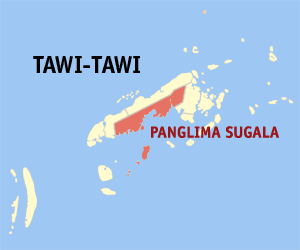
Panglima Sugala, officially the Municipality of Panglima Sugala, is a 3rd class municipality in the province of Tawi-Tawi, Philippines. According to the 2015 census, it has a population of 44,184 people.

Picong, officially the Municipality of Picong, is a 4th class municipality in the province of Lanao del Sur, Philippines. According to the 2015 census, it has a population of 16,615 people.

Ampatuan, officially the Municipality of Ampatuan, is a 4th class municipality in the province of Maguindanao, Philippines. According to the 2015 census, it has a population of 24,801 people.

Paglat, officially the Municipality of Paglat, is a — municipality in the province of Maguindanao, Philippines. According to the 2015 census, it has a population of 15,920 people.

Guindulungan, officially the Municipality of Guindulungan, is a — municipality in the province of Maguindanao, Philippines. According to the 2015 census, it has a population of 19,911 people.

Shariff Kabunsuan was a short-lived province of the Philippines within the Autonomous Region in Muslim Mindanao (ARMM) that existed from 2006 to 2008. Its designated seat of government was Datu Odin Sinsuat. Initially comprising ten municipalities carved out of Maguindanao, Shariff Kabunsuan was created by virtue of Muslim Mindanao Autonomy Act No. 201; this law was nullified by the Supreme Court of the Philippines in 2008, thus disestablishing the province.
The Shariff Kabunsuan creation plebiscite was a plebiscite on the creation of the Province of Shariff Kabunsuan in the Philippines. The plebiscite was conducted on October 28, 2006 and results were announced on October 31, 2006.

In the Philippines, the Autonomous Region in Muslim Mindanao (ARMM) is the only autonomous region; as such it is the sole region with a regional government as prescribed by the Constitution of the Philippines. In 2001, Republic Act No. 9054 was passed for the expansion of the ARMM to include the areas which initially rejected inclusion and the provinces which were carved from them, however only Marawi City and Basilan with the exception of Isabela City opted to be integrated in the region.
General elections are held for the first time in the newly created Autonomous Region in Muslim Mindanao for the Regional Governor and Vice-Governor were held on February 12, 1990.
The Autonomous Region of Muslim Mindanao region was first created on August 1, 1989 through Republic Act No. 6734 otherwise known as the Organic Act in pursuance with a constitutional mandate to provide for an autonomous area in Muslim Mindanao. A plebiscite was held in the provinces of Basilan, Cotabato, Davao del Sur, Lanao del Norte, Lanao del Sur, Maguindanao, Palawan, South Cotabato, Sultan Kudarat, Sulu, Tawi-Tawi, Zamboanga del Norte and Zamboanga del Sur; and in the cities of Cotabato, Dapitan, Dipolog, General Santos, Iligan, Marawi, Pagadian, Puerto Princesa and Zamboanga to determine if the residents would want to be part of the ARMM. Of the areas where the plebiscites were held only Lanao del Sur, Maguindanao, Sulu and Tawi-Tawi voted favorably for inclusion in the new autonomous region.

ARMM Regional Assembly, also known as ARMM Regional Legislative Assembly, was the devolved unicameral regional legislature of the Autonomous Region of Muslim Mindanao (ARMM). It was known as the "Little Congress" of the ARMM.
Autonomous Region in Muslim Mindanao general elections was held in the ARMM for the regional governor, vice-governor posts and election of members of the ARMM Regional Legislative Assembly on August 11, 2008. The electronic voting used is the first in Philippines election history. The P 500 million COMELEC's "ARMM balloting" is a pilot program for the 2010 national polling.

Sema vs. COMELEC is a court case that was heard before the Supreme Court of the Philippines. It was consolidated with Marquez v. COMELEC. It held that the Regional Assembly of the Autonomous Region in Muslim Mindanao does not have the power to create provinces and cities. Thus, the creation of the province of Shariff Kabunsuan was unconstitutional and that province no longer exists as a political entity in the Philippines.

Officially local government in the Philippines, often called local government units or LGUs, are divided into three levels – provinces and independent cities; component cities and municipalities; and barangays. In one area, above provinces and independent cities, is an autonomous region, the Autonomous Region of Muslim Mindanao. Below barangays in some cities and municipalities are sitios and puroks. All of these, with the exception of sitios and puroks, elect their own executives and legislatures. Sitios and puroks are often led by elected barangay councilors.
An autonomous region of the Philippines is a first-level administrative division and it has the authority to control the region's culture and economy. It is a minority entity that has a higher population of a particular minority ethnic group. The Constitution of the Philippines allows for two autonomous regions: for Cordilleras and Muslim Mindanao.
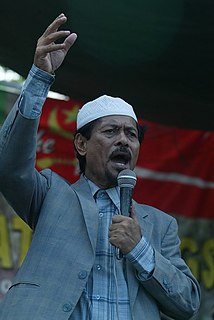
The 2001 rebellion of the Moro National Liberation Front Misuari faction against the Philippine government during the presidency of Gloria Macapagal Arroyo was led by Nur Misuari, the founder of the Moro National Liberation Front (MNLF). It began on 19 November 2001 when members of a faction of the MNLF loyal to Misuari attacked a Philippine Army headquarters in Jolo, Sulu in the Philippines. The attack was meant to disrupt the Autonomous Region in Muslim Mindanao elections scheduled for 26 November of that year, which eventually replaced Misuari as governor.
Datu Zacaria A. Candao is a Filipino politician who served as the first governor of the Autonomous Region in Muslim Mindanao (ARMM).


