Related Research Articles

Andrea Pia Yates is an American woman from Houston, Texas, who confessed to drowning her five children in their bathtub on June 20, 2001. The case of Yates—who had exhibited severe postpartum depression, postpartum psychosis, and schizophrenia leading up to the murders—placed the M'Naghten rules, along with the irresistible impulse test for sanity, under close public scrutiny in the United States.
A duty to warn is a concept that arises in the law of torts in a number of circumstances, indicating that a party will be held liable for injuries caused to another, where the party had the opportunity to warn the other of a hazard and failed to do so.

Gaslighting is a colloquialism, defined as manipulating someone into questioning their own perception of reality. The expression, which derives from the title of the 1944 film Gaslight, became popular in the mid-2010s. Merriam-Webster cites deception of one's memory, perception of reality, or mental stability. Some mental health experts have expressed concern that the term has been used too broadly. In 2022, the Washington Post reported that it had become a buzzword improperly used to describe ordinary disagreements.
Lise Van Susteren is an American psychiatrist, commentator, author and environmental activist. She is a general and forensic psychiatrist in Washington, D.C., and an expert on the physical and psychological impacts of climate change.

Alan Morton Dershowitz is an American lawyer and law professor known for his work in U.S. constitutional law and American criminal law. From 1964 to 2013, he taught at Harvard Law School, where he was appointed as the Felix Frankfurter Professor of Law in 1993. Dershowitz is a regular media contributor, political commentator, and legal analyst.

Jablonski by Pahls v. United States, 712 F.2d 391 is a landmark case in which the 9th Circuit Court of Appeals determined that a mental health professional's duty to predict dangerousness includes consulting a patient's prior records, and that their duty to protect includes the involuntary commitment of a dangerous individual; simply warning the foreseeable victim is insufficient.
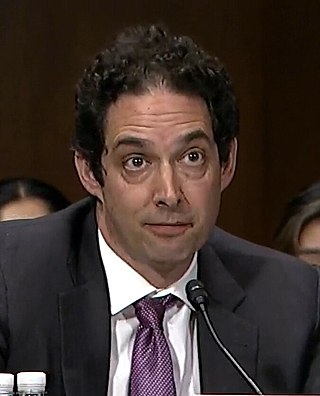
Alex Norman Berenson is an American writer who was a reporter for The New York Times, and has authored several thriller novels as well a book on corporate financial filings. His 2019 book Tell Your Children: The Truth About Marijuana, Mental Illness and Violence sparked controversy, earning denunciations from many in the scientific and medical communities.

Jeffrey Alan Lieberman is an American psychiatrist who specializes in schizophrenia and related psychoses and their associated neuroscience (biology) and pharmacological treatment. He was principal investigator for CATIE, the largest and longest independent study ever funded by the United States National Institute of Mental Health to examine existing pharmacotherapies for schizophrenia. He was president of the American Psychiatric Association from May 2013 to May 2014.
Political abuse of psychiatry, also known as punitive psychiatry, refers to the misuse of psychiatric diagnosis, detention, and treatment to suppress individual or group human rights in society. This abuse involves the deliberate psychiatric diagnosis of individuals who require neither psychiatric restraint nor treatment, often for political purposes.
Allen J. Frances is an American psychiatrist. He is currently Professor and Chairman Emeritus of the Department of Psychiatry and Behavioral Sciences at Duke University School of Medicine. He is best known for serving as chair of the American Psychiatric Association task force overseeing the development and revision of the fourth edition of the Diagnostic and Statistical Manual of Mental Disorders (DSM-IV). Frances is the founding editor of two well-known psychiatric journals: the Journal of Personality Disorders and the Journal of Psychiatric Practice.
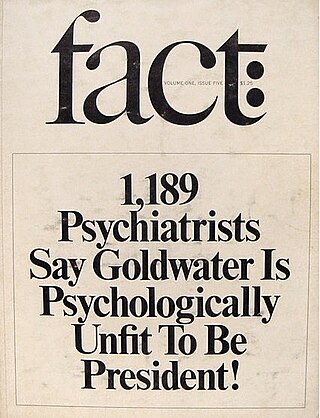
The Goldwater rule is Section 7 in the American Psychiatric Association's (APA) Principles of Medical Ethics, which states that psychiatrists have a responsibility to participate in activities contributing to the improvement of the community and the betterment of public health, but when asked to comment on public figures, they shall refrain from diagnosing, which requires a personal examination and consent. It is named after former U.S. Senator and 1964 Republican presidential nominee Barry Goldwater.

Mary Cannon is an Irish psychiatrist, research scientist, public figure, and former member of the Cannabis Risk Alliance. She has received the Royal Academy of Medicine in Ireland's "Doctors Award" for psychiatry and is among the most highly cited scientists in the world. Cannon is known for her views on cannabis, being described as 'anti-cannabis'. She is best known in the field of psychiatry for her study of the risk factors for mental illness in young people.
This bibliography of Donald Trump is a list of written and published works, by and about Donald Trump, the 45th and 47th president of the United States. Due to the sheer volume of books about Trump, the titles listed here are limited to non-fiction books about Trump or his presidency, published by notable authors and scholars. Tertiary sources, satire, and self-published books are excluded.

The Dangerous Case of Donald Trump is a 2017 book edited by Bandy X. Lee, a forensic psychiatrist, containing essays from 27 psychiatrists, psychologists, and other mental health professionals describing the "clear and present danger" that US President Donald Trump's mental health poses to the "nation and individual well being". A second edition updated and expanded the book with additional essays. Lee maintains that the book remains strictly a public service, and all royalties were donated to the public good to remove any conflict of interest.
John D. Gartner is an American psychologist, psychotherapist, author, activist, and former part-time assistant professor at Johns Hopkins University Medical School.

Trump derangement syndrome (TDS) is a pejorative term, usually for criticism or negative reactions to President-elect Donald Trump that are perceived to be irrational and to have little regard towards Trump's actual policy positions, or actions undertaken by his administration. The term has mainly been used by Trump supporters to discredit criticism of him, as a way of reframing the discussion by suggesting that his opponents are incapable of accurately perceiving the world. Some journalists have used the term to call for restraint when judging Trump's statements and actions.

At 78 years, 6 months and 27 days old, Donald Trump, the 45th and soon-to-be 47th president of the United States, is the oldest president-elect in the country's history. He previously became the oldest major-party presidential nominee in history five weeks after his 78th birthday, after President Joe Biden withdrew from contention prior to becoming the nominee of his own party in the 2024 United States presidential election. Should he live to the end of his second presidency on January 20, 2029, he will become the oldest person ever to hold the office at 82 years, seven months, and six days old, sparking renewed discussion of his fitness to assume the presidency. Since the early days of Trump's 2016 presidential campaign, his physical and mental health have been a subject of public debate. Trump was 70 years old when he first took office, surpassing Ronald Reagan as the oldest person to assume the presidency to that date. During Trump's presidency, comments on his age, weight, lifestyle, and history of heart disease raised questions about his physical health. In addition, numerous public figures, media sources, and mental health professionals have speculated that Trump may have mental health impairments, ranging from narcissistic personality disorder to some form of dementia, which runs in his family.
Shubulade Smith, also known as Lade Smith is a British academic and consultant psychiatrist at the South London and Maudsley NHS Foundation Trust (SLaM). She is a senior lecturer at King's College, London and Clinical Director at the NCCMH and forensic services at SLaM, and is currently serving as the first black President of the Royal College of Psychiatrists.

Jonathan Michel Metzl is an American psychiatrist and author. He is the Frederick B. Rentschler II Professor of Sociology and Psychiatry at Vanderbilt University, where he is also Director of the Center for Medicine, Health, and Society. Metzel is an expert on gun violence and mental illness, which is the subject of his latest book, What We've Become, Living and Dying in a Country of Arms. He is the author of several other books, including The Protest Psychosis, Prozac on the Couch, Against Health: How Health Became the New Morality, and Dying of Whiteness.

Megan L. Ranney is a practicing American emergency physician currently serving as the Dean of the Yale School of Public Health. Previously, Ranney served as the Deputy Dean of the Brown University School of Public Health, was Warren Alpert Endowed Professor in the Department of Emergency Medicine at Rhode Island Hospital and the Alpert Medical School of Brown University. Ranney was the founding Director of the Brown-Lifespan Center for Digital Health.
References
- ↑ Bandy X. Lee at Library of Congress
- 1 2 Lee, Bandy X. (February 19, 2019). "Violence: An Interdisciplinary Approach to Causes, Consequences, and Cures". Wiley.com . Archived from the original on June 6, 2019.
- ↑ "Interview With Yale Forensic Psychiatrist Bandy Lee". Psychology Today. Retrieved 2021-04-17.
- ↑ Schwirtz, Michael (2014-03-19). "Rikers Island Struggles With a Surge in Violence and Mental Illness". The New York Times. ISSN 0362-4331 . Retrieved 2021-04-17.
- ↑ "Annan welcomes study on violence against children that calls for urgent global action". UN News. 2006-10-11. Retrieved 2021-04-17.
- ↑ "Violence Prevention Alliance". www.who.int. Retrieved 2021-04-17.
- ↑ Lin, Serena (May 13, 2020). "Profile: Dr. Bandy Lee and the psychiatric case against Donald Trump". yaledailynews.com. Retrieved 2021-04-17.
- ↑ "Transcript of the Duty to Warn Conference" (PDF).
- ↑ "APA Reaffirms Support for Goldwater Rule". www.psychiatry.org. Retrieved 2021-04-17.
- ↑ Lee, Bandy X.; Glass, Leonard L. (2018-01-10). "We're Psychiatrists. It's Our Duty to Question the President's Mental State". POLITICO Magazine. Retrieved 2025-01-09.
- ↑ Lee, Bandy X. (October 11, 2019). "Mental health experts see Trump is dangerous, but our professional gatekeepers protect him". USA Today . Retrieved January 30, 2020.
- ↑ Sharman, Joe (April 25, 2017). "Psychiatrist issues urgent warning over Trump's mental health". The Independent . Retrieved February 2, 2020.
- ↑ Lee, Bandy X.; Glass, Leonard L. (January 10, 2018). "We're Psychiatrists. It's Our Duty to Question the President's Mental State". Politico Magazine . Retrieved January 21, 2020.
- ↑ "Trump chief of staff used book on president's mental health as guide". the Guardian. 2022-09-15. Retrieved 2022-09-30.
- ↑ Petrizzo, Zachary (2022-09-16). "John Kelly Reportedly Bought a Book on Trump's Mental Health". The Daily Beast. Retrieved 2022-09-30.
- ↑ "'That's Hitler, Bannon thought': 2022 in books about Trump and US politics". the Guardian. 2022-12-11. Retrieved 2022-12-12.
- ↑ "The Divider review: riveting narrative of Trump's plot against America". the Guardian. 2022-09-16. Retrieved 2022-09-30.
- ↑ "Trump discussed using a nuclear weapon on North Korea in 2017 and blaming it on someone else, book says". NBC News. 12 January 2023. Retrieved 2023-01-20.
- ↑ "Report: Donald Trump Wanted to Nuke North Korea and Then Blame It on Another Country". Vanity Fair. 2023-01-12. Retrieved 2023-01-20.
- ↑ Begley, Sharon (2017-08-16). "Democrats in Congress to explore creating an expert panel on Trump's mental health". STAT. Retrieved 2022-11-11.
- ↑ "Washington's growing obsession: The 25th Amendment". POLITICO. 3 January 2018. Retrieved 2022-11-11.
- ↑ "Top Psychiatrist SOUNDS ALARM on Trump's Deteriorating Mental Fitness…". Evergreen Podcasts. Retrieved 2022-11-11.
- ↑ "[The Dangerous Case of Donald Trump] | C-SPAN.org". www.c-span.org. Retrieved 2022-11-11.
- ↑ Lee, Bandy X. "January 6". bandyxlee.substack.com. Retrieved 2022-12-05.
- 1 2 Hahamy, Madison; Horta, Beatriz (March 23, 2021). "Former professor says Yale fired her over tweet on Trump, Dershowitz". yaledailynews.com. Retrieved 2021-04-17.
- ↑ Yu, Isaac (2021-11-09). "Bandy Lee lawyers file counter to Yale's motion to dismiss suit". Yale Daily News. Retrieved 2021-11-10.
- ↑ Lee, Bandy X. (2023-05-31). "Academic Freedom and Professional Responsibility". The Newsletter of Dr. Bandy X. Lee. Retrieved 2025-01-09.
- 1 2 Ruling on Motion to Dismiss, Lee v. Yale University, Civ. No. 3:21CV00389(SALM) (D. Conn. Aug. 30, 2022).
- ↑ "Yale Lawsuit". Bandy X Lee. Retrieved 2022-11-12.
- 1 2 Lee v. Yale Univ.
- ↑ Howell, Jordan (2023-06-26). "Yale shreds faculty rights to rid itself of professor who called Trump mentally unstable | The Foundation for Individual Rights and Expression". www.thefire.org. Retrieved 2024-03-31.
- ↑ Lee, Bandy X. (2023-10-21). "Saving American Democracy through Truth". The Newsletter of Dr. Bandy X. Lee. Retrieved 2024-03-31.
- ↑ Kendall, Joshua. "The psychiatrist who warned us that Donald Trump would unleash violence was absolutely right". Mother Jones. Retrieved 2022-09-30.
- ↑ Kendall, Joshua. "The psychiatrist who warned us that Donald Trump would unleash violence was absolutely right". Mother Jones. Retrieved 2022-09-15.
- ↑ Lee, Bandy X. (2023-12-17). "Alan Dershowitz—Is He a Spreader of 'Trump Contagion'?". The Newsletter of Dr. Bandy X. Lee. Retrieved 2025-01-09.
- ↑ "The more dangerous state of the world and the need for fit leadership". National Press Club. Archived from the original on 2025-01-03. Retrieved 2025-01-09.
- ↑ Behar, Richard. "Trump, Madoff, And The Art (And Science) Of Pathological Lying". Forbes. Retrieved 2025-01-09.
- 1 2 3 4 Blakely, Rhys (18 January 2018). "Are Donald Trump's test results fake news?" . The Times . Retrieved 21 January 2018.
- ↑ Wright, Sarah (2021-04-05). "The doctor is in — and she specializes in violence prevention". The Berkshire Edge. Retrieved 2021-04-17.
- 1 2 3 4 5 Bandy X. Lee, MD, M.Div. Archived 2018-01-18 at the Wayback Machine Yale School of Medicine: Psychiatry. Retrieved 21 January 2018.
- ↑ "Not Found (404) < Yale School of Medicine". medicine.yale.edu. Archived from the original on 30 June 2020. Retrieved 14 January 2022.
- ↑ Kendall, Joshua. "The psychiatrist who warned us that Donald Trump would unleash violence was absolutely right". Mother Jones. Retrieved 2022-08-18.
- 1 2 Bandy Lee, Yale University's Violence and Health Study Group Archived 2016-04-03 at the Wayback Machine Violence Prevention Alliance, World Health Organization. Retrieved 23 January 2018.
- ↑ "Project groups". www.who.int. Retrieved 2021-04-17.
- ↑ "UN Study on Violence Against Children | UN Special Representative of the Secretary-General on Violence Against Children". violenceagainstchildren.un.org. Retrieved 2021-04-17.
- ↑ Morris, Alex (November 12, 2018). "What Happens When the Walls Finally Close in on Trump?". Rolling Stone . Retrieved January 21, 2020.
- ↑ Sheehy, Gail (April 23, 2017). "At Yale, Psychiatrists Cite Their 'Duty to Warn' About an Unfit President". Intelligencer . Retrieved January 21, 2020.
- ↑ Kalmbacher, Colin (January 21, 2020). "Interview: Law Professor Richard Painter, Psychiatrist Bandy Lee Explain Views on Trump's Trial". lawandcrime.com. Retrieved January 21, 2020.
- 1 2 DeVega, Chauncey (May 25, 2017). "Psychiatrist Bandy Lee: "We have an obligation to speak about Donald Trump's mental health issues... Our survival as a species may be at stake". Salon . Archived from the original on November 6, 2017. Retrieved January 23, 2018.
- ↑ Sword, Rosemary K.M.; Zimbardo, Philip (28 September 2017). ""The Dangerous Case of Donald Trump": A new book delves into the president's mental health". Psychology Today . Retrieved 21 January 2018.
- ↑ Lieberman, J. A. (December 27, 2017). "Correspondence: Psychiatrists Diagnosing the President — Moral Imperative or Ethical Violation?". New England Journal of Medicine . 378 (5): 483–484. doi: 10.1056/NEJMc1716751 . PMID 29281477.
- ↑ "Trumpism Did Not End With Donald Trump". HillReporter.com. 2021-02-22. Archived from the original on 2021-04-21. Retrieved 2021-04-17.
- ↑ "Psychiatrist's new warning that Trump's mental state 'is a national and international security risk'". CBC Radio. 2018-01-12. Retrieved 2023-01-20.
- ↑ Lee, Dr. Bandy (2021-02-21). "Op Ed: Trumpism Did Not End with Donald Trump". MeidasTouch. Retrieved 2023-01-20.
- ↑ "Petition to the Judiciary Committee". World Mental Health Coalition. Retrieved 2020-01-21.
- ↑ Porter, Tom (December 5, 2019). "350 health professionals sign letter to Congress claiming Trump's mental health is deteriorating dangerously amid impeachment proceedings". Business Insider . Retrieved December 6, 2019.
- 1 2 Kendall, Joshua (April 25, 2020). "Muzzled by Psychiatry in a Time of Crisis". Mad In America. Retrieved November 22, 2020.
- ↑ Fingar, Courtney (September 22, 2020). "The silencing of psychiatry: is the Goldwater rule doing more harm than good ahead of the US 2020 election?". New Statesman . Retrieved November 22, 2020.
- ↑ "The Mental Health Pandemic that Did Not Need to Be". Bioethics.net. 27 October 2020. Retrieved November 22, 2020.
- ↑ Lee, Bandy X. (September 29, 2020). "The Trump Mental Health Pandemic". Medium . Retrieved November 22, 2020.
- ↑ "Half a million dead in US, confirming virus's tragic reach". The Associated Press. 2021-02-22. Retrieved 2021-03-30.
- ↑ The ‘Shared Psychosis’ of Donald Trump and His Loyalists , Scientific American, January 11, 2021
- 1 2 3 Lee, Bandy X. (2020-10-01). Profile of a Nation: Trump's Mind, America's Soul. World Mental Health Coalition.
- ↑ "Is it possible that Trump's fixation on reversing the election drove him nuts?". BillMoyers.com. Retrieved 2021-03-30.
- ↑ Lee, Bandy X. (2017-10-01). The Dangerous Case of Donald Trump: 27 Psychiatrists and Mental Health Experts Assess a President. St. Martin's Publishing. ISBN 978-1250179456.
- ↑ "Statement: WMHC Calls for the Immediate Removal of President Donald Trump from Office". World Mental Health Coalition. Retrieved 2021-03-30.
- ↑ Lewis, Tanya, The ‘Shared Psychosis’ of Donald Trump and His Loyalists , Scientific American, January 11, 2021
- ↑ "Declaration of the Freedom of Mind". World Mental Health Coalition. 27 February 2020. Retrieved 7 June 2024.
- ↑ , Common Dreams, The Boston Globe, January 17, 2021
- ↑ Lee, Bandy X.; Sachs, Jeffrey D, One Group Who Knew All Along How Dangerous Trump Was: Mental Health Experts , Common Dreams, Opinion, The Boston Globe, January 17, 2021
- ↑ Lee, Bandy X. (January 2, 2020). "Alan Dershowitz's employing the odd use of "perfect"—not even a synonym—might be dismissed as ordinary influence in most contexts. However, given the severity and spread of "shared psychosis" among just about all of Donald Trump's followers, a different scenario is more likely". Twitter (Tweet). Retrieved 2021-03-24.
- ↑ Lee, Bandy X. (January 2, 2020). "Which scenario? That he has wholly taken on Trump's symptoms by contagion. There is even proof: his bravado toward his opponent with a question about his own sex life—in a way that is irrelevant to the actual lawsuit—shows the same grandiosity and delusional-level impunity". Twitter (Tweet). Retrieved 2021-03-24.
- ↑ Dershowitz, Alan M. (January 11, 2020). "Yale Psychiatrist Issues Diagnosis of "Psychotic" for Defending Constitutional Rights". Gatestone Institute . Retrieved 2021-03-24.
- ↑ Complaint, Lee v. Yale University, Case 3:21-cv-00389-MPS (D. Conn. filed Mar. 22, 2021), ¶ 29.
- ↑ Kendall, Joshua (2021-12-30). "She Tweeted That Alan Dershowitz Might Be Acting Crazy. So Yale Fired Her". Intelligencer. Retrieved 2024-03-29.
- ↑ "Yale Psychiatry Grand Rounds: "Chair's State of the Department Address"". medicine.yale.edu. Retrieved 2024-03-29.
- ↑ Complaint, Lee v. Yale University, Case 3:21-cv-00389-MPS (D. Conn. filed Mar. 22, 2021), ¶ 33.
- ↑ Complaint, Lee v. Yale University, Case 3:21-cv-00389-MPS (D. Conn. filed Mar. 22, 2021), ¶ 30.
- ↑ "Select Letters of Support". Bandy X Lee. Retrieved 2021-05-11.
- ↑ Lee, Bandy X. (2021-03-31). "Psychiatrists' responsibility to society: Rethinking the Goldwater Rule - CERL". www.penncerl.org. Retrieved 2022-11-12.
- ↑ Lee, Bandy X.; Fisher, Edwin B.; Glass, Leonard L. (2018-01-26). "The Goldwater rule has been turned into a silencing mechanism aimed at those who would speak out - The Boston Globe". Boston Globe. Retrieved 2022-11-12.
- ↑ "Blog - Appeal for Principle before Rule, and Uniform Application of Rules: A Case of Psychiatric Ethics". Bioethics Today. 17 January 2018. Retrieved 2022-11-12.
- ↑ Lee, Bandy X.; Glass, Leonard L. (10 January 2018). "We're Psychiatrists. It's Our Duty to Question the President's Mental State". POLITICO Magazine. Retrieved 2022-11-12.
- ↑ Zaveri, Mihir (2021-03-26). "A Yale Psychiatrist's Tweet About Dershowitz, Her Dismissal, and a Lawsuit". The New York Times. ISSN 0362-4331 . Retrieved 2021-04-17.
- ↑ @tribelaw (March 23, 2021). "This is a disgusting way for any university to act. Dr. Bandy Lee should never have been fired" (Tweet) – via Twitter.
- 1 2 "Bandy Lee Yale Lawsuit" . Retrieved April 17, 2021.
- ↑ "Cornel West, Campus Politics, and BDS". Algemeiner.com. Retrieved 2021-04-17.
- ↑ "Letters 3.26". yaledailynews.com. March 25, 2021. Retrieved 2021-04-17.
- ↑ "A Yale psychiatrist was fired for warning the public about Trump's mental health. Really?". MSNBC.com. 27 March 2021. Retrieved 2021-04-17.
- ↑ Appel, Jacob M. (2 April 2021). "'Goldwater Rule' stifles psychiatrists' free speech | Commentary". baltimoresun.com. Retrieved 2021-04-17.
- ↑ Glass, Leonard L.; Fisher, Edwin B.; Dodes, Lance (April 14, 2021). "Why did Yale dismiss Bandy X. Lee? - The Boston Globe". BostonGlobe.com. Retrieved 2021-04-17.
- ↑ "Academic Freedom and the Goldwater Rule". ACADEME BLOG. 2021-03-26. Retrieved 2021-04-17.
- ↑ Olear, Greg (26 March 2021). "Guilt by Association". gregolear.substack.com. Retrieved 2021-04-17.
- ↑ "A Petition to Yale to Reinstate Dr. Bandy Lee". World Mental Health Coalition. Retrieved 2021-04-17.
- ↑ Fire (2022-02-02). "10 Worst Colleges for Free Speech: 2022". www.thefire.org. Retrieved 2024-03-29.
- ↑ Schuessler, Jennifer (2021-09-30). "Leader of Prestigious Yale Program Resigns, Citing Donor Pressure". The New York Times. ISSN 0362-4331 . Retrieved 2021-10-10.
- ↑ "Cancellation of course on dissent at Yale-NUS campus in Singapore prompted academic freedom inquiry". www.insidehighered.com. October 2019. Retrieved 2021-10-10.
- ↑ "BIO". Bandy X Lee. Retrieved 2021-10-10.
- ↑ Mongkol, Chatwan (2022-08-31). "Court dismisses ex-Yale psychiatrist's lawsuit alleging wrongful firing over Trump criticism". New Haven Register. Retrieved 2022-08-31.
- ↑ Hagen, Lisa (2022-09-15). "U.S. Senate confirms CT judge Sarah Merriam to 2nd Circuit Court". CT Mirror. Retrieved 2024-03-29.
- ↑ Howell, Jordan (2023-06-26). "Yale shreds faculty rights to rid itself of professor who called Trump mentally unstable | The Foundation for Individual Rights and Expression". www.thefire.org. Retrieved 2024-03-29.
