| Bayraktar family | |
|---|---|
| Role | Unmanned aerial vehicle |
| National origin | Turkey |
| Manufacturer | Baykar |
| Designer | Baykar |
| Status | In service |
| Primary user | Turkish Armed Forces |
| Number built | 260+ [1] [2] |
| Variants | |
The Bayraktar UAV or Bayraktar UCAV is a family of unmanned aerial vehicles designed and manufactured by Turkish company Baykar. [3] The UAVs were developed for the Turkish Armed Forces from 2004 until the present. Some models are designed for surveillance and reconnaissance only, others are capable of tactical ground-strike missions. Baykar is also developing drones to counter other aerial systems. [4] "Bayraktar" means flag-bearer in Turkish.
Bayraktar Mini UAV is a miniature UAV and the first UAV produced by Turkish company Baykar. [5] [6]
With the concept of short range day and night aerial reconnaissance and surveillance applications, system design activities started in 2004. An initial prototype Bayraktar Mini A was developed in 2005, and following successful autonomous flight demonstrations, Baykar was awarded a contract to start series production by the Turkish Armed Forces. The first batch was composed of 19 aircraft and they were mainly deployed to the southeast parts of Turkey for use in counterterrorism operations. [7]
After hundreds of hours of flight trials, the system was subjected to major modifications and improved versions were developed. As a result, Bayraktar Mini B was fielded and became operational in December 2007 to be initially operated by the Turkish Armed Forces. [8] [9] Due to its success in the region, the system was also exported to the Qatar Armed Forces in 2012. [10] [11] The development of the aircraft is being continued and the most recent version (Bayraktar MINI D) has twice the communication range and 3 times higher maximum altitude of its predecessors. [12] [13]
Bayraktar TB1 (or Bayraktar Çaldıran) is the prototype UAV made for the Tactical UAV program of the Undersecretariat for Defence Industries (Savunma Sanayii Mustesarligi or SSM; now the Presidency of Defense Industries) of Turkey, [14] started in 2007. SSM invited two companies to compete for a prototype demonstration phase of the Tactical UAS Program. In 2009, Kale-Baykar, a joint venture between the Kale Group and Baykar Technologies, demonstrated Block A (named Bayraktar Çaldıran) [15] with its dual redundant avionics system and fully autonomous takeoff and landing capability. The aircraft was selected as the winner of the program. [16] [17] [18] While the contract was signed with the Presidency of Defense Industries for Bayraktar TB1s, these products were not delivered and remained as prototypes for Bayraktar Block 2s. Instead, serial production commenced with Bayraktar TB2. [19]
Bayraktar TB2 is the serial production aircraft of the first tactical UAV of Baykar, Bayraktar TB1.
Baykar started to develop a new combat tactical aerial vehicle system on request of Presidency of Defense Industries, after the experiences of its first tactical UAV Bayraktar Çaldıran (TB1) flown in 2011. [20] The Bayraktar TB2 conducted its maiden flight in August 2014. On 18 December 2015, a video was published for the missile test of Bayraktar TB2 in collaboration with ROKETSAN, testing Roketsan's MAM (Smart Micro Munition)s and TUBITAK-SAGE BOZOK laser-guided bombs for the first time. [21] [22] [23] [24] [25]
The Turkish Armed Forces describe Bayraktar as a "Tactical UAV Class" to avoid competition with the TAI Anka UAV, but international standards would classify it as a medium-altitude long-endurance UAV. [26] [27]
Bayraktar Akıncı is the first High-altitude Long Endurance (HALE) class unmanned combat aerial vehicle (UCAV) of Baykar.
The aircraft has a 5.5+ ton maximum takeoff weight (MTOW), with 1350+ kg of this composed of payload. Akıncı is equipped with two turboprop engines which have two different thrust capabilities: 450 or 750 hp. Akinci is equipped with electronic support and countermeasure systems, dual satellite communication systems, air-to-air radar, collision avoidance radar and national advanced synthetic aperture radar. [28]
The Bayraktar TB3 is a variant of the TB2 that is capable of landing on a ship deck. In February 2021, chairman of the Presidency of Defense Industries (SSB) Ismail Demir made public a new type of UAV being developed by Baykar that is planned to be stationed to Turkey's first amphibious assault ship, TCG Anadolu. [29] The new aircraft being developed is a naval version of the Bayraktar TB2, powered by an engine developed by Turkish company Tusaş Engine Industries (TEI). [30] [31] Demir said that between 30 and 50 folding-winged Bayraktar TB3 UAVs will be able to take off from and land on the deck of Anadolu. [32] [33] Baykar's Chief Technology Officer (CTO) Selçuk Bayraktar said in 2021 that the initial flight of the Bayraktar TB3 was scheduled for 2022. [34]
Bayraktar Kızılelma (Bayraktar Red Apple) is a proposed supersonic [35] jet-powered single-engined stealth [36] carrier-capable [37] unmanned combat aircraft in development in 2021, planned to fly for the first time in 2023. [38] [37]
According to data shared by the company, Bayraktar Kızılelma will have an operational altitude of 40,000 feet (12,192 m), a take-off weight of 5.5 tons, a payload of 1.5 tons, and an ammunition carrying capacity of 1 ton.
Turkish military use TB-2 gained prominence in counterinsurgency operations against Kurdistan Workers' Party (PKK) and People's Protection Units (YPG) positions across the border in Iraq and Syria. [39] [40] [41] Turkey considers PKK and YPG to be terrorist organizations. [42]
In June 2019, international news media reported that the Libyan, UN recognized, [43] Government of National Accord (GNA) used Bayraktar TB2s to strike an airbase held by General Haftar's Libyan National Army (LNA). Despite the UN embargo on Libya's ongoing civil war, it is suspected that at least three Bayraktar TB2 UCAV were being used over Tripoli by the GNA government forces. On 6 June 2019, two GNA Bayraktar TB2 drones were destroyed along with an operation room by LNA attacks on Mitiga Airport. [44] [45] Video evidence shows at least one Bayraktar TB2 flying over Tripoli [46] about to land at Mitiga's Military section, under control of GNA-allied forces.
In March 2020 Bayraktar TB2s, Anka-S UAVs and an array of Koral electronic jammers were deployed and extensively used in coordinated action to strike Syrian Army targets on the ground during the Operation Spring Shield launched by Turkey following losses the Turkish forces incurred at the hands of the Russian forces in northwestern Syria at the end February 2020. [47] [48] [49] The deployment was assessed by experts to be a success and a tactical game changer. [50] [51] [52]
In June 2020 the Defence Minister of Azerbaijan, Zakir Hasanov, announced that Azerbaijan had decided to purchase Bayraktar drones from Turkey. [53] During the 2020 Nagorno-Karabakh war, Bayraktar TB2s were used against Armed Forces of Armenia with great success. [54] Azerbaijan used TB-2s to destroy Armenian artillery, infantry positions and military vehicles including BM-30 Smerch MLRS, T-72s tanks, BMP-1 and BMP-2 IFVs. [55] [56] Several Osa, Strela-10 and 5 S-300 air defense systems were also destroyed by TB2s. [55] [57] [58] [59]
As a part of its military modernization program, Armed Forces of Ukraine acquired 12 Bayraktar TB2s in 2019. [60] [61] After successful use of the aircraft, the Ukrainian Navy ordered 5 additional Bayraktar TB2s, reportedly delivered in 2020. [62] Meanwhile, Turkish and Ukrainian officials announced the establishment of a joint venture to produce 48 additional Bayraktar TB2s in Ukraine. [63]
Ukraine's Bayraktar TB2s were used extensively during the 2022 Russian invasion [64] for surveillance of and attacks on Russian ground convoys. [65] [66]
Ukrainian Chief of General Staff Valery Zaluzhny made available Bayraktar TB2 operation photographs on his Facebook account, including destruction of a Russian-made Buk Air Defense Missile System. [67]
Baykar announced to the public via Twitter on 5 March 2022, that Bayraktar UAVs were exported to at least 19 countries. Only 11 of these user countries are publicly known, while the other 8 countries are unknown: [68] [69]
An unmanned combat aerial vehicle (UCAV), also known as a combat drone, colloquially shortened as drone or battlefield UAV, is an unmanned aerial vehicle (UAV) that is used for intelligence, surveillance, target acquisition, and reconnaissance and carries aircraft ordnance such as missiles, ATGMs, and/or bombs in hardpoints for drone strikes. These drones are usually under real-time human control, with varying levels of autonomy. Unlike unmanned surveillance and reconnaissance aerial vehicles, UCAVs are used for both drone strikes and battlefield intelligence.
The Turkish Naval Forces, or Turkish Navy is the naval warfare service branch of the Turkish Armed Forces.
The history of unmanned combat aerial vehicles (UCAVs) is closely tied to the general history of unmanned aerial vehicles (UAVs). While the technology dates back at least as far as the 1960s, common usage in live operations came in the 2000s. UCAVs have now become an important part of modern warfare, including in the Syrian civil war, the 2020 Nagorno-Karabakh war and during the 2022 Russian invasion of Ukraine.
Bayraktar Mini UAV is a miniature UAV produced by Turkish company Baykar.
A drone strike is an airstrike delivered by one or more unmanned combat aerial vehicles (UCAV) or weaponized commercial unmanned aerial vehicles (UAV). Only the United States, Israel, China, Iran, Italy, India, Pakistan, Russia, Turkey, and Poland are known to have manufactured operational UCAVs as of 2019. As of 2022, the Ukrainian group Aerorozvidka have built strike-capable drones and used them in combat.
TAI Baykuş is a radio-controlled tactical unmanned drone designed, developed and built by Turkish Aerospace Industries (TAI) between 2003-2004.

Baykar is a private Turkish defence company specialising in UAVs, C4I and artificial intelligence.
Bayraktar Akıncı is a High-Altitude Long-Endurance (HALE) Unmanned Combat Aerial Vehicle (UCAV) being manufactured by the Turkish technology company Baykar. The first three units entered service with the Turkish Armed Forces on 29 August 2021.
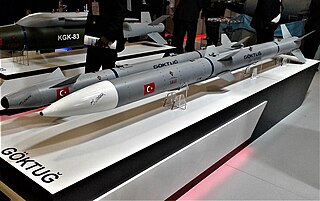
GÖKTUĞ is a Turkish program by TÜBİTAK-SAGE to develop four variants of air-to-air missiles that are to be launched from F-16s as well as future Turkish indigenous Hürjets and TF-Xs. These missiles are going to be Turkey's first indigenous air-to-air missiles. Bozdoğan (Merlin) are short-range infrared homing and Gökdoğan (Peregrine) are beyond visual range active radar homing missiles. Both missiles were successfully flight-tested in 2018. The missiles are also planned to be integrated on Bayraktar AKINCI and Bayraktar MIUS, indigenously developed Turkish UCAVs.
The TAI Aksungur is an unmanned aerial vehicle (UAV) built by Turkish Aerospace Industries (TAI) for the Turkish Armed Forces. Using existing technology from the TAI Anka series of drones, it is the manufacturer's largest drone with payload capacity for mission-specific equipment. It is intended to be used for long-term surveillance, signals intelligence, maritime patrol missions, or as an unmanned combat aerial vehicle. TAI planned to integrate weapon packages and put the Aksungur into production in early 2020. The first unit was delivered to the Turkish Naval Forces on 20 October 2021.
The Bayraktar TB2 is a medium-altitude long-endurance (MALE) unmanned combat aerial vehicle (UCAV) capable of remotely controlled or autonomous flight operations. It is manufactured by the Turkish company Baykar Makina Sanayi ve Ticaret A.Ş., primarily for the Turkish Armed Forces. The aircraft are monitored and controlled by an aircrew in a ground control station, including weapons employment. The development of the UAV has been largely credited to Selçuk Bayraktar, a former MIT graduate student. While the Turkish Armed Forces describes Bayraktar TB2 as "Tactical UAV Class" to prevent it from being a competitor to the TAI Anka UAV, international standards would classify it as a medium-altitude long-endurance UAV.
Mini Akıllı Mühimmat (MAM), meaning "smart micro munition" is a family of laser-guided and/or GPS/INS guided bombs produced by Turkish defence industry manufacturer Roketsan.
An unmanned surveillance and reconnaissance aerial vehicle, is an unarmed military UAV that is used for intelligence, surveillance, target acquisition, and reconnaissance (ISTAR). Unlike unmanned combat aerial vehicle (UCAV), this type of system is not designed to carry aircraft ordnance such as missiles, ATGMs, or bombs for drone strikes. The main purpose is to provide battlefield intelligence. Small sized short-range man-portable unmanned aerial vehicles are called miniature UAV also used for battlefield intelligence.
Bayraktar VTOL is a vertical take-off and landing (VTOL) unmanned aerial vehicle system developed by Baykar Defense, and announced for the first time in 2019. Bayraktar VTOL is expected to be used in the Landing helicopter dock TCG Anadolu.
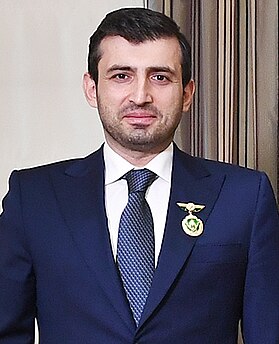
Selçuk Bayraktar is a Turkish engineer and businessman. He is the chief technology officer of Turkish technology company Baykar and the architect of Turkey’s first indigenous and operational unmanned aerial vehicle (UAV) systems. He is also the founding chairman of the Turkish Technology Team Foundation.
Haluk Bayraktar is a Turkish engineer and executive. He is the CEO of Baykar, TUBITAK Board Member and founder and chairman of the board of Turkey Technology Team Foundation and SAHA Istanbul. He is a pioneer of Turkey for autonomous technology efforts which reshaped battlefields and geopolitics which resulted with a change of future warfare doctrines.
The Baykar Bayraktar Kızılelma, is a jet-powered, single-engine, low-observable, supersonic, carrier-capable unmanned fighter aircraft, currently in development by Turkish defence company Baykar. The aircraft is being developed as part of Project MIUS.
The Baykar Bayraktar TB3 is a Turkish medium-altitude long-endurance (MALE) unmanned combat aerial vehicle (UCAV) capable of short-range landing and take-off, produced by Baykar. It is currently being developed due to the lack of aircraft to be deployed on the TCG Anadolu amphibious assault ship. According to the initial plans the ship was expected to be equipped with Lockheed Martin F-35B Lightning II fighter jets but following the removal of Turkey from the procurement program, the vessel entered a modification process to allow it to be able to accommodate UAVs.
p.32 The Panel is aware that two Bayraktar TB2 UCAVs were destroyed by HAF air strikes against the Misrata air academy on 6 and 7 June 2019, with a third shot down by HAF on 30 June 2019, but combat losses have reportedly been much higher
| Wikimedia Commons has media related to Kale-Baykar Bayraktar Tactical . |