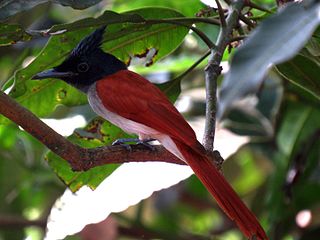
In biological classification, the term subspecies refers to one of two or more populations of a species living in different subdivisions of the species' range and varying from one another by morphological characteristics. A single subspecies cannot be recognized independently: a species is either recognized as having no subspecies at all or at least two, including any that are extinct. The term may be abbreviated to subsp. or ssp. The plural is the same as the singular: subspecies.

Bellis is a genus of flowering plants in the family Asteraceae.

Poa pratensis, commonly known as Kentucky bluegrass, smooth meadow-grass, or common meadow-grass, is a perennial species of grass native to practically all of Europe, North Asia and the mountains of Algeria and Morocco. Although the species is spread over all of the cool, humid parts of the United States, it is not native to North America. The Spanish Empire brought the seeds of Kentucky bluegrass to the New World in mixtures with other grasses. In its native range, Poa pratensis forms a valuable pasture plant, characteristic of well-drained, fertile soil. It is also used for making lawns in parks and gardens and has established itself as a common invasive weed across cool moist climates like the Pacific Northwest and the Northeastern United States. When found on native grasslands in Canada, for example, it is considered an unwelcome exotic plant, and is indicative of a disturbed and degraded landscape.
Mycobacterium avium subspecies paratuberculosis (MAP) is an obligate pathogenic bacterium in the genus Mycobacterium. It is often abbreviated M. paratuberculosis or M. avium ssp. paratuberculosis. It is the causative agent of Johne's disease, which affects ruminants such as cattle, and suspected causative agent in human Crohn's disease and rheumatoid arthritis. The type strain is ATCC 19698.

A botanical name is a formal scientific name conforming to the International Code of Nomenclature for algae, fungi, and plants (ICN) and, if it concerns a plant cultigen, the additional cultivar or Group epithets must conform to the International Code of Nomenclature for Cultivated Plants (ICNCP). The code of nomenclature covers "all organisms traditionally treated as algae, fungi, or plants, whether fossil or non-fossil, including blue-green algae (Cyanobacteria), chytrids, oomycetes, slime moulds and photosynthetic protists with their taxonomically related non-photosynthetic groups ."
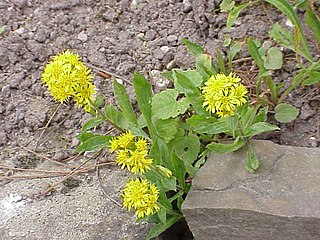
Solidago virgaurea, the European goldenrod or woundwort, is an herbaceous perennial plant of the family Asteraceae. It is widespread across most of Europe as well as North Africa and northern, central, and southwestern Asia. It is grown as a garden flower with many different cultivars. It flowers profusely in late summer.
In botany, an infraspecific name is the scientific name for any taxon below the rank of species, i.e. an infraspecific taxon or infraspecies. The scientific names of botanical taxa are regulated by the International Code of Nomenclature for algae, fungi, and plants (ICN). This specifies a 'three part name' for infraspecific taxa, plus a 'connecting term' to indicate the rank of the name. An example of such a name is Astrophytum myriostigma subvar. glabrum, the name of a subvariety of the species Astrophytum myriostigma.

Dactylis glomerata, also known as cock's-foot, orchard grass, or cat grass (due to its popularity for use with domestic cats) is a common species of grass in the genus Dactylis. It is a cool-season perennial C3 bunchgrass native throughout most of Europe, temperate Asia, and northern Africa.

Eucalyptus leucoxylon, commonly known as yellow gum, blue gum or white ironbark, is a species of small to medium-sized tree that is endemic to south-eastern continental Australia. It has smooth yellowish bark with some rough bark near the base, lance-shaped or curved adult leaves, flower buds in groups of three and cylindrical, barrel-shaped or shortened spherical fruit. A widely cultivated species, it has white, red or pink flowers.

Dactylorhiza incarnata, the early marsh-orchid, is a perennial, temperate-climate species of orchid generally found growing in wet meadows, and generally on base-rich soils, up to about 2100m asl. The species occurs widely in Europe and Asia from Portugal and Ireland east to Siberia and Xinjiang.

Bellis annua, the annual daisy, is a plant species in the genus Bellis. It is native in Europe. This species grow from 3 - 12 centimeters.
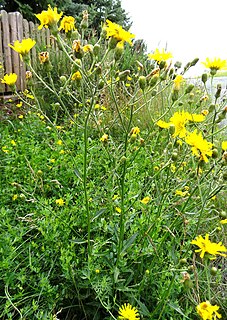
Hieracium laevigatum, or smooth hawkweed, is a Eurasian plant species in the tribe Cichorieae within the family Asteraceae. It is widespread across much of Europe and western Asia. It is very similar to Hieracium sabaudum and can be found on dry, more or less nutrient rich soil in light woods, grassy embankments and fields, or on walls.
Leifsonia xyli subsp. xyli is the bacterium that causes ratoon stunting disease, a major worldwide disease of sugarcane. It is Gram positive and grows slowly in the laboratory.
Vitis heyneana is a species of climbing vine in the grape family endemic to Asia. It can be found in shrubby or forested areas, from almost sea-level, to 3200 meters above. It has globose berries that are purple to almost black.

Felicia bellidioides is a perennial plant of up to about 25 cm (10 in) high, that is assigned to the family Asteraceae. Most of the narrowly inverted egg-shaped leaves are silky hairy and in a basal rosette with no or few very narrow bracts on the stalk in the subspecies bellidioides. In the subspecies foliosa, the narrower leaves are not silky hairy but variously bristly and glandular, with more and larger bracts on the inflorescence stalk. The flowerheads sit individually on top of a long peduncle and consist of an involucre with only two worls of bracts, about twenty purplish blue ray florets, surrounding many yellow disc florets. It occurs in the Western Cape province of South Africa.

Stachys annua, called the annual yellow woundwort, is a widespread species of flowering plant in the hedgenettle genus Stachys, native to Europe, the Middle East, and western Siberia, and introduced in Cyprus, eastern North America, and Amur Oblast and Primorsky Krai in far eastern Russia. It is a common plant in fields, road verges and waste places.
Bellis sylvestris subsp. pappulosa is a species of daisy in the genus Bellis and is a subspecies of Bellis sylvestris.
Bellis annua subsp. microcephala is a species of daisy in the genus Bellis and is a subspecies of Bellis annua. It is endemic to parts of western Europe and north Africa.

