Greer is a city in Greenville and Spartanburg counties in the U.S. state of South Carolina. As of the 2020 census, the population was 35,308, making it the 14th-most populous city in South Carolina. Greer is included in the Greenville-Anderson-Greer, SC Metropolitan Statistical Area, which is part of the Greenville-Spartanburg-Anderson, SC Combined Statistical Area in Upstate South Carolina.

Wofford College is a private residential liberal arts college in Spartanburg, South Carolina, United States. Founded in 1854, it is one of the few four-year institutions in the southeastern United States founded before the American Civil War that still operates on its original campus. The 175-acre (71 ha) campus is a national arboretum.
Converse University is a private university in Spartanburg, South Carolina. It was established in 1889 by a group of Spartanburg residents and named after textile pioneer Dexter Edgar Converse. It was originally a women's college but now admits men.

This is a list of the National Register of Historic Places listings in Spartanburg County, South Carolina.

The South Carolina School for the Deaf and the Blind is a school in unincorporated Spartanburg County, South Carolina, United States, near Spartanburg and with a Spartanburg postal address. It was founded in 1849 by the Reverend Newton Pinckney Walker as a private school for students who were deaf. The School for the Blind was established in 1855, and the school became state funded in 1856.

Arcadia Mills No. 2, now the Mayfair Lofts, is a historic mill building at 100 W. Cleveland St., Spartanburg, South Carolina. It was listed on the National Register of Historic Places in 2005.

Reidville Academy Faculty House is a historic house in Reidville, South Carolina. It was listed on the National Register of Historic Places in 1997.
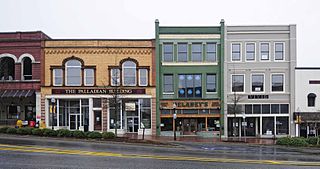
Spartanburg Historic District is a district in downtown Spartanburg, South Carolina It was named to the National Register of Historic Places in 1983. The district was expanded in 2000.

Mountain Shoals Plantation, also known as the James Nesbitt House, is a historic plantation house located at Enoree, Spartanburg County, South Carolina. It was built by 1837, and is a two-story, vernacular Federal style frame residence. It sits on a raised brick basement stuccoed to resemble granite and features a full-width, one-story, front porch. Also located on the property is a contributing well house and a one-story log cabin.

The Bivings-Converse House is a historic house located at 1 Douglas Street near Glendale, Spartanburg County, South Carolina.

Pacolet Mills Historic District is a national historic district in Pacolet, Spartanburg County, South Carolina. It encompasses 126 contributing buildings and 1 contributing site in the mill village of Pacolet. The Pacolet Mills village was laid out and built in 1919, with most worker and supervisor houses constructed between 1915 and 1920. Also located in the district are the Pacolet Mills Cloth Room and Warehouse, Pacolet Mill Office, and two churches. The three main Pacolet Mills and a fourth mill (1894) were demolished in the late 1980s.

Alexander House is a historic house located at 319 East Main Street in Spartanburg, Spartanburg County, South Carolina.

Bishop William Wallace Duncan House, also known as the DuPre House, is a historic home located at Spartanburg, Spartanburg County, South Carolina. It was designed by G. L. Norrman and built about 1886. It is a two-story, asymmetrical, clapboard and cedar shingled dwelling in the Queen Anne style. It has a high-pitched roof pierced by six chimneys, a decorative mosaic tile front porch landing, a massive wood shingle-clad cylindrical tower, and stained glass windows. It was moved from its original location at 249 N. Church St. to its present location in November 1999.

Evins-Bivings House, also known as the Dr. James Bivings House, is a historic home located at Spartanburg, Spartanburg County, South Carolina. It was built about 1854, and is a two-story, white clapboard house in the Greek Revival style. The house features double piazzas with massive Doric order columns and notable balustrades. Also on the property are the original kitchen, slave quarters, smokehouse, and well. It was built by Dr. James Bivings, who founded Glendale Mills.

Nicholls-Crook House is a historic home located near Spartanburg, Spartanburg County, South Carolina. It was built about 1800, and is a 2+1⁄2-story, three-bay, brick Georgian style dwelling. The interior features large fireplaces, an original hand-carved mantel, and a full basement, that was used as domestic slave quarters.
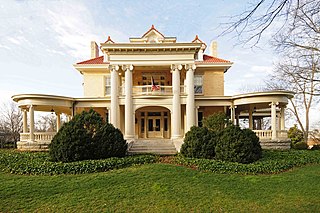
Walter Scott Montgomery House is a historic home located at Spartanburg, Spartanburg County, South Carolina. It was designed by architect George Franklin Barber and built in 1909. It is a 2+1⁄2-story, frame, yellow brick-veneer residence in the Colonial Revival style. building is of frame construction with a yellow brick veneer and a red tile roof. It features a distinctive portico and leaded glass windows. Also on the property is a one-story, reinforced concrete auto garage.

Cleveland Law Range is a historic office building located at Spartanburg, Spartanburg County, South Carolina. It was built in 1898–1899, and is a three-story, Richardsonian Romanesque style brick building. It features five arched bays on the ground floor, with repeated bay arrangements on the second and third floors. Three South Carolina governors maintained offices in the Cleveland Law Range: James F. Byrnes, John Gary Evans, and Donald S. Russell.
Palmetto Theater was a historic movie theater located at Spartanburg, Spartanburg County, South Carolina. It was built in 1940–1941, and was a one-story, rectangular plan brick building. It featured a large marquee and a separate shop storefront decorated in blue Carrera-glass panels. The interior featured double balconies, Terrazzo flooring, large Art Deco light fixtures, decorative wall painting, and a plaster Art Deco screen surround.

Fremont School, also known as Freemont School, is a historic elementary school building located in Spartanburg, Spartanburg County, South Carolina. It was built in 1915, and is a two-story, brick Classical Revival style building with a partially raised basement, and a major addition built in 1926. It features decorative brickwork, terra cotta ornamentation, and entrance porticoes. The building housed an elementary school from 1915 to 1979.

The Wilkins House is a historic house in Greenville, South Carolina, built in 1878 by Jacob W. Cagle (1832–1910) for merchant and capitalist William T. Wilkins (1825–1895). It was listed on the National Register of Historic Places on July 19, 2016.