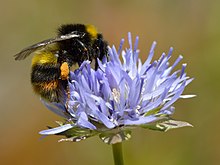
The early bumblebee or early-nesting bumblebee is a small bumblebee with a wide distribution in most of Europe and parts of Asia. It is very commonly found in the UK and emerges to begin its colony cycle as soon as February which is earlier than most other species, hence its common name. There is even some evidence that the early bumblebee may be able to go through two colony cycles in a year. Like other bumblebees, Bombus pratorum lives in colonies with queen and worker castes. Bombus pratorum queens use aggressive behavior rather than pheromones to maintain dominance over the workers.

The tree bumblebee or new garden bumblebee is a species of bumblebee common in the European continent and parts of Asia. Since the start of the twenty-first century, it has spread to Great Britain. These bumblebees prefer habitats that others do not, allowing them to pollinate flowers in areas that many other species do not get to.

Bombus barbutellus, or Barbut's cuckoo-bee, is a species of cuckoo bumblebee, widespread, if not especially common, in most of Europe.

Bombus vestalis, the vestal cuckoo bumblebee, is a species of cuckoo bumblebee that lives in most of Europe, as well as North Africa and western Asia. It is a brood parasite that takes over the nests of other bee species. Its primary host is Bombus terrestris. After its initial classification as Psithyrus vestalis, this bumblebee recently was reclassified into the genus Bombus, subgenus Psithyrus.

Bombus campestris is a very common cuckoo bumblebee found in most of Europe.
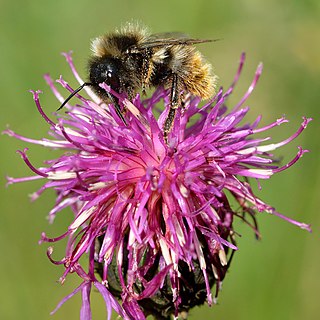
Bombus rupestris is a species of cuckoo bumblebee present in most of Europe except Iceland. In the Balkans it is found in montane and alpine habitats northwards from Central Greece. It is also found in Turkey.

Bombus sylvestris, known as the forest cuckoo bumblebee or four-coloured cuckoo bee, is a species of cuckoo bumblebee, found in most of Europe and Russia. Its main hosts are Bombus pratorum, Bombus jonellus, and Bombus monticola. As a cuckoo bumblebee, Bombus sylvestris lays its eggs in another bumblebee's nest. This type of bee leaves their young to the workers of another nest for rearing, allowing cuckoo bumblebees to invest minimal energy and resources in their young while still keeping the survival of their young intact.

Bombus bohemicus, also known as the gypsy's cuckoo bumblebee, is a species of socially parasitic cuckoo bumblebee found in most of Europe with the exception of the southern Iberian Peninsula and Iceland. B. bohemicus practices inquilinism, or brood parasitism, of other bumblebee species. B. bohemicus is a generalist parasite, successfully invading several species from genus Bombus. The invading queen mimics the host nest's chemical signals, allowing her to assume a reproductively dominant role as well as manipulation of host worker fertility and behavior.

Bombus monticola, the bilberry bumblebee, blaeberry bumblebee or mountain bumblebee, is a species of bumblebee found in Europe.
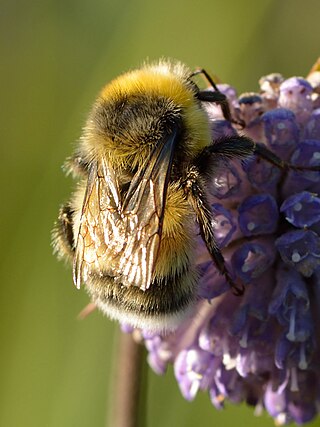
The heath humble-bee or small heath bumblebee, Bombus jonellus, is a species of bumblebee, widely distributed in Europe and northern Asia, as well as northern North America.

Bombus hortorum, the garden bumblebee or small garden bumblebee, is a species of bumblebee found in most of Europe north to 70°N, as well as parts of Asia and New Zealand. It is distinguished from most other bumblebees by its long tongue used for feeding on pollen in deep-flowered plants. Accordingly, this bumblebee mainly visits flowers with deep corollae, such as deadnettles, ground ivy, vetches, clovers, comfrey, foxglove, and thistles. They have a good visual memory, which aids them in navigating the territory close to their habitat and seeking out food sources.

Bombus lucorum, the white-tailed bumblebee, is a species of bumblebee, widespread and common throughout Europe. This name has been widely used for a range of nearly identical-looking or cryptic species of bumblebees. In 1983, Scholl and Obrecht even coined the term Bombus lucorum complex to explain the three taxa that cannot be easily differentiated from one another by their appearances. A recent review of all of these species worldwide has helped to clarify its distribution in Europe and northern Asia, almost to the Pacific. B. lucorum reaches the Barents Sea in the North. However, in southern Europe, although found in Greece it is an upland species with its distribution never quite reaching the Mediterranean.

Bombus ruderarius, commonly known as the red-shanked carder bee or red-shanked bumblebee, is a species of bumblebee found in Eurasia.

Bombus argillaceus is a bumblebee species of the subgenus Megabombus, distributed from south and south-eastern Europe to western Asia.

Bombus centralis, the central bumblebee, is a species of bumble bee found in parts of Canada and the western United States. The species was first described by Ezra Townsend Cresson in 1864.

Bombus sitkensis, the Sitka bumblebee, is a species of bumblebee common in western North America from Alaska to California.
The apple humble-bee or apple bumblebee is a species of bumblebee.

Bombus flavifrons, the yellow-fronted bumble bee or yellowhead bumblebee, is a species of bumblebee. It is native to North America, where it is distributed across much of Canada, Alaska, and the western contiguous United States.
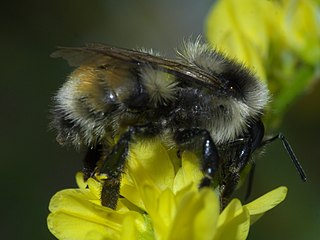
Bombus bifarius, the two-form bumblebee, is a species of eusocial bumblebee of the subgenus Pyrobombus. B. bifarius inhabits mountainous regions of western North America, primarily the states of Colorado and Utah. Its common name refers to a historical artifact, in that it was believed that this species had a color polymorphism, with a red-tailed nominate form and a black-tailed nearcticus form, present in the species. This polymorphism has recently been shown to belong instead to a cryptic sister species, Bombus vancouverensis, that occupies almost the entirety of the range of what was formerly classified as bifarius; true bifarius only has a red form, so it is not "two-formed" at all.

Bombus vancouverensis, the Vancouver Island Bumblebee, is a common species of eusocial bumblebee of the subgenus Pyrobombus. B. vancouverensis inhabits mountainous regions of western North America, where it has long been considered as a synonym of Bombus bifarius, and essentially all of the literature on bifarius refers instead to vancouverensis. B. vancouverensis has been identified as one of the two species of bumblebee observed to use pheromones in kin recognition. The other is the frigid bumblebee, Bombus frigidus.