Frangula californica is a species of flowering plant in the buckthorn family native to western North America. It produces edible fruits and seeds. It is commonly known as California coffeeberry and California buckthorn.

Ceanothus arboreus is a species of perennial shrub to small tree in the family Rhamnaceae, commonly known as the feltleaf ceanothus, island ceanothus, and island mountain lilac. It is the largest member of the California lilacs, and is characterized with glossy, dark green foliage that is adorned by pale blue to white flowers in bloom. It is endemic to the Channel Islands of California and Guadalupe Island in Mexico, only being re-discovered on Guadalupe Island after the elimination of feral goats.

Ceanothus papillosus, the wartleaf ceanothus, is a species of plant in the genus Ceanothus. It is endemic to California, where it grows in open habitat on the slopes of the coastal mountain ranges, such as woodland and chaparral.
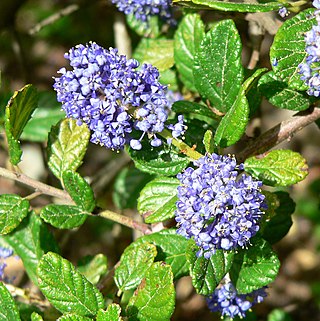
Ceanothus griseus is a species of flowering shrub known by the common names Carmel ceanothus and Carmel creeper. 'Carmel' refers to the Carmel-by-the-Sea region in California.
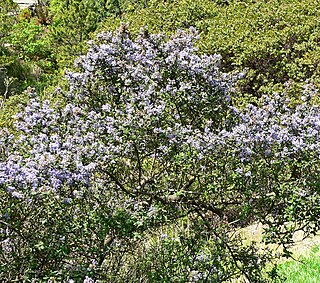
Ceanothus impressus is a species of shrub in the family Rhamnaceae known by the common name Santa Barbara ceanothus. It is endemic to the Central Coast of California, where it is known from San Luis Obispo and Santa Barbara Counties. It occurs in chaparral habitat.

Ceanothus ophiochilus is a rare species of flowering shrub known by the common name Vail Lake ceanothus, native to Southern California. It was not described until 1991.

Ceanothus confusus is a species of shrub in the family Rhamnaceae known by the common name Rincon Ridge ceanothus. It is endemic to northern California where it grows in the coastal mountains north of the San Francisco Bay Area. Its habitats include coniferous forest, woodland, and chaparral. This is a low, spreading shrub often forming a short mat up to about 1.2 meters wide. The stem is gray-brown with new twigs having a reddish color and fuzzy texture. The evergreen leaves are oppositely arranged. Each is up to 2 centimeters long and oval in shape with 3 to 5 large teeth. The upper surface is shiny green and the underside is paler and feltlike in texture with hairs along the veins. The inflorescence is a small cluster of blue or purple flowers. The fruit is a horned capsule about half a centimeter wide.

Ceanothus pauciflorus, known by the common name Mojave ceanothus, is a species of flowering shrub in the buckthorn family, Rhamnaceae. It is native to the Southwestern United States and Mexico, where it grows primarily in shrubland communities at moderate to high elevations. It is characterized by oppositely arranged leaves, corky stipules and white flowers. It was formerly known as Ceanothus greggii.

Ceanothus jepsonii is a species of shrub in the family Rhamnaceae known by the common names musk brush and Jepson ceanothus.
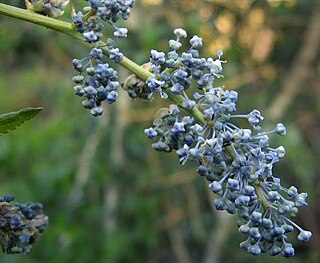
Ceanothus leucodermis, with the common names chaparral whitethorn or chaparral white thorn, is a species of shrub in the family Rhamnaceae. This Ceanothus is an importance browse for several types of ungulate, such as the mule deer and bighorn sheep, who prefer the new growth and shoots to the older, spiny parts.

Ceanothus masonii is a species of shrub in the buckthorn family, Rhamnaceae, known by the common name Mason's ceanothus. It is endemic to Marin County, California, where it is known only from an area near Bolinas on the Point Reyes National Seashore. It grows in the coastal chaparral on the windblown bluffs..
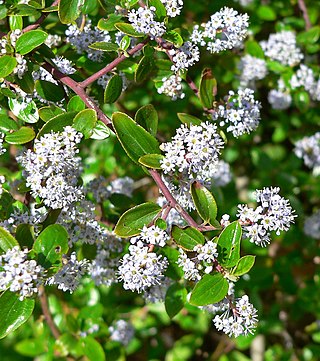
Ceanothus oliganthus is a species of shrub in the family Rhamnaceae known by the common name hairy ceanothus or hairy-leaf ceanothus.

Ceanothus parryi, with the common name Parry ceanothus, is a species of shrub in the buckthorn family Rhamnaceae. It is native to Oregon and northern California, where it grows in the canyons of coastal mountain ranges.
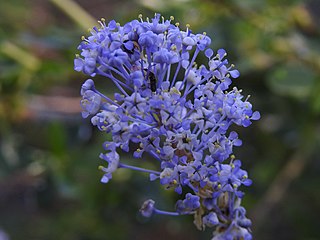
Ceanothus parvifolius is a species of shrub in the family Rhamnaceae known by the common name littleleaf ceanothus or littleleaf whitethorn. This deciduous plant is characterized by its blue flowers and flat topped habit, and is endemic to the Sierra Nevada of California, where it grows on mountain flats and coniferous forest.

Ceanothus pumilus is a species of shrub in the family Rhamnaceae known by the common names dwarf ceanothus and Siskiyou mat.

Ceanothus velutinus, with the common names snowbrush ceanothus, red root, tobacco brush, and sticky laurel, is a species of shrub in the family Rhamnaceae. It is native to western North America from British Columbia to California to Colorado.

Ceanothus verrucosus is a species of shrub in the family Rhamnaceae known by the common names wart-stem ceanothus, barranca brush, coast lilac and white coast ceanothus. It is endemic to northwestern Baja California and San Diego County, where it grows in coastal sage scrub and coastal succulent scrub habitats. It is considered a rare species north of the international border, as most of the valuable coastal land that hosts this plant in the San Diego area has been claimed for development. In California, several extant populations still remain scattered around the region, such as one protected at Torrey Pines.
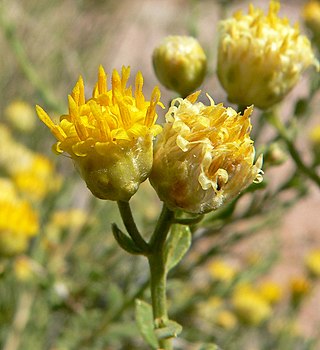
Acamptopappus sphaerocephalus is a species of flowering plant in the family Asteraceae known by the common name rayless goldenhead. It is native to the southwestern United States, where it occurs in southern California, southern Nevada, southern Utah, and Arizona.

Ericameria paniculata is a species of flowering plant in the sunflower family Asteraceae, native to the southwestern United States. It is an evergreen yellow-flowered desert shrub.
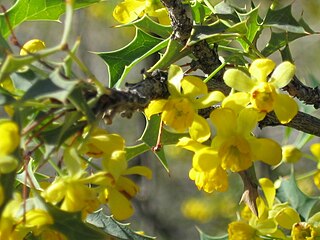
Berberis harrisoniana is a rare species of flowering plant in the barberry family, Berberidaceae. It is known by the common names Kofa barberry, Kofa Mountain barberry, Harrison's barberry, and red barberry.