Chief of the General Staff (Bundesheer)

Last updated
Chief of the General Staff of the Bundesheer
Chef des Generalstabes des Bundesheeres
Roundel of Austria.svg
Roundel of Austria
Robert Brieger in 2019.jpg
Incumbent
Robert Brieger

since 24 July 2018
General staff of the Bundesheer
Ministry of Defense
Style Mr. Chief of the General Staff
(formal)
StatusHead of a general staff
Member ofGeneral staff
Reports to Minister of Defense
Seat Rossauer Barracks, Innere Stadt, Vienna
PrecursorChief of the Austro-Hungarian General Staff
First holder Rudolf Vidossich
as Army Inspector of the Bundesheer (1922)

The Chief of the General Staff is the head of the General Staff of the Bundesheer (which is the professional leadership of the Austrian Armed Forces).

Austrian Armed Forces combined military forces of Austria

The Austrian Armed Forces are the military forces of the Republic of Austria and the main military organisation responsible for the national defence.

Contents

List of chiefs of the general staff

Army Inspectors (1922–1937)

Army InspectorTook officeLeft officeTime in office
1
Rudolf Vidossich.jpg
Vidossich, RudolfOberstbrigadier
Rudolf Vidossich
(1872–1929)
192219230–1 years
2
TheodorKorner18731957L1110247 (3).jpg
Körner, TheodorMajor General
Theodor Körner
(1873–1957)
[lower-alpha 1]
192319240–1 years
3
Blank.png
Schneider, JosefMajor General
Josef Schneider
1924December 19240 years
4
Blank.png
Buzek, ThomasGeneral
Thomas Buzek
January 192519260–1 years
5
Blank.png
Schilhawsky, RichardGeneral
Richard Schilhawsky
(1879–1960)
192619292–3 years
6
General Ludwig v. Eimannsberger.jpg
Schilhawsky, RichardGeneral
Ludwig von Eimannsberger  [ de ]
(1878–1945)
192919300–1 years
7
Bundesarchiv Bild 102-09307, Sigmund Knaus.jpg
Knaus, SiegmundGeneral of the Infantry
Siegmund Knaus
(1879–1971)
193019321–2 years
8
Blank.png
Schilhawsky, SigismundGeneral of the Infantry
Sigismund Schilhawsky
193219374–5 years

General Inspector of Troops (1937–1938)

General Inspector of TroopsTook officeLeft officeTime in office
1
Blank.png
Bahnbrück, SigismundGeneral of the Infantry
Sigismund Ritter Schilhawsky von Bahnbrück
(1881–1957)
193712 March 19380–1 years

Chiefs of the General Staff (1936–1938)

Chief of the General StaffTook officeLeft officeTime in office
1
Blank.png
Jansa, AlfredLieutenant field marshal
Alfred Jansa
(1884–1963)
[lower-alpha 2]
1 April 193612 February 19381 year, 317 days
2
Bundesarchiv Bild 183-J21813, Franz Bohme.jpg
Böhme, FranzMajor General
Franz Böhme
(1885–1947)
[lower-alpha 3]
12 February 193812 March 193828 days

General Inspectors of Troops (1956–2002)

General Inspectors of TroopsTook officeLeft officeTime in office
1
Blank.png
Fussenegger, ErwinGeneral
Erwin Fussenegger  [ de ]
(1908–1986)
31 August 195616 December 197014 years, 107 days
2
Blank.png
Seitz, OttoGeneral of the Infantry
Otto Seitz (general)  [ de ]
(1911–1974)
1 January 197130 November 1971349 days
3
Blank.png
Leeb, AntonGeneral of the Infantry
Anton Leeb  [ de ]
(1913–2008)
30 November 197131 December 19776 years, 31 days
4
Blank.png
Wingelbauer, HubertGeneral of the Infantry
Hubert Wingelbauer  [ de ]
(1915–1987)
1 January 197831 December 19803 years, 0 days
5
Blank.png
Scharff, HeinzGeneral
Heinz Scharff  [ de ]
(1920–2014)
1 January 198131 December 19866 years, 0 days
6
Blank.png
Tauschitz, OthmarGeneral
Othmar Tauschitz
1 January 19871 October 19904 years, 273 days
7
Blank.png
Majcen, KarlGeneral
Karl Majcen  [ de ]
(born 1934)
1 October 199020 December 19999 years, 80 days
8
Blank.png
Pleiner, HorstGeneral
Horst Pleiner  [ de ]
(born 1941)
1 January 20001 December 20022 years, 334 days

Chiefs of the General Staff (2002–present)

Chief of the General StaffTook officeLeft officeTime in officeRef
1
Blank.png
Ertl, RolandGeneral
Roland Ertl  [ de ]
(born 1945)
1 December 200230 November 20074 years, 364 days
2
Edmund Entacher.jpg
Entacher, EdmundGeneral
Edmund Entacher  [ de ]
(born 1949)
30 November 200724 January 20113 years, 55 days
-
Gala-Nacht des Sports 2013 Wien red carpet Othmar Commenda.jpg
Commenda, OthmarLieutenant General
Othmar Commenda
(born 1954)
Acting
24 January 20117 November 2011287 days
(2)
Edmund Entacher.jpg
Entacher, EdmundGeneral
Edmund Entacher  [ de ]
(born 1949)
7 November 201123 March 20131 year, 136 days [1]
3
Gala-Nacht des Sports 2013 Wien red carpet Othmar Commenda.jpg
Commenda, OthmarGeneral
Othmar Commenda
(born 1954)
22 May 201324 July 20185 years, 63 days
4
Robert Brieger in 2019.jpg
Brieger, RobertMajor general
Robert Brieger
(born 1955)
24 July 2018Incumbent247 days [2]

See also

Austro-Hungarian General Staff

The Imperial and Royal General Staff of Austria-Hungary was part of the Ministry of War. It was headed by the Chief of the General Staff for the Whole Armed Forces, who had direct access to the Emperor.

Minister of War (Austria-Hungary) Ministers of War

The Imperial and Royal Minister of War, until 1911: Reich Minister of War (Reichskriegsminister), was the head of one of the three common ministries shared by the two states which made up the dual monarchy of Austria-Hungary from its creation in the Compromise of 1867 until its dissolution in 1918.

The Austrian Minister of Defence was head of the Ministerium für Landesverteidigung or Landwehrministerium. It was set up in 1868 with responsibility for the armed forces and militia in the Cisleithanian half of the Dual Monarchy of Austria-Hungary, effectively what is now Austria. It was succeeded in 1918 by the Ministry of Defence of the First Austrian Republic.

Notes

  1. Later served as the President of Austria from 1951 to 1957.
  2. Dismissed according to paragraph 8 of the Berchtesgaden agreement of 12 February 1938.
  3. Appointed according to paragraph 8 of the Berchtesgaden agreement of 12 February 1938.

Related Research Articles

Turkish Armed Forces Combined military forces of Turkey

The Turkish Armed Forces are the military forces of the Republic of Turkey. They consist of the Army, the Navy and the Air Force. The Gendarmerie and the Coast Guard, both of which have law enforcement and military functions, operate as components of the internal security forces in peacetime, and are subordinate to the Ministry of Interior. In wartime, they are subordinate to the Army and Navy. The President of Turkey is the military's overall head.

Commander-in-chief supreme commanding authority of a military

A commander-in-chief, sometimes also called supreme commander, is the person that exercises supreme command and control over an armed forces or a military branch. As a technical term, it refers to military competencies that reside in a country's executive leadership – a head of state or a head of government.
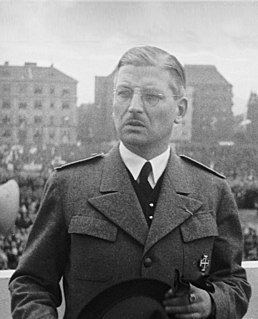
Kurt Schuschnigg Chancellor of Austria

Kurt Alois Josef Johann Schuschnigg was an Austrofascist politician who was the Chancellor of the Federal State of Austria from the 1934 assassination of his predecessor Engelbert Dollfuss until the 1938 Anschluss with Nazi Germany. Although Schuschnigg accepted that Austria was a "German state" and that Austrians were Germans, he was strongly opposed to Adolf Hitler's ambitions to absorb Austria into the Third Reich and wished for it to remain independent.

Following the termination of hostilities in World War II, the Allies were in control of the defeated Axis countries. Anticipating the defeat of Germany and Japan, they had already set up the European Advisory Commission and a proposed Far Eastern Advisory Commission to make recommendations for the post war period. Accordingly, they managed their control of the defeated countries through Allied Commissions, often referred to as Allied Control Commissions (ACC), consisting of representatives of the major Allies.
Timeline of events preceding World War II timeline

This timeline of events preceding World War II covers the events of the interwar period (1918–1939) after World War I that affected or led to World War II.

Feldmarschalleutnant Alfred Johann Theophil Jansa von Tannenau, was an Austrian Army Officer.

Edmund Glaise-Horstenau Austrian officer in the Austro-Hungarian Army, last Vice-Chancellor of Austria before the 1938 Anschluss, a military historian and archivist, and general in the German Wehrmacht during the Second World War

Edmund Glaise-Horstenau was an Austrian officer in the Austro-Hungarian Army, last Vice-Chancellor of Austria before the 1938 Anschluss, a military historian and archivist, and general in the German Wehrmacht during the Second World War.

Chief of the Romanian General Staff

The Chief of General Staff is the highest professional military authority in the Romanian Armed Forces. He is appointed by the President of Romania, at the National Defense Minister’s proposal on a four-year period, with the possibility of one year extension. The Deputy Chief of General Staff or one of the Chiefs of the Services can be appointed in this position.

Hungary in World War II

During World War II, the Kingdom of Hungary was a member of the Axis powers. In the 1930s, the Kingdom of Hungary relied on increased trade with Fascist Italy and Nazi Germany to pull itself out of the Great Depression. Hungarian politics and foreign policy had become more stridently nationalistic by 1938, and Hungary adopted an irredentist policy similar to Germany's, attempting to incorporate ethnic Hungarian areas in neighboring countries into Hungary. Hungary benefited territorially from its relationship with the Axis. Settlements were negotiated regarding territorial disputes with the Czechoslovak Republic, the Slovak Republic, and the Kingdom of Romania. In 1940, under pressure from Germany, Hungary joined the Axis powers. The following year, Hungarian forces participated in the invasion of Yugoslavia and the invasion of the Soviet Union.

Order of Saint Stephen of Hungary order of knighthood founded by Holy Roman Empress Maria Theresa in 1764

The Order of Saint Stephen was an order of knighthood founded by Maria Theresa in 1764. In 1938, Miklós Horthy took the rights and activities of Grand Master as Regent of Hungary. The name of the Order changed to The Royal Hungarian Order of Saint Stephen. The Order was terminated at the time of the proclamation of the Republic of Hungary in 1946. It was recreated in 2011 as the Hungarian Order of Saint Stephen, and to this day remains the highest order in Hungary.

1938 (MCMXXXVIII) was a common year starting on Saturday of the Gregorian calendar, the 1938th year of the Common Era (CE) and Anno Domini (AD) designations, the 938th year of the 2nd millennium, the 38th year of the 20th century, and the 9th year of the 1930s decade.

Chief of defence highest ranked commissioned officer of a nations armed forces

The chief of defence is the highest ranked commissioned officer of a nation's armed forces. The term CHOD is in common use within NATO and the European Union as a generic term for the highest national military position within the NATO and EU member states, rather than the actual term used for individual positions. Thus, irrespective if the formal national designation of that position is some variation on Commander-in-Chief, Chief of Staff, Supreme Commander or something else, they can all be referred to unambiguously as CHODs in NATO and EU terminology, although other terms are sometimes also seen within NATO. Thus, the Chairman of the Joint Chiefs of Staff is the CHOD of the United States, the Chief of the Defence Staff is the CHOD of United Kingdom, and the Chief of Defence (Forsvarssjefen) is the CHOD of Norway.
Romanian Armed Forces armed forces of Romania

The Land Forces, Air Force and Naval Forces of Romania are collectively known as the Romanian Armed Forces. The current Commander-in-chief is General Nicolae Ionel Ciuca who is managed by the Minister of National Defence while the president is the Supreme Commander of the Armed Forces during wartime.
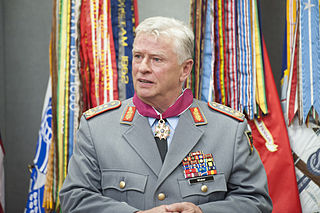
Volker Wieker German general

Volker Wieker is the former Chief of Staff of the Bundeswehr, the German armed forces, and a general of the German Army. Trained as an artillery officer, Wieker served in every major foreign Bundeswehr deployment since 1996, including Bosnia, Kosovo and Afghanistan.
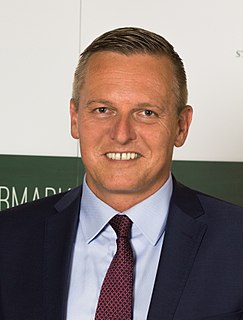
Ministry of Defense (Austria) Austrian ministry responsible for military and defence

The Ministry of Defense of Austria is the ministry in charge of all matters relating to military affairs, especially the Austrian Armed Forces. Its current minister is Mario Kunasek (FPÖ).

Events in the year 1938 in Germany.

Godesberg Memorandum

The Godesberg Memorandum is a document issued by Adolf Hitler in the early hours of 24 September 1938 concerning the Sudetenland and amounting to an ultimatum addressed to the government of Czechoslovakia.

Royal Hungarian Army 1922-1945 land warfare branch of Hungarys military

The Royal Hungarian Army was the name given to the land forces of the Kingdom of Hungary in the period from 1922 to 1945. Its name was inherited from the Royal Hungarian Honvéd which went under the same Hungarian title of Magyar Királyi Honvédség from 1867 to 1918. Initially restricted by the Treaty of Trianon to 35,000 men, the army was steadily upgraded during the 1930s and fought on the side of the Axis powers in the Second World War.
Supreme Commander of the Imperial and Royal Armed Forces group of humans

The Supreme Commander of the Imperial and Royal Armed Forces was the ultimate authority of the Austro-Hungarian Armed Forces – which comprised the Army, Navy and Aviation Troops of Austria-Hungary.

References

  1. "Entacher wird in den Ruhestand verabschiedet". BVZ (in German). 22 March 2013. Retrieved 21 July 2018.
  2. Editor. "Commendas Nachfolger als Generalstabschef steht fest". ORF (in German). Retrieved 21 July 2018.