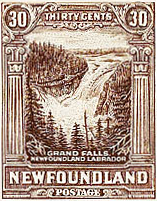
Rather than a single large dam, the plant's reservoir is contained by 88 dikes, totalling 64 km in length. The Smallwood Reservoir has a capacity of 33 cubic kilometres in a catchment area of about 72,000 square kilometres, an area larger than the Republic of Ireland. It drops over 305 metres to the site of the plant's 11 turbines.
The plant's power house was hewn from solid granite 300 metres underground. It is about 300 metres long and as high as a 15-story building.[1]
Originally called the Mishta-shipu (Big River) by the Innu,[2] in 1821 the river was called Hamilton by Captain William Martin of HMS Clinker, after Sir Charles Hamilton the governor of Newfoundland from 1818 to 1823. The waterfall itself was called Grand Falls. In 1965, after the death of Winston Churchill the falls, river, town, and generating station were all renamed again.[2]
In 1915, Wilfred Thibaudeau surveyed the Labrador Plateau. He designed a channel scheme to divert water before it arrived at the falls. The scheme would use the natural capacity of the drainage basin, which covers over 23,300mi2 (60,000km2), eliminating the need for the construction of dams. The advantage of the site was the river's drop of more than 300 metres in less than 32 km, and steady supply of water. These findings were confirmed in a 1947 survey, but development did not proceed due to the remoteness of the site and the distance from markets for the power.[3]
Canada is a federation where legal authority is split between the federal and provincial governments; natural resources such as lumber, petroleum, and inland waterways are under the jurisdiction of provincial, rather than the federal government.[5] Since Labrador had no internal market for the power, the Government of Newfoundland had to negotiate with neighbouring Quebec to export the energy. Controversy over the location of the international border on the Labrador Peninsula added to the difficulties of negotiating between Newfoundland and Quebec. A country at the time, Newfoundland disputed the border location with the Government of Canada. The Judicial Committee of the Privy Council in the United Kingdom ruled in favour of the Dominion of Newfoundland in 1927,[6] an unpopular judgment in Quebec. A member of the Legislative Assembly of Quebec, Jacques Dumoulin, stated that for Canada the best judges are Canadians.[7] The Quebec government did not accept this judgement as seen by borders on maps issued in 1939 by the Quebec Ministry of Energy and Natural Resources. Certain newspapers called for a takeover of the territory.[8]
BRINCO could not get funding for the generating station without a guaranteed market for its power. In 1963, Quebec nationalized all of its hydro-electric facilities, and proposed to Newfoundland that it do the same with the Hamilton Falls project, which Premier Joey Smallwood refused.[6] BRINCO explored alternatives to sending the electricity to neighbouring Quebec, including sending it to New Brunswick and asking for federal intervention. This proposal was known as the Anglo-Saxon route(fr).[11] However, the only practical solution was to negotiate an agreement with Quebec. By 1969, after 16 years of attempts to finance the project, BRINCO was in dire financial straits whereas Quebec was flush with money, further strengthening Quebec's negotiating position. In the end BRINCO would sell 90 percent of the power to Hydro Quebec, at a fixed price, over 40 years renewable for a further 25.[12]
At the time BRINCO was praised for having built the station with no public money from Newfoundland, while Hydro-Québec assumed nearly all the financial risk. It is unlikely that BRINCO would have found other investors willing to take on that risk.[12] In 1981, it made a good return on the investment at almost no risk.[6]
Construction
Churchill Falls as it appeared in 2008, four decades after the water was redirected.
Construction started in July 1967, at the time the largest civil engineering project ever undertaken in North America[13] and the largest underground power station in the world.
After five years of non-stop work by 6,300 workers, the first two generating units began delivering power in 1971, almost half a year ahead of schedule.[14] In 1974, the station went into full-time production.[13]
Technical characteristics
One of the main turbines of the station during repairs
The drainage area for the Churchill River includes much of western and central Labrador. Ossokmanuan Reservoir, originally developed as part of the Twin Falls Power System also drains into this system. Churchill River's natural drainage area covers over 60,000km2 (23,000sqmi). Dyking Orma and Sail lakes brought the total to 72,000km2 (28,000sqmi). Studies showed this drainage area collected 410mm (16in) of rainfall plus 391cm (154in) of snowfall annually equalling 12.5mi3 (52km3) of water per year; more than enough to meet the project's needs.
Total natural drop of the water starting at Ashuanipi Lake and ending at Lake Melville is 1,735ft (529m). As a comparison, the water starting 30km (19mi) upriver until it enters the power plant drops over 1,000ft (300m).
The machine hall, hewn from solid granite, is almost 300m (980ft) underground. The 1,800,000 cubic metres of rock excavated was used in roads, building the town site, and as dike material. The hall is about 300m (980ft) long, up to 25m (82ft) wide and about 50m (160ft) high. It houses 11 generating units. The Francis turbine wheels are cast of stainless steel and weigh 73 tonnes each.
Water is contained by a reservoir created not by a single large dam, but by a series of 88 dikes that have a total length of 64km (40mi). The reservoir, later known as Smallwood Reservoir, covers 5,700km2 (2,200sqmi) and can contain more than 28km3 (1trillionft3) of water.
The Government of Newfoundland and Labrador has unsuccessfully challenged the 1969 contract in court. In November 2018, the Supreme Court of Canada rejected a bid to force Hydro-Québec to reopen the contract before 2041, deciding that the high profits of Hydro-Québec did not justify re-opening the contract. The majority decision held that the unforeseeability of future energy price increases was a risk that the CFLCo had assumed when the contract was signed and the court could not force the parties to re-open the contract. Gascon additionally said that unforeseeability would justify overturning the contract only if it made the contract less beneficial to one party and not in this case, where it merely made the contract more beneficial to one party (Hydro-Québec).[15][16][Falls (Labrador) Corp. v. Hydro‑Québec], 2018 SCC 37238, 428 DLR (4th) 1, AZ-51540971, [2018] EXP 2950, EYB 2018-303592, [2018] SCJ No 46 (QL), Canada
In 2019, Quebec's highest court, the Quebec Court of Appeal ruled that Hydro-Quebec's right to sell Churchill Falls energy had a monthly cap, simplifying the management of water resources for the Lower Churchill Project's Muskrat Falls station.[17]
In December 2024, Newfoundland premier Andrew Furey and Quebec premier François Legault signed a 50-year memorandum of understanding renegotiating the contract. If ratified by both provinces, the rates Hydro-Quebec pays for Churchill Falls electricity would rise by 2,850% and Quebec would pay Newfoundland and Labrador Hydro $3.5 billion for co-development rights for two anticipated Churchill River energy projects. At the press conference announcing the deal, Furey symbolically tore up a copy of the 1969 agreement.[18]
Legal cases brought forward by the Innu Nation
The Churchill Falls hydroelectric plant development was undertaken in the absence of any agreement with the Innu people, but has resulted in significant[clarification needed] damage to their traditional territory. The plant caused flooding of over 5,000km2 (1,900mi2), which damaged the habitats of many[quantify] animals, disrupted caribou migratory routes, and drowned wildlife such as beavers.[19] Furthermore, Innu burial sites and hunting grounds were destroyed, causing irreparable damage to the traditions and livelihoods of the Innu people.[20] A 2016 study commissioned by the Nunatsiavut government — the government of the Labrador Inuit — concluded that the flooding produced methylmercury and could contaminate the local water, food sources, and health of the Innu in the region.[21] These negative impacts may infringe on the aboriginal rights and treaty rights of the Innu people.[19]
In February 2010, the government of Newfoundland and Labrador and the Innu Nation initialed an agreement to compensate for the negative impacts of the Churchill Falls plant. The agreement offered the Labrador Innu hunting rights within 34,000km2 (13,000mi2) of land, plus $2 million annually in compensation from Nalcor Energy.[22]
In October 2020, the Innu Nation of Labrador filed a $4 billion claim against Hydro-Québec through the Supreme Court of Newfoundland and Labrador.[23] The amount represents approximately 5% of Hydro-Quebec's estimated $80 billion profits over the 50 years that the hydroelectric plant has been in operation.[24] Furthermore, the Innu Nation have united with First Nations in Canada and the United States to oppose Hydro-Québec's planned transmission line to Massachusetts. A large portion of the energy for this project would be generated in the Churchill Falls hydroelectric plant.[25]
The timing of this lawsuit comes as the Innu Nation seeks to formalize a land claims agreement with the Government of Canada.[26]
↑Martin, Melanie (2006). "The 1969 Contract". Heritage Newfoundland and Labrador. Archived from the original on December 21, 2025. Retrieved December 21, 2025.
This page is based on this Wikipedia article Text is available under the CC BY-SA 4.0 license; additional terms may apply. Images, videos and audio are available under their respective licenses.