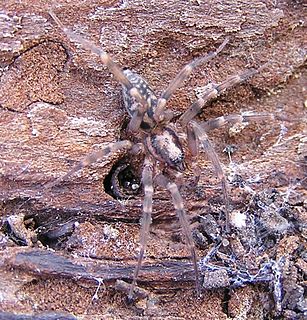
Liocranidae is a family of araneomorph spiders first described by Eugène Simon in 1897. They are one of several groups called "sac spiders". The holarctic genus Agroeca is the best-known, but it also includes various genera of more obscure spiders that still lack a diagnosis. Two species in the North American genus Neoanagraphis are found in the extremely dry conditions in the Mojave, Sonoran and Chihuahuan deserts. Females live in animal burrows while males wander and are the ones most often caught in pitfall traps.

Myrmarachne is a genus of ant-mimicking jumping spiders that was first described by W. S. MacLeay in 1839. They are commonly called antmimicking spiders, but they are not the only spiders that have this attribute. The name is a combination of Ancient Greek μύρμηξ (myrmex), meaning "ant", and ἀράχνη (arachne), meaning "spider".

Gasteracantha is a genus of orb-weaver spiders first named by Carl Jakob Sundevall in 1833. The females of most species are brightly colored with six prominent spines on their broad, hardened, shell-like abdomens. The name Gasteracantha is derived from the Greek gaster (γαστήρ), meaning "belly, abdomen", and akantha (άκανθα), meaning "thorn, spine". Spiny-backed orb-weavers are sometimes colloquially called "crab spiders" because of their shape, but they are not closely related to the true crab spiders. Other colloquial names for certain species include thorn spider, star spider, kite spider, or jewel spider.
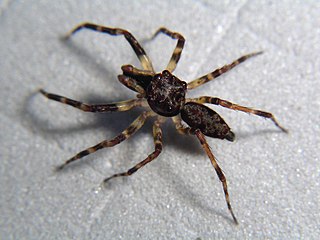
Allococalodes is a genus of Papuan jumping spiders that was first described by F. R. Wanless in 1982. As of June 2019 it contains only three species, found only in Papua New Guinea: A. alticeps, A. cornutus, and A. madidus. The name is name a combination of Ancient Greek ἄλλος ("allo"), meaning "other", and the genus Cocalodes.
Bathippus is a genus of jumping spiders.

Hasarius is a spider genus of the family Salticidae.
Pristobaeus is a genus of jumping spiders that was first described by Eugène Louis Simon in 1902.
Gelotia is a genus of jumping spiders that was first described by Tamerlan Thorell in 1890.

Ordgarius is a genus of orb-weaver spiders first described by Eugen von Keyserling in 1886. Adult females of the genus are bolas spiders, capturing their prey with one or more sticky drops at the end of a single line of silk rather than in a web. Males and juvenile females capture their prey directly with their legs.

Selenocosmia is a genus of tarantulas that was first described by Anton Ausserer in 1871.
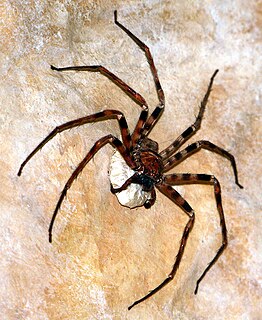
Heteropoda is a genus of spiders in the family Sparassidae, the huntsman spiders. They are mainly distributed in tropical Asia and Australia, while at least one species, H. venatoria, has a cosmopolitan distribution, and H. variegata occurs in the Mediterranean.
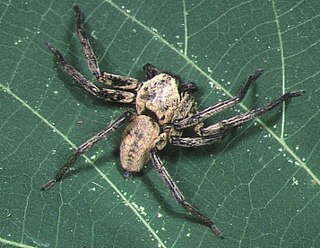
Thelcticopis is a genus of huntsman spiders that occurs almost exclusively in the Australasian region, from India to Japan to New Guinea and Fiji. However, one species occurs in Costa Rica, and another in Congo basin, although the latter species is probably misplaced in this genus.
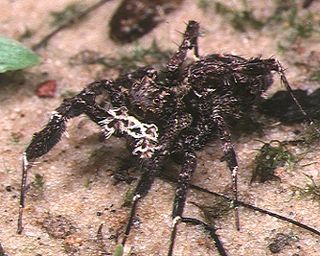
The Spartaeinae are a subfamily of the spider family Salticidae. The subfamily was established by Fred R. Wanless in 1984 to include the groups Boetheae, Cocaleae, Lineae, Codeteae and Cyrbeae, which in turn were defined by Eugène Simon.

Olios is the largest genus of huntsman spiders, containing 250 species. They are found throughout the world, with most species occurring in hot countries. The genus was first described by Charles Athanase Walckenaer in 1837.
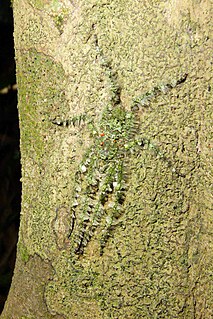
Pandercetes is a genus of huntsman spiders that was first described by Ludwig Carl Christian Koch in his 1875 treatise on Australian spiders. They are mainly distributed in tropical Asia and Australia, and are known for their cryptic coloration that matches local moss and lichen. Their legs have lateral hairs, giving them a feathery appearance, further masking their outline against tree trunks. Their head is somewhat elevated and the carapace has the thoracic region low and flat.

Phlogiellus is a genus of tarantulas that was first described by Reginald Innes Pocock in 1897.

Poltys is a genus of orb-weaver spiders first described by C. L. Koch in 1843. Many species are cryptic and are known to masquerade as leaves and twigs during the day, and build an orb web at night to capture prey. The shape of the abdomen which often gives the impression of a rough and broken branch can vary among individuals within a species. The web is eaten up before dawn and reconstructed after dusk.
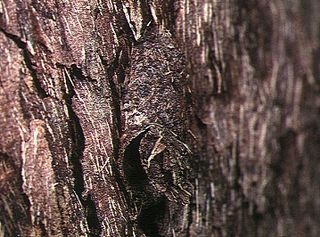
Conothele is a genus of mygalomorph spiders in the family Halonoproctidae, first described by Tamerlan Thorell in 1878. Originally placed with the Ctenizidae, it was moved to the Halonoproctidae in 2018.

