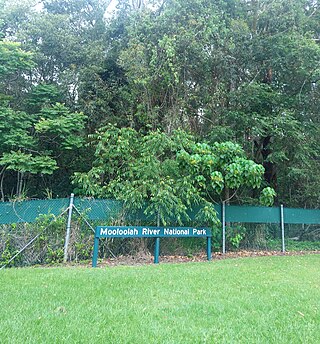
The Mooloolah River National Park is a nationally protected area located on the Sunshine Coast, Queensland. It covers an area of 830.9 hectares and is bordered by the Mooloolah River to the east, Claymore and Dixon Roads to the west, and the Lower Mooloolah River Environmental Reserve to the south. It is bisected by the Sunshine Motorway with the northern, 161.93 hectare component of the Park being a later addition. The Park was initially vacant crown land prior to national park designation in 1960. Surrounding land uses include livestock grazing, urban development and the campus of the University of the Sunshine Coast. It is the second largest mainland park on the coastal lowlands in South East Queensland after Noosa National Park and represents an example of low-lying coastal floodplain distinctive of the region.

The yellow-footed rock-wallaby, formerly known as the ring-tailed rock-wallaby, is a member of the macropod family.

The Environment Protection and Biodiversity Conservation Act 1999(Cth) is an Act of the Parliament of Australia that provides a framework for protection of the Australian environment, including its biodiversity and its natural and culturally significant places. Enacted on 17 July 2000, it established a range of processes to help protect and promote the recovery of threatened species and ecological communities, and preserve significant places from decline. The Act is as of September 2024 administered by the Department of Climate Change, Energy, the Environment and Water. Lists of threatened species are drawn up under the Act, and these lists, the primary reference to threatened species in Australia, are available online through the Species Profile and Threats Database (SPRAT).

Grevillea flexuosa, commonly known as zigzag grevillea or tangled grevillea, is a species of flowering plant in the family Proteaceae and is endemic to the south-west of Western Australia. It is an erect shrub with divided leaves, these lobes with three to five triangular lobes, and cylindrical clusters of cream-coloured to pale yellow flowers.

The eastern bristlebird is a species of bird in the bristlebird family, Dasyornithidae. It is endemic to Australia. Its natural habitats are temperate forests, temperate shrubland, and temperate grassland. It is threatened by habitat loss.

Grevillea venusta, commonly known as Byfield spider flower, is species of flowering plant in the family Proteaceae and is endemic to a small region of central eastern Queensland. It is an erect shrub with simple and/or divided leaves, the leaves or lobes narrowly oblong to narrowly elliptic, and clusters of green and yellow flowers with a deep maroon to purplish black style covered with white hairs.

Grevillea glossadenia is a species of flowering plant in the family Proteaceae and is endemic to Queensland, in northeastern Australia. It is an erect shrub with more or less elliptic leaves and deep yellow-orange to orange-red flowers.

Grevillea guthrieana, commonly known as Guthrie's grevillea, is a species of flowering plant in the family Proteaceae and is endemic to New South Wales. It is a spreading shrub with oblong leaves and clusters of two to six green and maroon flowers.

The Littoral Rainforests of New South Wales is a group of fragmented and endangered ecological communities found by the coast in eastern Australia. Much of this seaside form has been destroyed by mining, tourist development or housing. It is threatened by extinction in the near future. 90% of the 433 sites are less than ten hectares in size. Littoral rainforest amounts to 0.6% of the rainforests in New South Wales.

Gilberton is a rural locality in the City of Gold Coast, Queensland, Australia. In the 2021 census, Gilberton had a population of 31 people.

Grevillea quadricauda, commonly known as four-tailed grevillea, is a species of flowering plant in the family Proteaceae and is endemic to eastern Australia. It is an erect, dense, bushy shrub with narrowly egg-shaped to elliptic leaves and small, loose clusters of green and pinkish-red flowers.
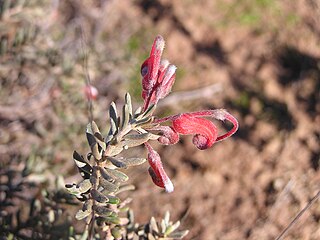
Grevillea pythara, commonly known as Pythara grevillea, is a species of flowering plant in the family Proteaceae and is endemic to a restricted part of the South West region of Western Australia. It is a low, suckering shrub with linear to narrowly elliptic leaves and small groups of red flowers.

Stackhousia clementii is a species of plant in the family Celastraceae and is native to Australia.

Fontainea venosa, also commonly known as southern blushwood, veiny fontainea, Queensland fontainea and formerly named as Bahrs scrub fontainea is a rare rainforest shrub or tree of the family Euphorbiaceae. It is found in southeastern Queensland, Australia, extending from Boyne Valley to Cedar Creek and is considered vulnerable due to several contributing threats. The total population size is around 200 plants.
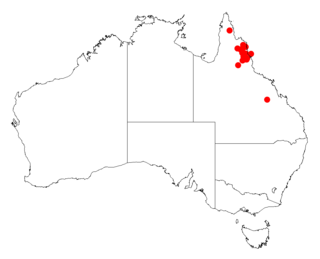
Acacia guymeri is a shrub belonging to the genus Acacia and the subgenus Juliflorae that is native to north eastern Australia. It was listed as vulnerable according to the Environment Protection and Biodiversity Conservation Act 1999 but was delisted in 2013. It is still listed as Vulnerable according to the Nature Conservation Act 1992 in Queensland.
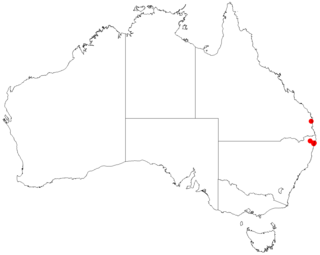
Prostanthera palustris, commonly known as swamp mint-bush, is a species of flowering plant in the family Lamiaceae and is endemic to a restricted area of New South Wales. It is a low, spreading, weak shrub with spatula-shaped leaves and pale mauve and white flowers with yellow spots in the petal tube.

The southern greater glider, also known as the southern and central greater glider, is a species of large gliding marsupial native to the forests of southeastern Australia. It is a vulnerable species per the IUCN Red List classification, but since 5 July 2022 is listed as endangered under the EPBC Act in Australia. The main threats to its survival are climate change and logging.
Grevillea elongata, also known as Ironstone grevillea, is a species of flowering plant in the family Proteaceae and is endemic to the south-west of Western Australia. It is a shrub with divided leaves with sharply-pointed linear lobes, and conical or cylindrical groups of white flowers.

Corynotheca licrota, otherwise known as the antler zig-zag lily, club-fruit lily, or sand lily, is a perennial herbaceous member of the family Asphodelaceae and is found in arid inland areas of Australia.

