This article needs additional citations for verification .(February 2013) (Learn how and when to remove this template message) |
| Culasi | |
|---|---|
| Municipality | |
| Municipality of Culasi | |
Municipal Hall | |
Map of Antique with Culasi highlighted | |
Location within the Philippines | |
| Coordinates: 11°25′N122°04′E / 11.42°N 122.07°E Coordinates: 11°25′N122°04′E / 11.42°N 122.07°E | |
| Country | |
| Region | Western Visayas (Region VI) |
| Province | Antique |
| District | Lone district |
| Barangays | 44 (see Barangays) |
| Government [1] | |
| • Type | Sangguniang Bayan |
| • Mayor | Jose Jeffrey Lomugdang |
| • Electorate | 23,942 voters (2016) |
| Area [2] | |
| • Total | 228.56 km2 (88.25 sq mi) |
| Highest elevation(Mount Madia-as) | 2,117 m (6,946 ft) |
| Population (2015 census) [3] | |
| • Total | 41,228 |
| • Density | 180/km2 (470/sq mi) |
| Time zone | PST (UTC+8) |
| ZIP code | 5708 |
| PSGC | 060606000 |
| IDD : area code | +63 (0)36 |
| Climate type | tropical climate |
| Income class | 3rd municipal income class |
| Website | elgu |
Culasi, officially the Municipality of Culasi, (Kinaray-a : Banwa kang Culasi; Hiligaynon : Banwa sang Culasi; Filipino : Bayan ng Culasi), is a 3rd class municipality in the province of Antique, Philippines. According to the 2015 census, it has a population of 41,228 people. [3]
The Hiligaynon language, also often referred to by most of its speakers simply as Ilonggo, is an Austronesian regional language spoken in the Philippines by about 9.1 million people, mainly in Western Visayas and Soccsksargen, most of whom belong to the Visayan ethnic group, mainly the Hiligaynons. It is the second-most widely spoken language and a member of the so-named Visayan language family and is more distantly related to other Philippine languages.
Filipino is the national language of the Philippines. Filipino is also designated, along with English, as an official language of the country. It is a standardized variety of the Tagalog language, an Austronesian regional language that is widely spoken in the Philippines. As of 2007, Tagalog is the first language of 28 million people, or about one-third of the Philippine population, while 45 million speak Tagalog as their second language. Tagalog is among the 185 languages of the Philippines identified in the Ethnologue. Officially, Filipino is defined by the Commission on the Filipino Language as "the native dialect, spoken and written, in Metro Manila, the National Capital Region, and in other urban centers of the archipelago."
Antique is a province of the Philippines located in the region of Western Visayas. The province capital is San Jose, the most populous town in Antique. The province is situated in the western section of Panay Island and borders Aklan, Capiz and Iloilo to the east, while facing the Sulu Sea to the west.
During the Spanish colonial times, Culasi was known by its old name "Bacong". Now, Bacong is only one of its barangays. Bacong was one of the four visitas or towns established by the Spaniards. The others were Nalupa (now Barbaza), Bugason (now Bugasong), and Hamtik (now Hamtic). The name Culasi or Kulasi was derived from the local term for a species of mangrove Lumnitzera racemosa which grow abundantly in the vicinity's river basin.
The 1905 census revealed that Culasi had the biggest Chinese population in Antique, so much so that it had a barrio named "Villa de Hong Kong" in their honor. It is now part of the Poblacion.
Culasi is located at 11°25′N122°04′E / 11.42°N 122.07°E . It is 92 kilometres (57 mi) north from San Jose de Buenavista, the capital of Antique, and 90 kilometres (56 mi) south from Kalibo, the capital of Aklan.
Aklan (Akean) is a province in the Philippines located in the Western Visayas region. Its capital is Kalibo. The province is situated in the northwest portion of Panay Island, bordering Antique to the southwest, and Capiz to the east. Aklan faces the Sibuyan Sea and Romblon province to the north.
According to the Philippine Statistics Authority, the municipality has a land area of 228.56 square kilometres (88.25 sq mi) [2] constituting 8.37% of the 2,729.17-square-kilometre- (1,053.74 sq mi) total area of Antique.
The Philippine Statistics Authority (PSA) was created on September 12, 2013 when the Philippine Statistical Act of 2013 was signed by President Benigno S. Aquino III. The new government authority was created by merging the National Statistics Office, the National Statistical Coordination Board, the Bureau of Agricultural Statistics, and the Bureau of Labor and Employment Statistics.
Located in the northern portion of the province, it is bounded on the north by Sebaste, south by Tibiao, west by the Sulu Sea and east by Mount Madja-as and the Municipality of Madalag, Aklan, just beyond. Its territory includes Maniguin (or Maningning / Hammerhead) and Batbatan Islands.
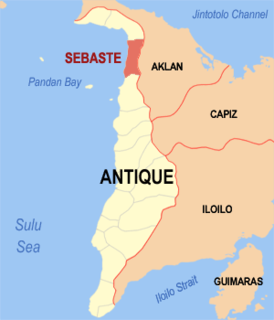
Sebaste, officially the Municipality of Sebaste,, is a 4th class municipality in the province of Antique, Philippines. According to the 2015 census, it has a population of 17,907 people.
The Sulu Sea is a body of water in the southwestern area of the Philippines, separated from the South China Sea in the northwest by Palawan and from the Celebes Sea in the southeast by the Sulu Archipelago. Borneo is found to the southwest and Visayas to the northeast.
Excluding the outlying islands, its northernmost point is located at 11°32’05" latitude and 122°05’00" longitude. Its easternmost point is located at 11°30’50" latitude and 122°10’05" longitude. Its southernmost point is located at 11°21’04" latitude and 122°02’08" longitude and the westernmost point is at 11°31’05" latitude and 122°03’08" longitude.
Culasi has a slope of 8°. Eastern height ranges from 200 metres (660 ft) to 2,117 metres (6,946 ft) at the summit of Mount Madia-as, it is the highest point in Panay. It has unbroken mountain range from barangay Batonan Sur in the south to barangay Salde in the northernmost. From the peak of Madia-as Mountain it gradually flattens down to a narrow strip of the coastal plain. Land area roughly covers 82.92% upland and above lowland comprises 17.08% of the land area with a slope of 18% and below. Forest areas comprise almost half of the total land area covering 12,078 hectares (29,850 acres).
Mount Madia-as is a dormant volcano, it is the highest peak on the island of Panay, Philippines.
Panay is the sixth-largest and fourth most-populous island in the Philippines, with a total land area of 12,011 km2 (4,637 sq mi) and with a total population of 4,477,247. Panay comprises 4.4 percent of the entire population of the country. The City of Iloilo is its largest settlement with a total population of 447,992 inhabitants. It is a triangular island, located in the western part of the Visayas. It is about 160 km (99 mi) across. It is divided into four provinces: Aklan, Antique, Capiz and Iloilo, all in the Western Visayas Region. It is located southeast of the island of Mindoro and northwest of Negros across the Guimaras Strait. Just off the mid-southeastern coast lies the island-province of Guimaras. To the north and northeast is the Sibuyan Sea, Jintotolo Channel and the islands of Romblon and Masbate; to the west and southwest is the Sulu Sea and the Palawan archipelago and to the south is Panay Gulf. Panay is the only main island in the Visayas whose provinces don't bear the name of their island.
Culasi has two distinct seasons, the rainy and dry. Rainy season occurs in the months of May to November and dry season for the rest of the year. Areas like the mountainous barangays of Flores and Osorio located at the southern portion of the municipality are characterized by a relatively cool temperature which is highly suited for coffee. The higher precipitation acquired may be caused by high mountain range or because of its high topography.
Culasi is politically subdivided into 44 barangays, [4] which are classified into 3 island, 11 upland, 16 coastal and 14 interior/lowland barangays.
| PSGC | Barangay | Population | ±% p.a. | |||
|---|---|---|---|---|---|---|
| 2015 [3] | 2010 [5] | |||||
| 060606001 | Alojipan | 1.1% | 462 | 446 | 0.67% | |
| 060606002 | Bagacay | 3.6% | 1,480 | 1,462 | 0.23% | |
| 060606003 | Balac-balac | 1.6% | 660 | 601 | 1.80% | |
| 060606005 | Batbatan Island | 6.9% | 2,851 | 2,407 | 3.28% | |
| 060606007 | Batonan Norte | 1.5% | 620 | 608 | 0.37% | |
| 060606008 | Batonan Sur | 1.8% | 749 | 730 | 0.49% | |
| 060606009 | Bita | 1.0% | 431 | 410 | 0.96% | |
| 060606010 | Bitadton Norte | 1.9% | 788 | 711 | 1.98% | |
| 060606011 | Bitadton Sur | 5.3% | 2,166 | 2,075 | 0.82% | |
| 060606012 | Buenavista | 1.8% | 726 | 683 | 1.17% | |
| 060606013 | Buhi | 1.5% | 619 | 582 | 1.18% | |
| 060606014 | Camancijan | 4.7% | 1,938 | 1,901 | 0.37% | |
| 060606015 | Caridad | 2.1% | 882 | 828 | 1.21% | |
| 060606016 | Carit-an | 1.5% | 628 | 518 | 3.73% | |
| 060606032 | Centro Norte ( Poblacion ) | 5.1% | 2,114 | 1,947 | 1.58% | |
| 060606031 | Centro Poblacion | 6.0% | 2,477 | 2,668 | −1.40% | |
| 060606033 | Centro Sur (Poblacion) | 4.0% | 1,654 | 1,791 | −1.50% | |
| 060606017 | Condes | 1.0% | 420 | 389 | 1.47% | |
| 060606018 | Esperanza | 2.7% | 1,132 | 1,029 | 1.83% | |
| 060606019 | Fe | 1.9% | 770 | 678 | 2.45% | |
| 060606020 | Flores | 2.0% | 822 | 804 | 0.42% | |
| 060606021 | Jalandoni | 3.6% | 1,485 | 1,384 | 1.35% | |
| 060606022 | Janlagasi | 0.5% | 215 | 204 | 1.00% | |
| 060606023 | Lamputong | 1.5% | 628 | 617 | 0.34% | |
| 060606024 | Lipata | 4.8% | 1,962 | 1,831 | 1.32% | |
| 060606004 | Magsaysay (Balua) | 1.4% | 578 | 524 | 1.89% | |
| 060606025 | Malacañang | 3.8% | 1,572 | 1,466 | 1.34% | |
| 060606026 | Malalison Island | 1.6% | 649 | 584 | 2.03% | |
| 060606027 | Maniguin | 1.7% | 719 | 643 | 2.15% | |
| 060606028 | Naba | 3.9% | 1,628 | 999 | 9.74% | |
| 060606029 | Osorio | 1.3% | 524 | 485 | 1.48% | |
| 060606030 | Paningayan | 0.9% | 354 | 330 | 1.35% | |
| 060606034 | Salde | 0.5% | 203 | 121 | 10.35% | |
| 060606036 | San Antonio | 2.3% | 962 | 1,664 | −9.91% | |
| 060606037 | San Gregorio | 1.2% | 476 | 450 | 1.08% | |
| 060606038 | San Juan | 1.8% | 751 | 632 | 3.34% | |
| 060606039 | San Luis | 1.7% | 715 | 696 | 0.51% | |
| 060606040 | San Pascual | 1.0% | 416 | 384 | 1.54% | |
| 060606041 | San Vicente | 1.0% | 396 | 390 | 0.29% | |
| 060606042 | Simbola | 0.6% | 229 | 201 | 2.51% | |
| 060606043 | Tigbobolo | 1.1% | 460 | 423 | 1.61% | |
| 060606044 | Tinabusan | 0.4% | 177 | 167 | 1.11% | |
| 060606045 | Tomao | 1.8% | 751 | 667 | 2.28% | |
| 060606046 | Valderama | 2.4% | 989 | 956 | 0.65% | |
| Total | 41,228 | 39,086 | 1.02% | |||
| Population census of Culasi | ||
|---|---|---|
| Year | Pop. | ±% p.a. |
| 1903 | 10,966 | — |
| 1918 | 15,790 | +2.46% |
| 1939 | 19,019 | +0.89% |
| 1948 | 20,601 | +0.89% |
| 1960 | 23,923 | +1.25% |
| 1970 | 22,621 | −0.56% |
| 1975 | 23,584 | +0.84% |
| 1980 | 25,674 | +1.71% |
| 1990 | 29,719 | +1.47% |
| 1995 | 30,431 | +0.44% |
| 2000 | 32,998 | +1.75% |
| 2007 | 37,100 | +1.63% |
| 2010 | 39,086 | +1.92% |
| 2015 | 41,228 | +1.02% |
| Source: Philippine Statistics Authority [3] [5] [6] [7] | ||
In the 2015 census, Culasi had a population of 41,228. [3] The population density was 180 inhabitants per square kilometre (470/sq mi).
In the 2016 electoral roll, it had 23,942 registered voters. [8]
Farming and fishing are the major livelihood where the Culasinhon depend their living.
The rolling hills of Mount Madja-as are rich in manganese, copper and coal found in Timbaban. Other metallic mineral deposits are white clay and pebbles in the island barangays of Malalison and Batbatan. Sand and gravel is being extracted in various rivers and used for infrastructure. Another metallic mineral is the limestone deposit found in Sitio Bula, Camancijan and is used for agricultural and industrial purpose. Limestone is used in the production of cement.
Most treasured one is the oil deposit in Maniguin Island explored by the Philippine National Oil Corporation (PNOC). Several companies drilled oil deposit in Maniguin with black coal. Maniguin has a potential reserve of 28 million barrels to 250 mmbbls. based on the PNOC drilling project report.
Villaba, officially the Municipality of Villaba, is a 3rd class municipality in the province of Leyte, Philippines. According to the 2015 census, it has a population of 41,891 people.
San Remigio, officially the Municipality of San Remigio,, is a 3rd class municipality in the province of Antique, Philippines. According to the 2015 census, it has a population of 31,935 people.
Bacong, officially the Municipality of Bacong, is a 4th class municipality in the province of Negros Oriental, Philippines. According to the 2015 census, it has a population of 36,527 people.
Sibulan, officially the Municipality of Sibulan,, is a 2nd class municipality in the province of Negros Oriental, Philippines. According to the 2015 census, it has a population of 59,455 people.
Altavas, officially the Municipality of Altavas,, is a 4th class municipality in the province of Aklan, Philippines. According to the 2015 census, it has a population of 24,619 people.

Balete, officially the Municipality of Balete,, is a 4th class municipality in the province of Aklan, Philippines. According to the 2015 census, it has a population of 28,920 people.
Laua-an, officially the Municipality of Laua-an,, is a 4th class municipality in the province of Antique, Philippines. According to the 2015 census, it has a population of 26,072 people.
Patnongon, officially the Municipality of Patnongon,, is a 3rd class municipality in the province of Antique, Philippines. According to the 2015 census, it has a population of 37,176 people.
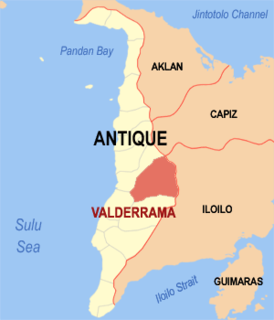
Valderrama, officially the Municipality of Valderrama,, is a 4th class municipality in the province of Antique, Philippines. According to the 2015 census, it has a population of 19,124 people. The area is home to the indigenous Iraynun-Bukidnon, speakers of a dialect of the Kiniray-a language, who have crafted the only rice terrace clusters in the Visayas through indigenous knowledge and sheer vernacular capabilities. The rice terraces of the Iraynun-Bukidnon are divided into three terraced fields, namely, Lublub rice terraces, Baking rice terraces, and San Agustin rice terraces. All of the rice terrace clusters have been researched on by the National Commission for Culture and the Arts and various scholars from the University of the Philippines. There have been campaigns to nominate the Iraynun-Bukidnon Rice Terraces, along with the central Panay mountain range, into the UNESCO World Heritage List.

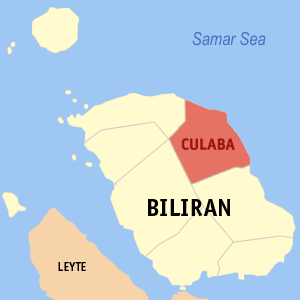
Culaba, officially the Municipality of Culaba,, is a 5th class municipality in the province of Biliran, Philippines. According to the 2015 census, it has a population of 12,325 people.

Hinabangan, officially the Municipality of Hinabangan, is a 4th class municipality in the province of Samar, Philippines. According to the 2015 census, it has a population of 13,673 people.
Bobon, officially the Municipality of Bobon, is a 4th class municipality in the province of Northern Samar, Philippines. According to the 2015 census, it has a population of 23,668 people.
Balangkayan,, officially the Municipality of Balangkayan, is a 5th class municipality in the province of Eastern Samar, Philippines. According to the 2015 census, it has a population of 10,125 people.

Ajuy, officially the Municipality of Ajuy, is a 2nd class municipality in the province of Iloilo, Philippines. According to the 2015 census, it has a population of 52,268 people.
Guimbal, officially the Municipality of Guimbal,, is a 4th class municipality in the province of Iloilo, Philippines. According to the 2015 census, it has a population of 33,820 people.

Igbaras, officially the Municipality of Igbaras, is a 3rd class municipality in the province of Iloilo, Philippines. According to the 2015 census, it has a population of 32,004 people.
Bato, officially the Municipality of Bato, is a 4th class municipality in the province of Leyte, Philippines. According to the 2015 census, it has a population of 38,356 people.
Mararison or 'Malalison' for travelers is a small island beach destination and a barangay in Culasi in Antique. The beauty of the island was only seen by media after the devastation of Typhoon Haiyan in the province. Mararison is just behind the world's most popular beach destination, Boracay. Mararison or Malalison means the one who is fond of violating or the one who refuses to follow rules.
| Wikimedia Commons has media related to Culasi, Antique . |