East Rock, New Haven

Last updated

East Rock
Neighborhood of New Haven
East Rock.jpg
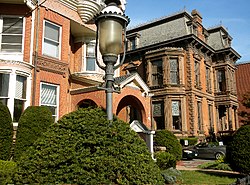
East Rock neighborhood with the trap rock feature for which it is named, behind
New Haven map - East Rock.png
East Rock within New Haven
Coordinates: 41°19′16″N72°54′25″W / 41.321°N 72.907°W / 41.321; -72.907
Country United States
State Connecticut
City New Haven

East Rock is a neighborhood in the city of New Haven, [1] Connecticut, named for nearby East Rock, a prominent trap rock ridge. The area is home to a large group of Yale students, staff, and faculty, as well as many young professionals and families. [2]

Contents

About

Writing in the Times Literary Supplement, Hirsh Sawhney describes East Rock as a "yuppie enclave", which is "increasingly composed of wealthy professionals and graduate students, most of whom are affiliated with Yale University, whose lavish campus lies just over a mile away" [3] East Rock is also a popular destination for cyclists, as a city bike lane runs along Orange Street, the neighborhood's spine. East Rock is the safest neighborhood in New Haven County[ citation needed ]. East Rock is home to East Rock Park, which is frequently visited by families and tourists.

History

Houses in the Orange Street Historic District Orange St.1.jpg
Houses in the Orange Street Historic District

The current East Rock neighborhood remained unsettled farmland into the 1800s, when its largest landowner was Abraham Bishop, a prominent New Haven lawyer and businessman. The southernmost streets were developed first, between the late 1830s and 1860, as these were nearest to the industrializing city center. Following Bishop's death in 1844, the rest of the neighborhood was gradually subdivided and developed.

Sub-neighborhoods developed as New Haven continued to industrialize and grow, with immigrants arriving to take newly available jobs. An Irish community developed in Goatville (around Upper State Street) and a Polish population formed around St. Stanislaus Roman Catholic Church. A commercial district developed on Upper State Street. By 1900 most of the neighborhood's land was developed. The final blocks, near East Rock Park, were developed in the first decades of the 1900s.

Throughout its history East Rock has contained residences of faculty and alumni from neighboring Yale University. As the university has grown, the East Rock neighborhood has increasingly housed the university's graduate students and researchers while many faculty now live outside New Haven's borders.

During the late 20th century a series of businesses were developed on primarily residential Orange Street, including markets and coffee shops. [4] During the 2010s a large-scale addition of 238 apartments was constructed on the 'Corsair' site, a former airplane propeller factory on Upper State Street.

Geography

Restaurants on Upper State Street, East Rock's main commercial strip Upper State4.jpg
Restaurants on Upper State Street, East Rock's main commercial strip

The neighborhood is bordered on the north by the town of Hamden, on the east by Amtrak railroad tracks, on the southeast by Interstate 91 (between Exits 3 and 6), on the south by Trumbull Street, and on the west by Whitney Avenue. The northeast corner of the area, separated from the main neighborhood by the Mill River and the East Rock hill, is part of the community known as Cedar Hill.

The neighborhood is divided between New Haven's ninth and tenth aldermanic wards. Before redistricting, it lay in the fifteenth ward; the area was the subject of William Lee Miller's book The Fifteenth Ward and the Great Society. The western half of the neighborhood (west of Orange Street) is within the Whitney Avenue Historic District. The southerly parts of the neighborhood are also listed as historic districts: Upper State Street Historic District along State Street, and Orange Street Historic District along Orange Street. The northern portion of the neighborhood is occupied by part of East Rock Park.

Notable sites

East Rock with its trap rock cliffs and Soldiers & Sailors monument East Rock from SSS Hall, October 17, 2008.jpg
East Rock with its trap rock cliffs and Soldiers & Sailors monument

List of streets

StreetOrigin of nameOther
Anderson Streetpossibly William S. Anderson of Boston, who owned land in the area
Alburt Street
Avon Streetprobably Avon, New York
Bishop StreetBishop family, heirs of Abraham Bishop
Bradley StreetAbraham Bradley, landownerpreviously named Third Street as well as Marshall Street
Burns Drivepossibly James Burns, painter, or Mary C. Burns, mother of John W. Bishop, landowner
Canner Streeteither Henry Caner, Bostonian constructor of Yale College, or his son Dr. Henry Caner, rector of King's Chapel in Boston.The name of the street has become misspelled with time.
Cedar Hill AvenueNamed after the Cedar Trees that once grew in the area
Clark StreetMary Ann Clark, daughter of Abraham Bishop
Cold Spring Streetnamed for a cold spring that sourced from the Mill River
Cottage Streetnamed for a Greek villa on the estate of wealthy New Yorker Henry Whitneypreviously called Amity Place
Eagle Streetpreviously called North Vernon Street
East Rock Road East Rock previously called Rock Lane
Edwards Streetprobably Pierpont Edwards
Eld StreetLt. Henry Eld who originally settled in Cedar Hill
Everit StreetRichard Mansfield Everit, landowner
Farnum Drive
Foster StreetStella Bishop Foster, daughter of Abraham Bishop
Grace StreetGrace Clarissa, Major Lyman Atwater's daughter who was married to Elias B. Bishop
Humphrey Street David Humphreys previously Humphreys
Lawrence StreetCornelia Lawrence, daughter-in-law of James Hillhouse
Lincoln Street Abraham Lincoln previously Clinton Place
Linden Streetnamed for the Linden tree
Livingston StreetMaria Whitney Livingston, heir to Henry Whitney's estate
Lyman StreetNamed after Major Lyman Atwater
May Street
Mechanic Streethouses were built on this street for mechanics of the Marlin Firearms Co.
Mitchell DriveDonald D. Mitchell, landscape gardener
Nash Streetpossibly Thomas Nash, gunsmith, or Burr Nash, blacksmith
Nicoll StreetCaroline B. Nicoll, daughter of Abraham Bishop
North Bank Streetlocated on the south bank of the Mill River
Orange Street William III of England, Prince of Orange one of the first paved streets in the city, called Mill Lane in colonial days
Pearl Streetnamed for the pearly oyster shells covering the roads
Pleasant Street
Ridge Street
Rock StreetThe Highway to East Rock is its nickname built by Mr. Warren and Mr. Blatchleypreviously called Rock Lane
State StreetPreviously named Neck Lane "The Neck", Hancock Avenue [6]
Trumbull Streetnamed for the widow of Jonathan Trumbull previously called New Street, then Second Street
View Streetthe original place of residence of Henry Eld
Warren PlaceCharles Warren, one of the two men that built the road to the top of East Rock
Welton StreetOne of the main Streets to the Cedar Hill Rail Yards
Whitney Avenue Eli Whitney previously Long Lane
Willow Street Willow trees on the river bank

References

  1. "New Haven, CT – East Rock". City of New Haven. Archived from the original on February 3, 2018. Retrieved September 9, 2019.
  2. "The Great New Haven Real Estate Hunt". Yale Law School. March 9, 2009. Archived from the original on April 2, 2013. Retrieved September 9, 2019.
  3. Sawhney, H. (2020). Respect New Haven. TLS. Times Literary Supplement, (6112), 17-18.
  4. Langdon, P. (2017). Creating Gathering Places: The East Rock Neighborhood, New Haven, Connecticut. In Within Walking Distance (pp. 60-89). Island Press, Washington, DC.
  5. "St. John's Episcopal Church, New Haven, CT".
  6. Papers of the New Haven Colony Historical Society. Vol. 5. New Haven Colony Historical Society. 1894. p.  90.

Bibliography

Print