Architecturally, the synagogue is a rectangular building oriented roughly east-west, with an eastern exedra. Three entrances in the east wall lead from the exedra into a single large prayer hall. Inside, the northern wall is especially massive and incorporates three elevated niches: a central, wider niche flanked by two narrower ones. Benches of ashlar stone run along much of the northern and southern walls, and both the exedra and the hall were paved with mosaic floors, including a decorated pavement.
At the foot of the southern column base in the exedra, a mosaic inscription in Aramaic commemorates "Eleazar the priest and his sons", who donated a gold coin to the synagogue. Within the hall, fragments of marble menorahs and architectural elements with menorah reliefs support the common interpretation that the central northern niche housed the Torah ark.
Archaeological research
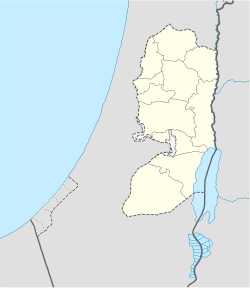
The ancient synagogue came to light in modern As-Samu, today a Palestinian Arab town generally identified with Eshtemoa, the Levitical city of Judah mentioned in the Book of Joshua (21:14; 15:50) and again in 1 Samuel 30:28.[3] Eusebius, a Christian bishop writing in the late Roman period, describes Eshtemoa as a large Jewish village.[4] Scholars had long suspected the presence of a synagogue there, thanks to early travellers who noted carved stones bearing menorahs and other Jewish motifs reused in village homes, though the exact spot remained uncertain until the 1930s.[3]
The first clear identification of the synagogue remains was made in 1934 by Leo Aryeh (L.A.) Mayer and A. Reifenberg,[5] who described, among other features, a recessed niche in one of the walls that may well have held the Torah Ark.[6][7] A much fuller exposure of the building followed in 1969–70, when Ze'ev Yeivin directed a systematic excavation that removed later additions and domestic structures in order to reveal the original synagogue more completely.[8]
Architecture and description
The synagogue at Eshtemoa was a substantial rectangular building, built in the "broadhouse" style and measured 13.3 by 21.3 metres (44 by 70ft).[9] It had an open-fronted porch or exedra on the eastern side, approached by three broad steps.[3] These steps were constructed directly over an earlier paved roadway, showing that the synagogue was built after the road and aligned independently of it.[3][4] Two large stone pillars flanked the porch, and column bases found on the upper step indicate that a row of columns once supported its roof.[3] Portions of a mosaic floor survive in this area, including the remains of a dedicatory inscription in Aramaic in which a donor, Eleazar the priest, and his sons are commemorated.[3]
Three doorways in the eastern façade led from the porch into the main hall, with the central entrance significantly wider than the flanking ones.[3] These openings, framed by carved mouldings, do not lead into aisles but into a single broad interior space. This arrangement is considerably different from the multi-aisled plan in some northern synagogues as documented in Galilee.[3] The eastern wall was built of large, well-cut ashlar blocks, and later alterations, probably after the synagogue had ceased functioning, closed the two smaller entrances and narrowed the central one using reused masonry.[3]
Inside, the building was designed without interior columns; its roof was instead carried by exceptionally thick walls, particularly the northern one.[3] Set into the middle of that northern wall are three elevated niches, including a large central recess with two smaller ones on either side.[3] A raised platform or bema, now largely destroyed, projected from the base of these niches into the hall. Four seven-branched menorahs were discovered carved onto door lintels and one of them is displayed in Jerusalem's Rockefeller Museum.[10] Remains of marble menorahs were also found, indicating that the central niche once held the Torah ark while the side niches likely supported menorah stands, an arrangement known from other Judean synagogues.[8] Along the northern and southern walls of the synagogue were built two long benches, one on top of the other, of which only remnants remain.[8]
The main hall originally had a mosaic floor, though only patches survive today.[8][4] These include areas of geometric decoration and sections paved with larger white tesserae, probably representing later repairs.[8] The southern side of the hall underwent significant alteration when the building was converted into a mosque after the Muslim conquest of the Levant, with the installation of a semicircular mihrab (Niche in a mosque indicating the direction of prayer) and internal partition walls that divided the space into multiple rooms.[8]
Later history
Aftermath of the Islamic conquest
After the Muslim conquest, the synagogue was converted into a mosque and a mihrab was added in its southern wall.[9][11][8] According to "a local tradition" narrated by Jewish scholars, this addition was made during the conquest of Saladin (in the 12th century), rather than during the early Muslim conquest of the Levant.[8] Scholar Robert Schick suggests that the conversion may have taken place in the 10th century instead of during the Umayyad period.[12]
A Crusader church was constructed near the eastern side of the synagogue in the 12th century.[8]
Modern era
The western wall is still standing to a height of 7m (23ft).[9] Many architectural elements of the building have been reused in the modern village.[13]
In 2024, the synagogue was the targeted in an arson attack. Local settler activists described it as an attempt to "erase the site's Jewish identity".[14]
↑Mayer, L. A.; Reifenberg, A. (1939). "The Synagogue of Eshtemoa - Preliminary Report". Journal of the Palestine Oriental Society. 19: 314–326. OCLC873183425.
↑Press, I., ed. (1951), "אשתמוע", A Topographical-Historical Encyclopaedia of Palestine, vol.1, Jerusalem: Rubin Mass, p.26 (folio iii)
↑Abel, F. M. (1929). Revue Biblique. Vol.35. pp.585–ff.
123456789Amit, David (n.d.). "es-Samua'". In Ben-Yosef, Sefi (ed.). Israel Guide - Judaea (A useful encyclopedia for the knowledge of the country) (in Hebrew). Vol.9. Jerusalem: Keter Publishing House, in affiliation with the Israel Ministry of Defence. pp.146–149. OCLC745203905.
↑Schick, Robert (1995). The Christian Communities of Palestine from Byzantine to Islamic Rule: A Historical and Archaeological Study. Studies in Late Antiquity and Early Islam 2. Princeton, NJ: The Darwin Press.
This page is based on this Wikipedia article Text is available under the CC BY-SA 4.0 license; additional terms may apply. Images, videos and audio are available under their respective licenses.