
Magenta is a purplish-red color. On color wheels of the RGB (additive) and CMY (subtractive) color models, it is located precisely midway between violet and red. It is one of the four colors of ink used in color printing by an inkjet printer, along with yellow, cyan, and black to make all the other colors. The tone of magenta used in printing, printer's magenta, is redder than the magenta of the RGB (additive) model, the former being closer to rose.

Fuchsia is a genus of flowering plants that consists mostly of shrubs or small trees.

Leonhart Fuchs, sometimes spelled Leonhard Fuchs and cited in Latin as Leonhartus Fuchsius, was a German physician and botanist. His chief notability is as the author of a large book about plants and their uses as medicines, a herbal, which was first published in 1542 in Latin. It has about 500 accurate and detailed drawings of plants, which were printed from woodcuts. The drawings are the book's most notable advance on its predecessors. Although drawings had been used in other herbal books, Fuchs' book proved and emphasized high-quality drawings as the most telling way to specify what a plant name stands for.
In computing, a futex is a kernel system call that programmers can use to implement basic locking, or as a building block for higher-level locking abstractions such as semaphores and POSIX mutexes or condition variables.
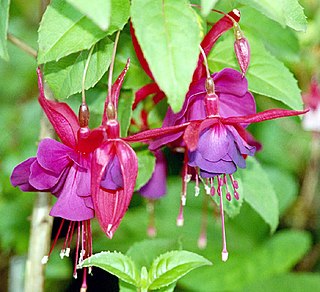
Fuchsia is a vivid pinkish-purplish-red color, named after the color of the flower of the fuchsia plant, which was named by a French botanist, Charles Plumier, after the 16th-century German botanist Leonhart Fuchs.
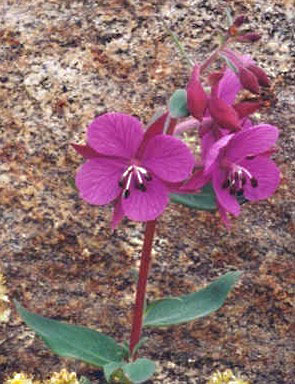
The Onagraceae are a family of flowering plants known as the willowherb family or evening primrose family. They include about 650 species of herbs, shrubs, and trees in 17 genera. The family is widespread, occurring on every continent from boreal to tropical regions.

The Circaea, or enchanter's nightshades, are a genus of flowering plants in the evening primrose family Onagraceae. About two dozen taxa have been described, including eight species. Plants of the genus occur throughout the temperate and boreal forests of the Northern Hemisphere. Three taxa occur in North America: Circaea alpina, Circaea canadensis, and the hybrid Circaea × sterilis. The generic name Circaea refers to the enchantress Circe from Greek mythology who is said to have used the herb as a charm.

Fuchsia excorticata, commonly known as tree fuchsia, New Zealand fuchsia and by its Māori name kōtukutuku, is a New Zealand native tree belonging to the family Onagraceae. It is commonly found throughout New Zealand and as far south as the Auckland Islands. It grows from sea level up to about 1,000 m (3,300 ft), particularly alongside creeks and rivers. It is easily recognised in its native environment by the characteristic appearance of its bark, which peels spontaneously, hanging in red papery strips to show a pale bark underneath. Its scientific name, excorticata, reflects this distinctive property.
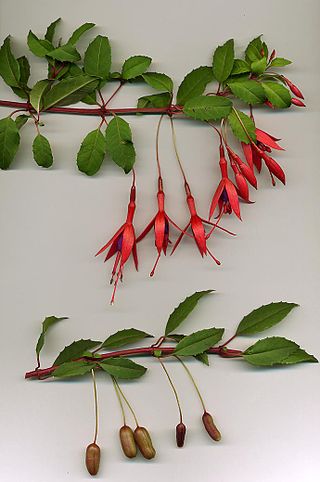
Fuchsia magellanica – commonly known as the hummingbird fuchsia, hardy fuchsia or chilco – is a species of flowering plant in the evening primrose family Onagraceae, native to the lower Southern Cone of southern South America.

Gormenghast is a four-episode television series based on the first two novels of the Gothic fantasy Gormenghast series by Mervyn Peake. It was produced and broadcast by the BBC.
Fuchsia triphylla is one of over 110 species that comprise the genus Fuchsia. Due to its attractiveness and its extensive blooming period which spans from early spring to late autumn, the plant has found a major role as a popular species to breed. This has a resulted in an extensive breed of cultivars allowing it to grow in various settings around the world. The visually appealing flowers of the Fuchsia triphylla have contributed to some of the most elegant Fuchsia hybrids produced today.

Fuchsia Swing Song is the debut album by American saxophonist Sam Rivers recorded in 1964 and released on the Blue Note label. The album was reissued on CD in 1995, and again in 2003 as part of the "Connoisseur Series" including four alternate takes as bonus tracks.

Fuchsia procumbens is a prostrate shrub that is endemic to coastal areas of the North Island of New Zealand. Common names include creeping fuchsia, climbing fuchsia or trailing fuchsia.

Aculops fuchsiae, commonly known as fuchsia gall mite, is a species of mite in the family Eriophyidae. It feeds on Fuchsia plants, causing distortion of growing shoots and flowers. It is regarded as a horticultural pest.

Fuchsia arborescens, commonly known as the tree fuchsia, is a tree of the genus Fuchsia native to Central America. It belongs to the section Schufia and is most closely related to Fuchsia paniculata.
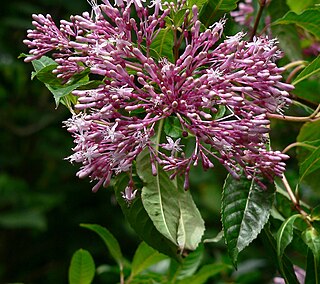
Fuchsia paniculata is a plant of the genus Fuchsia native to Central America. It belongs to the section Schufia and is most closely related to Fuchsia arborescens.

Hauya is a genus of plants of the family Onagraceae native to montane Central America. They are related to a lineage that gave rise to Fuchsia and Circaea.

Fuchsia is an open-source capability-based operating system developed by Google. In contrast to Google's Linux-based operating systems such as ChromeOS and Android, Fuchsia is based on a custom kernel named Zircon. It publicly debuted as a self-hosted git repository in August 2016 without any official corporate announcement. After years of development, its official product launch was in 2021 on the first-generation Google Nest Hub, replacing its original Linux-based Cast OS.
Paul Edward Berry is an American botanist and curator. He is Director of the Wisconsin State Herbarium.
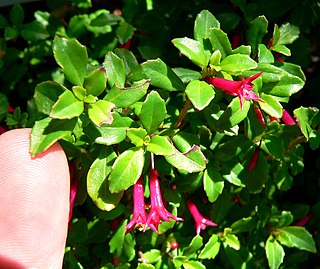
Fuchsia microphylla, also known as small leaf fuchsia and small-leaved fuchsia, is a flowering shrub in the family Onagraceae. The specific epithet (microphylla) was named for the plant's small (micro) leaves (phylla).

