
Fuchsia is a genus of flowering plants that consists mostly of shrubs or small trees.
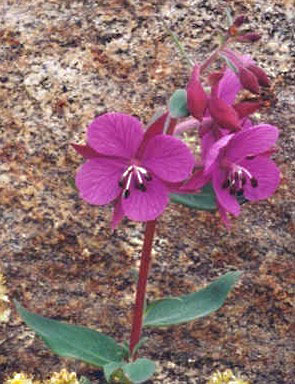
The Onagraceae are a family of flowering plants known as the willowherb family or evening primrose family. They include about 650 species of herbs, shrubs, and trees in 17 genera. The family is widespread, occurring on every continent from boreal to tropical regions.

The Circaea, or enchanter's nightshades, are a genus of flowering plants in the evening primrose family Onagraceae. About two dozen taxa have been described, including eight species. Plants of the genus occur throughout the temperate and boreal forests of the Northern Hemisphere. Three taxa occur in North America: Circaea alpina, Circaea canadensis, and the hybrid Circaea × sterilis. The generic name Circaea refers to the enchantress Circe from Greek mythology who is said to have used the herb as a charm.

Fuchsia excorticata, commonly known as tree fuchsia, New Zealand fuchsia and by its Māori name kōtukutuku, is a New Zealand native tree belonging to the family Onagraceae. It is commonly found throughout New Zealand and as far south as the Auckland Islands. It grows from sea level up to about 1,000 m (3,300 ft), particularly alongside creeks and rivers. It is easily recognised in its native environment by the characteristic appearance of its bark, which peels spontaneously, hanging in red papery strips to show a pale bark underneath. Its scientific name, excorticata, reflects this distinctive property.
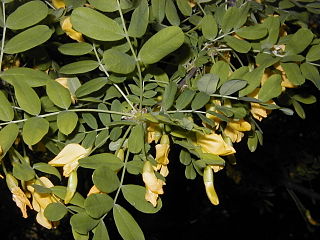
Caragana arborescens, the Siberian peashrub, Siberian pea-tree, or caragana, is a species of legume native to Siberia and parts of China and neighboring Mongolia and Kazakhstan. It was taken to the United States by Eurasian immigrants, who used it as a food source while travelling west. In some areas of the United States it is considered an invasive species. Introduced on the Canadian prairies in the 1880's, the hardy caragana provided shelter-belts, wildlife habitat, nitrogen fixation, and wind-breaks to prevent soil erosion and snow drifting.

Psorothamnus is a genus of plants in the legume family. These are shrubs and small trees. Many are known by the general common name indigo bush. Some are referred to as daleas, as this genus was once included in genus Dalea. These are generally thorny, thickly branched, strongly scented bushes. Most species bear lupinlike raceme inflorescences of bright purple legume flowers and gland-rich pods. Psorothamnus species are native to the southwestern United States and northern Mexico. The genus is paraphyletic and it has been proposed that the genus Psorodendron be reinstated to accommodate sections Xylodalea, Capnodendron, and Winnemucca.

Buchanania arborescens, commonly known as the little gooseberry tree or sparrow's mango, is a small and slender tree native to seasonal tropical forests of northern Australia, Southeast Asia, and the Solomon Islands.

Iochroma arborescens is a species of flowering plant in the genus Iochroma, belonging to the nightshade family Solanaceae. Formerly it was considered the single species in the monotypic genus Acnistus. Common names include gallinero, mata-gallina, fruta-de-sabiá, hollowheart, wild tobacco, siyou, bastard sirio, galán arbóreo, tabaco de monte, nigüito, marieneira, güitite, and tabak djab.

Fuchsia triphylla is one of over 110 species that comprise the genus Fuchsia. Due to its attractiveness and its extensive blooming period which spans from early spring to late autumn, the plant has found a major role as a popular species to breed. This has a resulted in an extensive breed of cultivars allowing it to grow in various settings around the world. The visually appealing flowers of the Fuchsia triphylla have contributed to some of the most elegant Fuchsia hybrids produced today.

Crassula arborescens, the silver jade plant, silver dollar plant, beestebul, Chinese jade, money plant, or money tree, is a species of succulent plant in the family Crassulaceae. It is an endemic plant of the Western Cape, South Africa. It is a 2 to 4 ft succulent shrub. It has round gray "Silver Dollar" leaves. It blooms in summer, with white to pink flowers. It is cultivated as an ornamental plant for use in drought tolerant and succulent gardens, and in container gardens. It is also suitable for growing indoors as a houseplant.

Dysoxylum arborescens, commonly known in Australia as Mossman mahogany, is a small tree in the mahogany family Meliaceae. It is native to rainforests of Malesia, Papuasia, Queensland and nearby islands.

Borrichia arborescens is a species of flowering plant in the family Asteraceae known by the common name tree seaside tansy. It is native to the Yucatán Peninsula, Cuba, Jamaica, Bahamas, Cayman Islands, Hispaniola, Puerto Rico, Bermuda, the Florida Keys, and other islands in the region. It is found on rocky and sandy coasts, in both beaches and marshes.

Fuchsia procumbens is a prostrate shrub that is endemic to coastal areas of the North Island of New Zealand. Common names include creeping fuchsia, climbing fuchsia or trailing fuchsia.

Aculops fuchsiae, commonly known as fuchsia gall mite, is a species of mite in the family Eriophyidae. It feeds on Fuchsia plants, causing distortion of growing shoots and flowers. It is regarded as a horticultural pest.
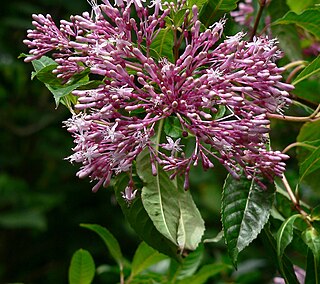
Fuchsia paniculata is a plant of the genus Fuchsia native to Central America. It belongs to the section Schufia and is most closely related to Fuchsia arborescens.
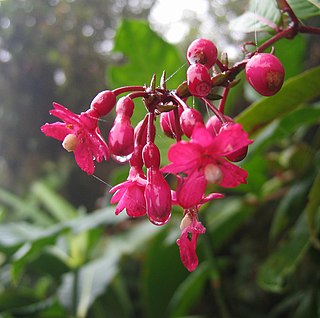
Fuchsia jimenezii is a plant of the genus Fuchsia native to Central America. It belongs to the section Jimenezia and is most closely related to the lineage that gave rise to Fuchsia arborescens and Fuchsia paniculata.

Hauya is a genus of plants of the family Onagraceae native to montane Central America. They are related to a lineage that gave rise to Fuchsia and Circaea.

Achyranthes arborescens is a plant in the Amaranthaceae family endemic to Norfolk Island. It is a critically endangered species under the Australian Federal government's Environment Protection and Biodiversity Conservation Act.
Paul Edward Berry is an American botanist and curator. He is Director of the Wisconsin State Herbarium.
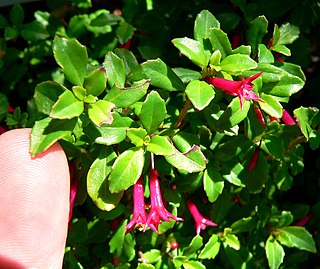
Fuchsia microphylla, also known as small leaf fuchsia and small-leaved fuchsia, is a flowering shrub in the family Onagraceae. The specific epithet (microphylla) was named for the plant's small (micro) leaves (phylla).


