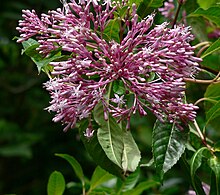
Fuchsia is a genus of flowering plants that consists mostly of shrubs or small trees.
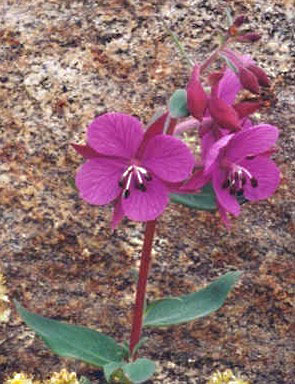
The Onagraceae are a family of flowering plants known as the willowherb family or evening primrose family. They include about 650 species of herbs, shrubs, and trees in 17 genera. The family is widespread, occurring on every continent from boreal to tropical regions.

The Circaea, or enchanter's nightshades, are a genus of flowering plants in the evening primrose family Onagraceae. About two dozen taxa have been described, including eight species. Plants of the genus occur throughout the temperate and boreal forests of the Northern Hemisphere. Three taxa occur in North America: Circaea alpina, Circaea canadensis, and the hybrid Circaea × sterilis. The generic name Circaea refers to the enchantress Circe from Greek mythology who is said to have used the herb as a charm.

Fuchsia excorticata, commonly known as tree fuchsia, New Zealand fuchsia and by its Māori name kōtukutuku, is a New Zealand native tree belonging to the family Onagraceae. It is commonly found throughout New Zealand and as far south as the Auckland Islands. It grows from sea level up to about 1,000 m (3,300 ft), particularly alongside creeks and rivers. It is easily recognised in its native environment by the characteristic appearance of its bark, which peels spontaneously, hanging in red papery strips to show a pale bark underneath. Its scientific name, excorticata, reflects this distinctive property.
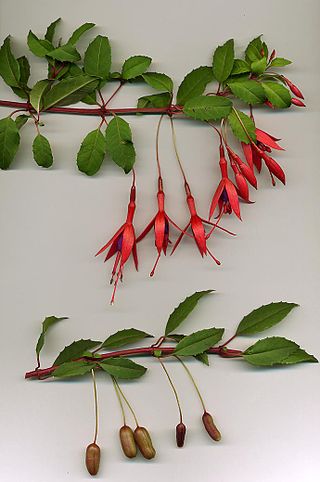
Fuchsia magellanica – commonly known as the hummingbird fuchsia, hardy fuchsia or chilco – is a species of flowering plant in the evening primrose family Onagraceae, native to the lower Southern Cone of southern South America.

Fuchsia loxensis is a species of fuchsia in the family Onagraceae. It is endemic to Ecuador.
Fuchsia triphylla is one of over 110 species that comprise the genus Fuchsia. Due to its attractiveness and its extensive blooming period which spans from early spring to late autumn, the plant has found a major role as a popular species to breed. This has a resulted in an extensive breed of cultivars allowing it to grow in various settings around the world. The visually appealing flowers of the Fuchsia triphylla have contributed to some of the most elegant Fuchsia hybrids produced today.

Fuchsia procumbens is a prostrate shrub that is endemic to coastal areas of the North Island of New Zealand. Common names include creeping fuchsia, climbing fuchsia or trailing fuchsia.

Fuchsia arborescens, commonly known as the tree fuchsia, is a tree of the genus Fuchsia native to Central America. It belongs to the section Schufia and is most closely related to Fuchsia paniculata.
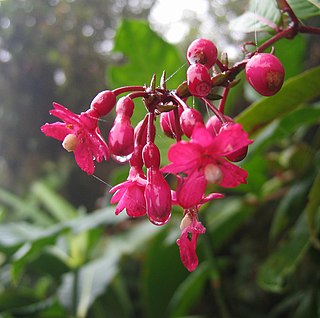
Fuchsia jimenezii is a plant of the genus Fuchsia native to Central America. It belongs to the section Jimenezia and is most closely related to the lineage that gave rise to Fuchsia arborescens and Fuchsia paniculata.

Hauya is a genus of plants of the family Onagraceae native to montane Central America. They are related to a lineage that gave rise to Fuchsia and Circaea.
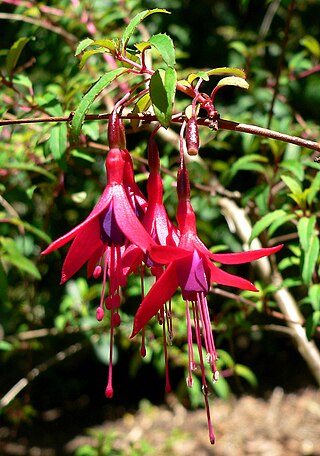
Fuchsia campos-portoi is a plant of the genus Fuchsia native to Brazil.
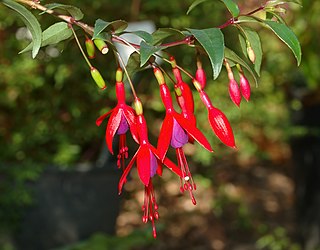
Fuchsia regia is a plant species in the genus Fuchsia native to Brazil.

Fuchsia simplicicaulis is a species of shrub in the family Onagraceae. It is endemic to Peru. Its Herbaria type is electrotype MA 11/92 11.
Paul Edward Berry is an American botanist and curator. He is Director of the Wisconsin State Herbarium.

Fuchsia glazioviana, called Glaziou's fuchsia, is a species of flowering plant in the genus Fuchsia, native to southeast Brazil. It has gained the Royal Horticultural Society's Award of Garden Merit.

Fuchsia hatschbachii, called Hatschbach's fuchsia, is a species of flowering plant in the genus Fuchsia, endemic to the state of Paraná in Brazil. It has gained the Royal Horticultural Society's Award of Garden Merit. The species is named after Gert Hatschbach, Director of the Museu Botânico de Curitiba who collects and studies flora of Paraná.
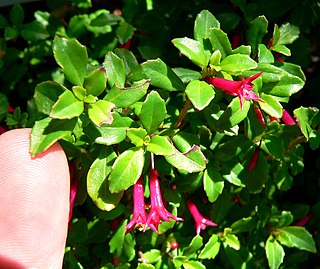
Fuchsia microphylla, also known as small leaf fuchsia and small-leaved fuchsia, is a flowering shrub in the family Onagraceae. The specific epithet (microphylla) was named for the plant's small (micro) leaves (phylla).

Fuchsia bracelinae is a species of Fuchsia found in Brazil.

Fuchsia coccinea is a species of Fuchsia found in Brazil.