Warren County is a county in the U.S. state of New York. As of the 2010 census, the population was 65,707. The county seat is Queensbury. The county is named in honor of General Joseph Warren, an American Revolutionary War hero of the Battle of Bunker Hill.

Macon County is a county located in the U.S. state of North Carolina. As of the 2010 census, the population was 33,922. Its county seat is Franklin.

The Dixie Highway was a United States automobile highway, first planned in 1914 to connect the US Midwest with the Southern United States. It was part of the National Auto Trail system and was expanded from an earlier Miami to Montreal highway. The final system is better understood as a network of connected paved roads, rather than one single highway. It was constructed and expanded from 1915 to 1929.

Fort Macon State Park is a North Carolina state park in Carteret County, North Carolina, in the United States. Located on Bogue Banks near Atlantic Beach, the park opened in 1936. Fort Macon State Park is the second most visited state park in North Carolina, with an annual visitation of 1.3 million, despite being one of the smallest state parks in North Carolina with 424 acres (1.72 km2). Fort Macon was built as part of the Third System of US fortifications, and was preceded by Fort Hampton of the Second System.

Nikwasi comes from the Cherokee word for "star", Noquisi (No-kwee-shee), and is the site of the Cherokee town which is first found in colonial records in the early 18th century, but is much older. The town covered about 100 acres on the floodplain of the Little Tennessee River. Franklin, North Carolina, was later developed by European Americans around this site.

The Church of the Incarnation built in 1896 is a historic Carpenter Gothic Episcopal church building located at 111 North 5th Street in Highlands, Macon County, North Carolina.
Cumnock formerly known as Egypt is an unincorporated community in northwestern Lee County, North Carolina, United States. It lies on Cumnock Road, about a mile north of U.S. Route 421.
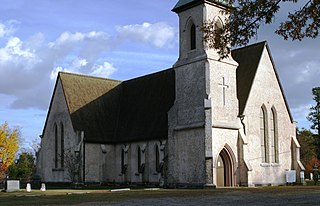
The High Hills of Santee, sometimes known as the High Hills of the Santee, is a long, narrow hilly region in the western part of Sumter County, South Carolina. It has been called "one of the state's most famous areas". The High Hills of Santee region lies north of the Santee River and east of the Wateree River, one of the two rivers that join to form the Santee. It extends north almost to the Kershaw county line and northeasterly to include the former summer resort town of Bradford Springs. Since 1902 the town has been included in Lee County.

Glen Mary is an historical home located in Hancock County, Georgia, near the town of Sparta. The home was listed on the Georgia Register of Historic Places in 1973, and on the National Register of Historic Places on May 8, 1974. As of 2013, Glen Mary is owned by Preservation America.

The Melrose Caverns and Harrison Farmstead is a historic property in rural Rockingham County, Virginia. It is located at 6639 North Valley Pike north of Harrisonburg, Virginia. The property includes a series of caves that have long been a tourist attraction, including visits by soldiers of both sides during the American Civil War. It also includes a c. 1859 Greek Revival farmhouse, and numerous agricultural outbuildings, one of which is a log-structure summer kitchen that may be as old as 1820.

The Baldwin-Coker Cottage is a historic house at 266 Lower Lake Road in Highlands, North Carolina. The Rustic-style 1-1/2 story log house was designed and built in 1925 by James John Baldwin, an architect from Anderson, South Carolina. The cottage is important as a prototype for a number of later houses that were built by members of the construction crew. The walls are constructed of notched logs, whose ends project at random-length intervals, both at the corners of the house, and from the interior, where logs are also used to partition the inside space. The house is topped by a side-gable wood shingle roof. The main gable ends, and the gables of the dormers, are clad in board-and-batten siding. A porch with naturalistic limb-and-twig railings spans the width of the main facade.

The Cowee–West's Mill Historic District encompasses an area of Macon County, North Carolina, which has historic significance predating the arrival of European settlers, and extending into the 20th century. It is located about 6 miles (9.7 km) north of Franklin, the county seat, along either side of Cowee Creek as it flows toward the Little Tennessee River. The district includes the archaeological site and platform mound of the Cherokee town of Cowee, a major settlement until the time of the American Revolutionary War. In the first half of the 19th century the area was developed as a mining community centered on a mill operated by the West family, and after the American Civil War it became one of a small number of rural African-American communities in western North Carolina. The core of the West's Mill area is centered on the junctions of SR 1350, SR 1341, SR 1340, and West's Mill Road, and North Carolina Route 28 is the major road passing through the district. Its northern and southern bounds are roughly where the valley floor gives way to hills on either side of Cowee Creek, ending in the west at Hall Mountain and in the east at the mouth of Caler Creek.
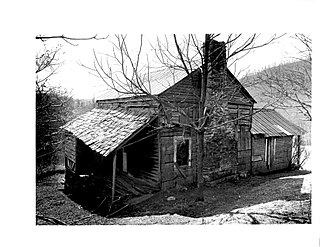
The Charles Noden George House is a historic house in rural Graham County, North Carolina. It is located on the south side of a private road, 0.4 miles (0.64 km) west of SR 1200 and 1 mile (1.6 km) north of United States Route 129, near Tulula Creek. It is a single-pen log structure built c. 1853, which faces east at the top of a 20-acre (8.1 ha) pasture and overgrown orchard. The logs are poplar, and are joined by half-dovetail notches. A fieldstone chimney rises from the uphill side of the structure, and there is a kitchen ell and a wraparound porch on the south and west sides, added c. 1900. It was built by a veteran of the War of 1812 during the second major wave of development in western North Carolina.

The Highlands North Nistoric District encompasses the historic heart of Highlands, North Carolina, a summer resort town high in the state's western mountains. Its 60 acres (24 ha) include some of the first permanent year-round settlements in the town, as well as a high concentration of its oldest surviving structures. It is laid out north of Main Street, the commercial heart of the town, roughly between North 4th Street and North 5th Street.

The Hall Cabin, also known as the J. H. Kress Cabin is a historic log cabin in Great Smoky Mountains National Park, about 15 miles (24 km) from Fontana, North Carolina. The cabin is a rectangular split-log structure 24 feet (7.3 m) wide and 17 feet (5.2 m) deep, with a porch spanning its front. The gable ends of the roof are sheathed in board-and-batten siding. It was built by a man named Hall in 1910, and underwent some remodeling around 1940 when J. H. Kress used it as a hunting lodge. It is located in the drainage of Hazel Creek, an area which historically had a small population and was abandoned after the construction of Fontana Lake and the national park. It is the only structure remaining in its immediate vicinity.
The Playmore–Bowery Road Historic District is a residential historic district composed of a collection of summer resort houses in the hills east of Highlands, North Carolina. The principal estate in the area, called Playmore, was established by the Ravenel family in 1879-80; it is situated on 140 acres (57 ha) south of Horse Cove Road. Bowery Road roughly parallels Horse Cove Road to the north, and is lined with a series of wood-frame summer that were built between about 1880 and 1930.
The Satulah Mountain Historic District is a residential historic district in Highlands, North Carolina. It is located in the southwestern part of the city, bounded on the north and west by Walhalla Road, on the east by properties on Satulah Road. The area is located on the slopes of Satulah Mountain, and was most significantly developed in the early decades of the 20th century, although the earliest development took place not long after Highlands was founded in 1875. There are a number of log houses, and rustic styling using log and fieldstone elements is common in the area. Many houses have Craftsman features.
The Wilson Log House is an historic house in rural Macon County, North Carolina. It is a single story log structure, located west of Highlands, on the west side of State Route 1621, 1.4 miles northwest of its junction with Route 1620. It was built c. 1882 by Jeremiah Wilson, and is one of a small number of period log buildings to survive in the county. The house remained in the Wilson family until the 1950s. It measures about 18' by 20', and is constructed from logs with dovetail joins, and red mud chinking. Its interior consists of a single large chamber, with a stair rising on one side to a loft area under the gable roof. At some point a frame addition was added to the rear of the house, but that has since been removed.
Buck Spring Plantation, also known as the Nathaniel Macon House, is a historic plantation house site located near Vaughan, Warren County, North Carolina. The property includes the graves of politician Nathaniel Macon (1757–1837) and his wife Hannah Plummer Mason, log corn crib, smokehouse, caretaker's house, and reconstructed dwelling house dated to the 1930s.

Foster's Log Cabin Court is located at 330-332 Weaverville Road in Woodfin, North Carolina, about five miles north of the City of Asheville. One of the first auto-oriented tourism facilities in the Asheville area, it features a number of one and two bedroom Rustic Revival log cabins and a dining lodge. It was placed on the National Register of Historic Places in 2017.