Gorki Leninskiye

Last updated

Gorki Leninskiye
Горки Ленинские
Gorki-Leninskie-2022.jpg
Gorki Leninskiye Estate Museum, Main House (June 2022)
Flag of Gorki Leninskie (Moscow oblast).png
Coat of Arms of Gorki Leninskie (Moscow oblast).png
Gorki Leninskiye
Interactive map of Gorki Leninskiye
Russia administrative location map and Crimea dashed.svg
Red pog.svg
Gorki Leninskiye
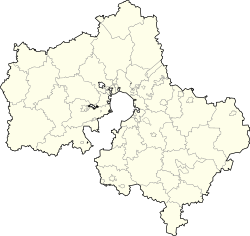
Location of Gorki Leninskiye
Russia Moscow oblast location map.svg
Red pog.svg
Gorki Leninskiye
Gorki Leninskiye (Moscow Oblast)
Coordinates: 55°30′16.2″N37°45′54.1″E / 55.504500°N 37.765028°E / 55.504500; 37.765028
Country Russia
Federal subject Moscow Oblast
Administrative district Leninsky District
Population
  Total
3,586
  Estimate 
(2024)
3,205 (−10.6%)
Time zone UTC+3 (MSK   OOjs UI icon edit-ltr-progressive.svg [2] )
Postal code [3]
142712 OOjs UI icon edit-ltr-progressive.svg
OKTMO ID46628155051

Gorki Leninskiye (Russian, Cyrillic : Горки Ленинские, lit.' Lenin Hill(ock)s') is an urban locality (a work settlement) in Leninsky District of Moscow Oblast, Russia, located 10 kilometers (6.2 mi) south of Moscow city limits and the Moscow Ring Road. Its population is: 3,586(2010 census); [1] 1,729(2002 census); [4] 1,711(1989 Soviet census). [5]

Contents

The estate of Gorki belonged to various Muscovite noblemen from the 18th century. Zinaida Morozova, the widow of Savva Morozov, purchased it in 1909, the year before she married General Anatoly Reinbot (later Anatoly Rezvoy), the chief of Moscow police. [6] She engaged the most fashionable Russian architect, Fyodor Schechtel, to remodel the mansion in the then-current Neoclassical style, complete with a six-column Ionic portico.

On 21 January 1924, Vladimir Lenin, the leader of Bolshevist Russia and subsequently the Soviet Union, died at this estate, which he had used as his personal dacha since its nationalization in 1918.

Lenin's dacha

After the Soviet government moved to Moscow in 1918, it nationalized the luxurious estate and converted it into Vladimir Lenin's dacha. In September 1918, the Soviet leader recuperated there following an assassination attempt. He spent an increasing amount of time there as his health declined over the following years. On May 15, 1923, Lenin followed medical advice and left the Moscow Kremlin for Gorki. He lived there in semi-retirement until his death on January 21, 1924.

1955 stamp depicting Lenin and Nadezhda Krupskaya among the peasants of Gorki Stamp of USSR 1812.jpg
1955 stamp depicting Lenin and Nadezhda Krupskaya among the peasants of Gorki

After Lenin's death, Gorki was renamed Gorki Leninskiye [7] (English: Lenin Hill(ock)s). The house became a museum holding many of Lenin's possessions. Also located on the estate is a large museum built in 1987 concerning Lenin's life there, containing such artifacts as his testament (as transcribed by Nadezhda Krupskaya), other documents, photos, books, Lenin's car (a Rolls-Royce Silver Ghost), his wheelchairs, and his apartment and office from the Kremlin, reconstructed in a separate building. A monument representing "The Death of the Leader" was unveiled in the 18th-century park in 1958.

See also

References

  1. 1 2 Russian Federal State Statistics Service (2011). Всероссийская перепись населения 2010 года. Том 1 [2010 All-Russian Population Census, vol. 1]. Всероссийская перепись населения 2010 года [2010 All-Russia Population Census] (in Russian). Federal State Statistics Service.
  2. "Об исчислении времени". Официальный интернет-портал правовой информации (in Russian). June 3, 2011. Retrieved January 19, 2019.
  3. Почта России. Информационно-вычислительный центр ОАСУ РПО. (Russian Post). Поиск объектов почтовой связи (Postal Objects Search) (in Russian)
  4. Federal State Statistics Service (May 21, 2004). Численность населения России, субъектов Российской Федерации в составе федеральных округов, районов, городских поселений, сельских населённых пунктов – районных центров и сельских населённых пунктов с населением 3 тысячи и более человек [Population of Russia, Its Federal Districts, Federal Subjects, Districts, Urban Localities, Rural Localities—Administrative Centers, and Rural Localities with Population of Over 3,000](XLS). Всероссийская перепись населения 2002 года [All-Russia Population Census of 2002] (in Russian).
  5. Всесоюзная перепись населения 1989 г. Численность наличного населения союзных и автономных республик, автономных областей и округов, краёв, областей, районов, городских поселений и сёл-райцентров [All Union Population Census of 1989: Present Population of Union and Autonomous Republics, Autonomous Oblasts and Okrugs, Krais, Oblasts, Districts, Urban Settlements, and Villages Serving as District Administrative Centers]. Всесоюзная перепись населения 1989 года [All-Union Population Census of 1989] (in Russian). Институт демографии Национального исследовательского университета: Высшая школа экономики [Institute of Demography at the National Research University: Higher School of Economics]. 1989 via Demoscope Weekly.
  6. Murrell, Kathleen Berton (2001). Discovering the Moscow Countryside: An Illustrated Guide to Russia's Heartland. I.B. Tauris. p. 102. ISBN   9781860646737 . Retrieved January 24, 2014. There has been an estate at Gorki since the late 18th century. In 1909 it was purchased by Zinaida Morozova, the widow of Savva Morozov, the wealthy textile merchant and Bolshevik sympathiser. [...] In 1910, five years after Savva's suicide, Zinaida married for the third time [...] General Anatoly Reinbot, the Moscow head of police. Reinbot, who changed his German name to Rezvoy in 1914, fell foul of the law and, although pardoned by Nicholas II, Zinaida divorced him. In 1917 she was evicted from Gorki [...].
  7. Russia Beyond the Headlines. Video on Gorki Leninskiye

Commons-logo.svg Media related to Gorki Leninskiye at Wikimedia Commons