It is named from exposures on a divide south of Harkless Flat in the southern half of the Waucoba Mountain 15-min quadrangle in the Inyo Mountains of central eastern California.[3]
The formation contains two members,[4] which are as follows, in ascending age:
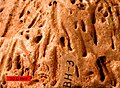
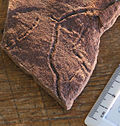
Weepah Member: Near the Andrews Mountain, at the type area of the formation, the member is dominated by greenish-gray and light-olive-gray siltstone, alongside a few layers of yellowish-gray fine to medium grained quartzite. The quartzite layers are identical to the layers found in the Zabriskie Quartzite. The siltstone ranges from grayish-olive, pale-olive, and dark-greenish-gray, and is composed of silt-size grains within a matrix of muscovite and chlorite, and is thinly laminated. They have also slightly metamorphosed, resulting in phyllite or hornfels. The hornfels are primarily composed of muscovite, chlorite, biotite, and quartz. Trace fossils are relatively common within the type area.[1] Within the Esmeralda County, Nevada, the lower sections of the member is still dominated by siltstone, although this differs greatly from the siltstones higher up in the formation. This is due to the layers being quartzitic, coarser and more resistant to natural erosion. The sizes of the grains within these layers hovers around the boundary between coarse silt and very fine sand.[1]
Alkali Member: The upper Alkali member is composed of limestone layers, up to 100ft (30m) thick, inter-stratified with siltstone, and contain an abundance of archeocyathid sponges. Further still there are light-brown limestone layers, only up to 1ft (0.30m) thick, that contain Salterella, and are also inter-stratified with the siltstone layers in the middle of the formation. More limestone can be found at the top of the member, being gray or locally yellowish-brown, and up to 40ft (12m) thick.[1] In some areas of the member, there are also tongues from the Zabriskie Quartzite, composed primarily of medium-grained quartzite, and can get up to 300ft (91m) thick in some places, and inter-stratify with the siltstones. The colour of the quartzite is commonly yellowish-gray or greenish-gray. It is also laminated to thin-bedded. Trace fossils are also common within these quartzite tongues, also appearing on the underlying siltstone layers.[1]
12345Wotte, Thomas; Sundberg, Frederick A. (September 2017). "Small shelly fossils from the Montezuman–Delamaran of the Great Basin in Nevada and California". Journal of Paleontology. 91 (5): 883–901. doi:10.1017/jpa.2017.8.
↑"Geologic Unit: Harkless". National Geologic Map Database. U.S. Geological Survey. Retrieved 23 April 2022.
123456789101112131415Sundberg, Frederick A.; Webster, Mark (July 2022). ""Ptychoparioid" trilobites of the Harkless Formation and Mule Spring Limestone (Cambrian Series 2, Stage 4), Clayton Ridge, Nevada". Journal of Paleontology. 96 (4): 886–920. doi:10.1017/jpa.2021.124.
123456789Skovsted, Christian B.; Holmer, Lars E. (December 2006). "The Lower Cambrian brachiopod Kyrshabaktella and associated shelly fossils from the Harkless Formation, southern Nevada". GFF. 128 (4): 327–337. doi:10.1080/11035890601284327.
1234567Pruss, Sara B.; Smith, Emily F.; Leadbetter, Olivia; Nolan, Rhiannon Z.; Hicks, Melissa; Fike, David A. (December 2019). "Palaeoecology of the archaeocyathan reefs from the lower Cambrian Harkless Formation, southern Nevada, western United States and carbon isotopic evidence for their demise". Palaeogeography, Palaeoclimatology, Palaeoecology. 536 109389. doi:10.1016/j.palaeo.2019.109389.
↑Skovsted, Christian B.; Peel, John S. (January 2011). "Hyolithellus in life position from the Lower Cambrian of North Greenland". Journal of Paleontology. 85 (1): 37–47. doi:10.1666/10-065.1.
↑Yang, Jie; Lan, Tian; Zhang, Xi-guang; Smith, Martin R. (16 March 2023). "Protomelission is an early dasyclad alga and not a Cambrian bryozoan". Nature. 615 (7952): 468–471. doi:10.1038/s41586-023-05775-5.
This page is based on this Wikipedia article Text is available under the CC BY-SA 4.0 license; additional terms may apply. Images, videos and audio are available under their respective licenses.