Henry Lee Hau Shik

Last updated

Yang Amat Berbahagia Tun
Henry Lee Hau Shik
SMN, KBE, JP
李孝式
Tun Henry H S Lee.jpg
1st Finance Minister of the Federation of Malaya
In office
31 August 1957 22 August 1959
Monarch Abdul Rahman
Preceded by Position established
Succeeded by Tan Siew Sin
Transport Minister of Malaya
In office
1 August 1955 31 August 1957
Monarch Elizabeth II
Preceded by Position established
Succeeded by Abdul Rahman Talib
Personal details
Born(1900-11-19)19 November 1900
Hong Kong
Died 22 June 1988(1988-06-22) (aged 87)
Kuala Lumpur, Malaysia
Political party Malaysian Chinese Association (MCA)
Spouse(s) Dawn Kathleen Glen
Kwan Choi Lin
Children Douglas K.K. Lee (M)
Thomas M.L. Lee (M)
Alex Y.L. Lee (M)
George Y.L. Lee (M)
Jasmine Lee (F)
Residence Kuala Lumpur, Malaysia
Occupation Politician, businessman, banker, lawyer

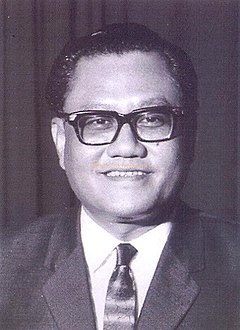
Colonel Tun Henry Lee Hau Shik SMN KBE JP (19 November 1900 – 22 June 1988), also known as H.S. Lee, was a Malaysian Chinese politician and businessman who served as the first Finance Minister of the Federation of Malaya and co-founded the Malaysian Chinese Association and Alliance Party, forerunner to Malaysia's ruling coalition Barisan Nasional. Lee was also a member of the Merdeka mission to London and the only Chinese signatory to Malaya's independence agreement with Britain. He was the only major leader of the independence movement not born in Malaya. [1]

Colonel is a senior military officer rank below the brigadier and general officer ranks. However, in some small military forces, such as those of Monaco or the Vatican, colonel is the highest rank. It is also used in some police forces and paramilitary organizations.

The Malay language has a complex system of styles, titles and honorifics, which are used extensively in Brunei and Malaysia. Singapore, whose Malay royalty was abolished by the British colonial government in 1891, has adopted civic titles for its leaders. The Philippines historically used Malay titles during its pre-Hispanic period, as evidenced by the titles of historical figures such as Rajah Sulayman, Lakandula and Dayang Kalangitan. Malay titles are still used by the royal houses of Sulu, Maguindanao, Buayan, and Maranao on the southern Philippine island of Mindanao, but these are retained on a traditional basis, as the 1987 Constitution explicitly reaffirms the abolition of royal and noble titles in the republic. Indonesia, meanwhile, as a republic, does not recognize hereditary rulers and aristocratic systems. Nevertheless, their royal titles and honors are still used as courtesy titles.

Order of the British Empire order of chivalry of British constitutional monarchy

The Most Excellent Order of the British Empire is a British order of chivalry, rewarding contributions to the arts and sciences, work with charitable and welfare organisations, and public service outside the civil service. It was established on 4 June 1917 by King George V and comprises five classes across both civil and military divisions, the most senior two of which make the recipient either a knight if male or dame if female. There is also the related British Empire Medal, whose recipients are affiliated with, but not members of, the order.

Contents

Early life and education

Henry Lee Hau Shik was born on 19 November 1900 in Hong Kong, the eldest son of prominent and wealthy businessman Lee Kwai-Lim and Kam Kwok-Chun. His family ran a silk-trading firm, Kam Lun Tai, and was also involved in remittance and mining, with offices in Hong Kong and Singapore. [2] He had two brothers and two sisters.

Hong Kong East Asian city

Hong Kong, officially the Hong Kong Special Administrative Region of the People's Republic of China and commonly abbreviated as HK, is a special administrative region on the eastern side of the Pearl River estuary in southern China. With over 7.4 million people of various nationalities in a 1,104-square-kilometre (426 sq mi) territory, Hong Kong is the world's fourth most densely populated region.

Lee's great-grandfather had been a senior official during the reign of Emperor Tongzhi of the Qing dynasty while his grandfather was a famous scholar and philanthropist in his hometown of Zhenlong, Xinyi in Guangdong.[ who? ]

Tongzhi Emperor emperor of the Qing Dynasty

The Tongzhi Emperor, born Zaichun of the Aisin Gioro clan, was the tenth emperor of the Manchu-led Qing dynasty, and the eighth Qing emperor to rule over China proper. His reign, from 1861 to 1875, which effectively lasted through his adolescence, was largely overshadowed by the rule of his mother, Empress Dowager Cixi. Although he had little influence over state affairs, the events of his reign gave rise to what historians call the "Tongzhi Restoration", an unsuccessful attempt to stabilise and modernise China.

Qing dynasty former empire in Eastern Asia, last imperial regime of China

The Qing dynasty, officially the Great Qing, was the last imperial dynasty of China. It was established in 1636, and ruled China proper from 1644 to 1912. It was preceded by the Ming dynasty and succeeded by the Republic of China. The Qing multi-cultural empire lasted for almost three centuries and formed the territorial base for modern China. It was the fifth largest empire in world history. The dynasty was founded by the Manchu Aisin Gioro clan in Manchuria. In the late sixteenth century, Nurhaci, originally a Ming Jianzhou Guard vassal, began organizing "Banners", military-social units that included Manchu, Han, and Mongol elements. Nurhaci formed the Manchu clans into a unified entity. By 1636, his son Hong Taiji began driving Ming forces out of the Liaodong Peninsula and declared a new dynasty, the Qing.

Xinyi, Guangdong County-level city in Guangdong, Peoples Republic of China

Xinyi, formerly romanized as Sunyi, is a county-level city in Guangdong Province, China. It is administered as part of the prefecture-level city of Maoming in the southwestern corner of the province, bordering Guangxi to the west. It has a population of 913,708 people.

Lee received his secondary education in Guangzhou in 1914, before attending Queen's College in Hong Kong. He completed degrees in Economics and Law at the University of London and St John's College, Cambridge, [3] where he came to know the future King George VI. [2]

Queens College, Hong Kong secondary school in Hong Kong

Queen's College, initially named The Government Central School in 1862, later renamed as Victoria College (皇后書院) in 1889, is a selective sixth form college for boys with a secondary school attached. It was the first public secondary school founded in Hong Kong by the British colonial government. Queen's College obtained its present name in 1894 and is now located at Causeway Bay, Hong Kong.

University of London federal public university in London, United Kingdom

The University of London is a collegiate federal research university located in London, England. As of October 2018, the university contains 18 member institutions, central academic bodies and research institutes. The university has over 52,000 distance learning external students and 161,270 campus-based internal students, making it the largest university by number of students in the United Kingdom.

St Johns College, Cambridge college of the University of Cambridge

St John's College is a constituent college of the University of Cambridge. The college was founded by Lady Margaret Beaufort. In constitutional terms, the college is a charitable corporation established by a charter dated 9 April 1511. The aims of the college, as specified by its statutes, are the promotion of education, religion, learning and research.

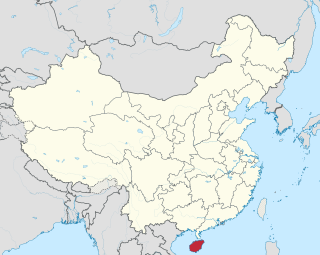
Lee's first job was as a government servant in Hainan, which he quit after three days as his boss would only play mahjong all day. [4] He then worked at P&O Bank in Hong Kong. [2]

Hainan Smallest and southernmost province of the Peoples Republic of China

Hainan is the smallest and southernmost province of the People's Republic of China (PRC), consisting of various islands in the South China Sea. Hainan Island, separated from Guangdong's Leizhou Peninsula by the Qiongzhou Strait, is the largest and most populous island under PRC control and makes up the majority of the province.

Mahjong game

Mahjong is a tile-based game that was developed in China during the Qing dynasty and has spread throughout the world since the early 20th century. It is commonly played by four players. The game and its regional variants are widely played throughout Eastern and South Eastern Asia and have become popular in Western countries too. The game has also been adapted into a widespread online entertainment. Similar to the Western card game rummy, Mahjong is a game of skill, strategy, and calculation and involves a degree of chance.

P&O Banking Corporation, was a bank established in 1920, by Peninsular and Oriental Steam Navigation Company to develop its private banking business.

Life in Malaya

Lee came to Malaya on holiday in 1924 and stayed on after acquiring a tin mine in Kepong, subsequently establishing himself as a major tin mine owner in Selangor and Perak. [5]

In Malaya, Lee was deeply involved in Chinese guild and clan associations and became a recognised leader of the Guangdong and Gaozhou communities. [4] He helped form the Kwantung Association, Chinese Mining Association and Chinese Chamber of Commerce. [2] He was also president of the Miners' Association of Negeri Sembilan, Selangor and Pahang from 1938 to 1955 and president of the Pan-Malayan Association of Tin Miners between 1946 and 1955. [6]

At various times, he was president of the Selangor Kwang Tung Association, National Kwang Tung Association, Pan-Malayan Kochow Association, United Lees' Association, Federation of Malaya Red Cross Association and Kuen Cheng Girls School. [6]

When Japan invaded China in 1937, Lee, who was known for his association with China's Kuomintang Party, headed the Selangor China Relief Fund in support of China. He was later made Chief of the Passive Defence Forces of Kuala Lumpur in 1941. Due to his anti-Japanese war efforts, Lee was forced to flee with his family to Mumbai via Chongqing when the war reached Malaya that same year and the Japanese put out a bounty on him. [2] [4] [7]

Lee was made a colonel in the Kuomintang army, then based in Burma, after meeting Chiang Kai-shek in Chongqing. Later, Lee was also made a colonel of the British Army in India and liaised between the two Allied armies along the China-Burma border for the remainder of the war. [2] [4]

Political career

After World War II, Lee was appointed to committees tasked with rebuilding the Malayan economy, which had suffered during the Japanese occupation. When emergency rule was imposed by the British in 1948 in response to the communist insurgency, he was appointed to the Malayan Union Advisory Council, Federal Legislative Council and Federal Executive Council.

Lee was also advisor to the Director of Operations representing the mining and farming communities, and managed to persuade British High Commissioner to Malaya Gerald Templer to reorganise the Home Guard in the Kinta Valley so they could defend the tin mines. For his active opposition to the communists, he was branded a "running dog of the British" and a sum of 60,000 Malayan dollars was put on his head. [6]

In time, Lee felt it was necessary for the Chinese community to distinguish itself from ethnic Chinese communist supporters and formed the Selangor Malayan Chinese Association (MCA), with the support of the Chinese Chamber of Commerce and Chinese guilds in the state. Other states eventually followed his lead and set up their own associations. Lee remained head of Selangor MCA until 1955, when he lost the post to Ong Yoke Lin. [8]

Lee was also involved in founding the central body of the MCA in 1949. He drafted the party's rules and regulations together with Yong Shook Lin and Khoo Teik Ee, and was instrumental in getting Tan Cheng Lock to become chairman of the MCA steering committee and its first president. [6]

Alliance Party

Lee played a key role in forging an ad hoc arrangement with the United Malays National Organisation (UMNO) to contest in the 1952 local elections that would later evolve into the Alliance Party, predecessor to the Barisan Nasional coalition that has governed Malaysia since independence. [1]

Lee, in his capacity as Selangor MCA chief, and Kuala Lumpur UMNO chairman Yahya Razak agreed to field a single slate of candidates in Kuala Lumpur to counter the formidable Independence of Malaya Party (IMP). The IMP was led by UMNO's founder Onn Jaafar and enjoyed support from several MCA leaders – including MCA president Tan Cheng Lock – due to the party's non-communal stance. [1] [4] [9]

Lee had attracted Yahya's attention with the election manifesto he penned for Selangor MCA, which declared that "the interests of the members of the other communities should also be represented" despite Kuala Lumpur's large Chinese population. Yahya then contacted former Victoria Institution schoolmate Ong Yoke Lin, another MCA leader, who fixed a meeting of representatives from MCA and UMNO. On 7 January 1952, both sides agreed to contest jointly in elections, fielding 12 candidates – five Malays, six Chinese and one Indian. [9]

The local electoral pact was at first opposed from within both MCA and UMNO. Senior MCA leaders Tan Siew Sin and Khoo Teik Ee declared during the campaign period that the party's central working committee had not approved the alliance and called on voters to support the non-racial IMP. Yahya was accused of selling out the Malays by working with the Chinese and his division head Datin Putih Mariah resigned just days before elections in protest. [9]

In the end, the UMNO-MCA ticket won 9 of the 12 seats contested in Kuala Lumpur, failing only to win any seat in Bangsar. In the weeks after the Kuala Lumpur elections, Lee was in contact with UMNO president Tunku Abdul Rahman, who mooted a nationwide alliance of the two parties. Despite some initial reluctance, Tan Cheng Lock, who had preferred to work with Onn, eventually agreed to meet Tunku together with Lee on 18 March 1952 to discuss the merger. After several more rounds of talks with other MCA leaders, the Alliance Party was institutionalised. [1]

Lee had managed to bring Tan around to his point of view by alerting him to the Select Committee's Report on the Immigration Ordinance of 1950, in which Onn was a signatory to a Majority Report with recommendations that were unfavourable to the Chinese and were opposed by Chinese members of the Legislative Council. This raised doubts in Tan's mind about Onn's commitment to multi-racial fairness. [9]

The Alliance would go on to sweep local elections held elsewhere that year and decisively win the 1955 general election to form the first locally elected government, with Tunku as chief minister. Lee was appointed transport minister, one of three portfolios held by MCA in Tunku's Cabinet. [10]

Road to independence

In 1956, Lee and Tan Tong Hye were selected to represent MCA as part of an Alliance delegation that went to London to pressure Britain into granting independence to Malaya. Lee was the only Chinese signatory to the independence agreement concluded in London that year. [1] [10] With independence in 1957, Tunku, now prime minister, appointed Lee as Malaya's first finance minister. His primary task included establishing the country's financial policy and the creation of a Central Bank of Malaya. Lee resigned from the post two years later due to ill health. [4]

Upon retiring from politics in 1959, Lee assumed the post of Financial Chairman for the Board of Commissioners of Currency Malaya until 1961. In 1966, he established the Development and Commercial Bank (D&C Bank), which became Malaysia's fifth largest bank. He would head the bank until his death in 1988. [5]

Other achievements

Lee was a keen sportsman and avid golfer. He was appointed president of the Senior Golfers Club as well as the Golf Association of Malaya in 1957. Between 1957 and 1959, he headed the Federation of Malaya Olympics Council. In addition, he practised taijiquan for health reasons. [6]

Lee was the first president of the Oxford and Cambridge Society of Malaysia. [11]

He also founded China Press in 1946 to counter the communist influence of Min Sheng Pao, the only local Chinese newspaper at that time. [2] [5]

Personal life

Lee met his first wife Dawn Kathleen Glen, an Englishwoman, while studying at Cambridge. They had two sons, Douglas and Vivien Leslie, in Hong Kong. Glen returned to Britain for good with Vivien after falling afoul of Lee's mother, who disliked her daughter-in-law's penchant for smoking and sports cars. Lee married his second wife, Kwan Choi Lin, with whom he had seven more children. He named his children after the places where they were born. [12]

Two of his sons also entered politics. Douglas Lee Kim Kiu contested successfully in the 1952 Kuala Lumpur elections while Alexander Lee Yu Lung was briefly in MCA before joining Gerakan and assuming several deputy minister posts between 1989 and 1995. [2]

Honours

Lee was appointed a Commander of the Order of the British Empire (CBE) in 1948 by King George VI and Knight Commander of the Order of the British Empire (KBE) in 1957 by Queen Elizabeth II in recognition of his services to the British colonial government. [6]

In 1959, Lee was awarded the Seri Maharaja Mangku Negara, which carries with it the title "Tun", for his significant contributions to Malaya's independence struggle and nation-building. He was the 10th recipient of the award. [6]

Jalan Bandar, originally known as High Street, was renamed Jalan Tun H.S. Lee in his honour in November 1988. [4]

Honours

Honours of Malaysia

International Honours

Related Research Articles

Malaysian Indian Congress political party

The Malaysian Indian Congress is a Malaysian political party and is one of the founding members of Barisan Nasional, previously known as the Alliance, that was in power from when the country achieved independence in 1957 until the recent 2018 elections. The party was among the first to fight for Malayan Independence and one of the oldest parties in Malaysia.

Abdul Razak Hussein Malaysian politician

Tun Haji Abdul Razak bin Dato' Hussein SMN KStJ b. 11 March 1922; d. 14 January 1976) was the second Prime Minister of Malaysia, serving from 1970 to 1976.
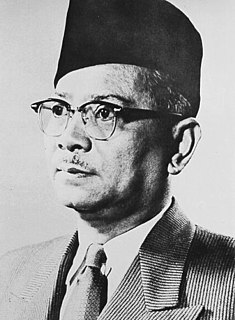
Tunku Abdul Rahman Malaysian politician

Tunku Abdul Rahman Putra Al-Haj ibni Almarhum Sultan Abdul Hamid Halim Shah, ; was a Malaysian politician who served as the first Chief Minister of the Federation of Malaya from 1955 to 1957, before becoming Malaya's first Prime Minister after independence in 1957. He remained Prime Minister following the formation of Malaysia in 1963, when Sabah, Sarawak, and Singapore joined the federation, until his resignation in 1970.

Hussein Onn Malaysian politician

Tun Hussein bin Dato' Onn,, was the third Prime Minister of Malaysia, serving in this role from 1976 to 1981 and also served for Sri Gading constituency. Born in Johor Bahru, Johor, to Dato' Onn Jaafar and Datin Halimah Hussein, he is of 3/4 Malay and 1/4 Circassian ancestry. He was granted the soubriquet "Bapa Perpaduan".

United Malays National Organisation Malaysian political party

The United Malays National Organisation is Malaysia's main opposition political party. It is a founding member of the Barisan Nasional coalition which, with its predecessor the Alliance, had been the government of Malaysia and dominated the country's politics from independence until 2018. Until then, all of Malaysia's Prime Ministers had been members of UMNO, until Mahathir Mohamad became the first prime minister from Pakatan Harapan, and the first prime minister to have tenures with two different parties.

Tan Cheng Lock Malaysian politician

Tun Dato' Tan Cheng Lock was a Chinese Malaysian businessman and a key public figure who devoted his life to fighting for the rights and the social welfare of the Chinese community in Malaya. Tan was also the founder and the first president of the Malayan Chinese Association (MCA), which advocated his cause for the Malaysian Chinese population.
PAP–UMNO relations

The sometimes turbulent relationship between the People's Action Party (PAP), the ruling party of Singapore since 1959, and United Malays National Organisation (UMNO), the ruling party of Malaysia between around 1955 and May 2018, has affected the recent history of both states.

Onn Jaafar Malaysian politician

Dato' Sir Onn bin Dato' Jaafar was a Malay politician and a Menteri Besar of Johore in Malaysia, then Malaya. He was the founder of United Malays National Organisation (UMNO) and was also responsible for the social economic welfare of the Malays by setting up the Rural Industrial Development Authority (RIDA). His son was Tun Hussein Onn, the third Prime Minister of Malaysia and his grandson is Hishammuddin Hussein.

Tan Siew Sin Malaysian politician

Tun Tan Siew Sin was a Malayan politician who was the first Minister of Commerce and Industry, Finance Minister for 15 years, and third president of the Malayan Chinese Association, a major component party of Alliance and later National Front (BN) coalition.

Ismail Abdul Rahman Malaysian politician

Tun Dr. Ismail bin Dato' Abdul Rahman was a Malaysian politician from the United Malays National Organisation (UMNO). He held several Malaysian ministerial posts and was appointed as the second Deputy Prime Minister in 1970 by then Prime Minister Tun Abdul Razak. Three years later, Ismail died in office due to a heart attack. Ismail has been called "the man who saved Malaysia" for his actions as Home Minister after the May 13 Incident of racial rioting in 1969.
Independence of Malaya Party

The Independence of Malaya Party was a political party in British-ruled Malaya that stood for political independence. Founded by Onn Ja'afar after he left UMNO in 1951, it opposed the UMNO policy of Malay supremacy.

Dato' Sir Ernest Emmanuel Clough Thuraisingham or E.E.C. Thuraisingham was the first local Member (Minister) for Education in the Communities Liaison Committee formed to build communal fraternity in British-ruled Malaya, from 1951–1955. He is also the first Asian chairman of the Selangor Turf Club.
Khir Johari Malaysian politician and sports administrator

Tan Sri Dato' Paduka Md Khir Johari was a Malaysian politician and the former Malaysian Minister of Education.

Abdul Aziz bin Ishak (1913–1999) was a Malaysian freedom fighter, politician and journalist.

DatoAhmad Boestaman, or Abdullah Sani, was a Malaysian freedom fighter, politician and was the founding president of Parti Rakyat Malaysia and Parti Marhaen Malaysia.

1955 Malayan general election

A general election was held on Wednesday, 27 July 1955, the only general election before Malaya's independence in 1957. It was held to elect members of the Federal Legislative Council, which prior to this was fully appointed by the British High Commissioner in Malaya. Voting took place in all 52 federal constituencies of Malaya, each electing one Federal Councillor to the Federal Legislative Council. State elections also took place in all 136 state constituencies in 9 states of Malaya and 2 settlements from 10 October 1954 to 12 November 1955, each electing one Councillor to the State Council or Settlement Council.

Alliance Party (Malaysia) political coalition in Malaysia

The Alliance Party was a political coalition in Malaysia. The Alliance Party, whose membership comprised United Malays National Organisation (UMNO), Malaysian Chinese Association (MCA) and Malaysian Indian Congress (MIC), was formally registered as a political organisation on 30 October 1957. It was the ruling coalition of Malaya from 1957 to 1963, and Malaysia from 1963 to 1973. The party became the Barisan Nasional in 1973.

Tun Haji Omar Ong Yoke Lin was a Malaysian politician, diplomat and businessman. He was a founding member of the Malaysian Chinese Association, and was a key figure in the country's road to independence. Ong served various positions in the government of Malaya and Malaysia, as a Cabinet minister and ambassador.

Tan Sri Mohammed Tahir Tan Tong Hye, also known as T. H. Tan (陈东海), was a Singapore-born journalist and politician who became the Secretary of the Malayan Chinese Association (MCA) and the first honorary Secretary-General of the Alliance Party in Malaya. He is mainly remembered for being among the three men who took part in the UMNO-MCA Alliance delegation to London in 1954 to demand for an effective elected majority in the Federal Legislative Council of Malaya.

Tan Sri Nik Ahmad Kamil bin Nik Mahmud was a Malaysian politician who played an active role during the country's road to independence. A prominent member of the United Malays National Organisation (UMNO) in the state of Kelantan, he served as the fourth Speaker of the Dewan Rakyat, the lower house of the Malaysian Parliament.

References

  1. 1 2 3 4 5 "A key man behind the alliance". The Star . 2007-07-30. Retrieved 2016-01-22.
  2. 1 2 3 4 5 6 7 8 "A long street of historical gems". The Star . 2013-12-27. Retrieved 2016-01-22.
  3. Hack, Karl (2000). Defence and Decolonisation in Southeast Asia: Britain, Malaya and Singapore, 1941-1968. Routledge. p. 254. ISBN   0700713034.
  4. 1 2 3 4 5 6 7 "Legacy of an organised man". The Star . 2010-05-16. Retrieved 2016-01-22.
  5. 1 2 3 "Tun Sir (Colonel) Henry H.S. Lee (1901 - 1988)" (PDF). Institute of Southeast Asian Studies . Retrieved 2016-01-22.
  6. 1 2 3 4 5 6 7 "The Life and Times of Tun Sir Henry H.S. Lee" (PDF). Malaysian Chinese Association . 1 December 2005. Archived from the original (PDF) on 3 February 2016. Retrieved 22 January 2016.
  7. "A generation of service to humanity". New Straits Times . 1998-11-20. Retrieved 2016-01-22.
  8. Ismail, Taufik; Ooi, Kee Beng (2008). Malaya's First Year at the United Nations. Singapore: Institute of Southeast Asian Studies. p. 62. ISBN   9812309020.
  9. 1 2 3 4 "Road to independence: MCA's missed opportunity". Centre for Policy Initiatives. 2010-02-06. Retrieved 2016-01-22.
  10. 1 2 "Party history (page 2)". Malaysian Chinese Association. Archived from the original on 3 February 2016. Retrieved 22 January 2016.
  11. "About Oxbridge Malaysia". The Oxford and Cambridge Society of Malaysia. Retrieved 2016-01-22.
  12. "'Najib's 1Malaysia is the only way to go'". New Straits Times . 2013-03-26. Retrieved 2016-01-22.
  13. "Senarai Penuh Penerima Darjah Kebesaran, Bintang dan Pingat Persekutuan Tahun 1959" (PDF).