
Xanthidae is a family of crabs known as gorilla crabs, mud crabs, pebble crabs or rubble crabs. Xanthid crabs are often brightly coloured and are highly poisonous, containing toxins which are not destroyed by cooking and for which no antidote is known. The toxins are similar to the tetrodotoxin and saxitoxin produced by puffer fish, and may be produced by bacteria in the genus Vibrio living in symbiosis with the crabs, mostly V. alginolyticus and V. parahaemolyticus.

The stalk-eyed mud crab is a marine large-eyed crab of the family Macrophthalmidae, endemic to New Zealand including Campbell Island. It grows to around 30 millimetres (1.2 in) shell width. It is either the only species in the subgenus Hemiplax and the most basal species in the genus Macrophthalmus, or the only species in the sister genus Hemiplax.
Xanthoidea is a superfamily of crabs, comprising seven families. Formerly, a number of other families were included in Xanthoidea, but many of these have since been removed to other superfamilies. These include Carpilioidea, Eriphioidea, Hexapodoidea, Pilumnoidea and Trapezioidea. Even in this reduced state, Xanthoidea remains one of the most species-rich superfamilies of crabs.

Discoplax is a genus of terrestrial crabs. It is very closely related to the genera Cardisoma and Tuerkayana.

Discoplax rotunda is a species of land crab in the genus Discoplax found in the Pacific Ocean.
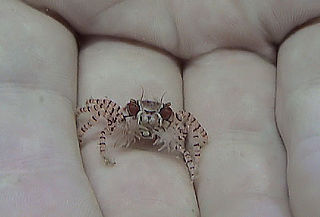
Lybia is a genus of small crabs in the family Xanthidae. Their common names include boxer crabs, boxing crabs and pom-pom crabs. They are notable for their mutualism with sea anemones, which they hold in their claws for defense. In return, the anemones get carried around, which may enable them to capture more food particles with their tentacles. Boxer crabs use at least three species of anemones, including Bundeopsis spp. and Triactis producta. The bonding with the anemone is not needed for survival, however, and boxer crabs have frequently been known to live without them, sometimes substituting other organisms such as sponges and corals for the sea anemones.
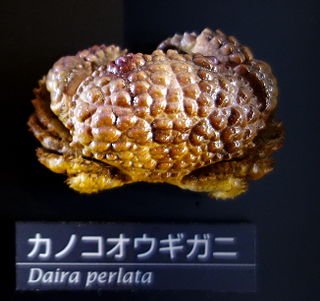
Dairoidea is a superfamily of crabs, comprising two families which each contain a single genus: Dairidae and Dacryopilumnidae (Dacryopilumnus) .
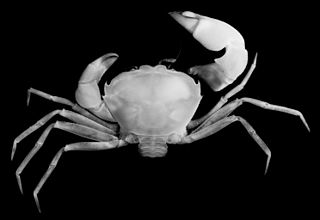
Pseudozioidea is a superfamily of crabs, formerly treated in the Eriphioidea, Carpilioidea, Xanthoidea, Pilumnoidea and Goneplacoidea. A number of fossils from the Eocene onwards are known from the family Pseudoziidae. Eleven genera are recognised in three families:

Medaeops is a genus of crabs in the family Xanthidae, containing the following species:

Medaeus is a genus of crabs in the family Xanthidae, containing the following species:
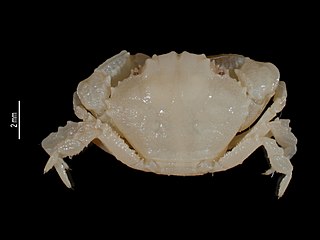
Paramedaeus is a genus of crabs in the family Xanthidae, containing the following species:
Vellodius etisoides is a species of crab in the family Xanthidae. It was originally described as Pilodius etisoides, but was transferred to the monotypic genus Vellodius in 1998. It is found around Amami Ōshima in the Ryūkyū Islands, and the Paracel Islands in the South China Sea.

Alainodaeus is a genus of crabs in the family Xanthidae, containing the following species:
Danielea moelensis is a species of crab in the family Xanthidae, and the only species in the genus Danielea.

Glyptoxanthus is a genus of crabs in the family Xanthidae, containing eight species. It was originally erected by Alphonse Milne-Edwards in 1879 for six species previously placed in the genus Actaea and elsewhere. Although previously included in subfamily Euxanthinae, the genus has a quite distinct morphology from other genera in that group, and was placed in 2011 in the new, monotypic subfamily, Glyptoxanthinae by Jose Christopher Mendoza and Danièle Guinot.

Guinotellus melvillensis is a species of crabs in the family Xanthidae, the only species in the genus Guinotellus. It is a benthic crab with an ovate carapace within the subfamily Euxanthinae.
Actiomera is a genus of crabs in the family Xanthidae, containing the following species:

Xanthias is a genus of crabs in the family Xanthidae, containing two exclusively fossil species and the following extant species:

Pulcratis is a genus of crabs in the family Xanthidae.

Heikeopsis is a genus of crabs containing two species, Heikeopsis japonica and Heikeopsis arachnoides. The genus was originally described under the name "Heikea" by Lipke Holthuis and Raymond B. Manning in 1990, but was later determined to be a junior homonym of the gastropod genus Heikea, erected by Orvar Isberg in 1934.

