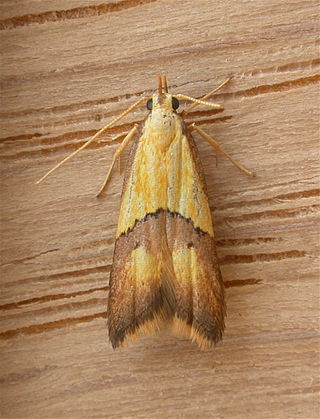
The Lecithoceridae, or long-horned moths, are a family of small moths described by Simon Le Marchand in 1947. Although lecithocerids are found throughout the world, the great majority are found in the Indomalayan realm and the southern part of the Palaearctic realm.
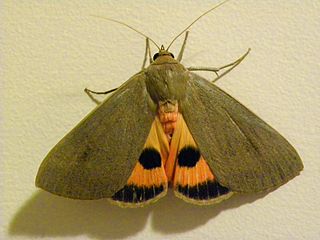
The Pyralini are a tribe of snout moths described by Pierre André Latreille in 1809. They belong to the subfamily Pyralinae, which contains the "typical" snout moths of the Old World and some other regions. The genus list presented here is provisional.
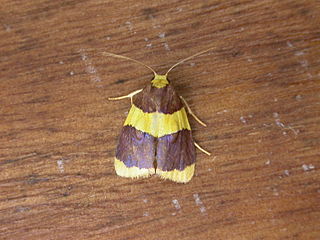
Heterallactis is a genus of moths in the family Erebidae erected by Edward Meyrick in 1886.

Philenora is a genus of moths in the subfamily Arctiinae. The genus was erected by Rudolph Rosenstock in 1885.

Scoliacma is a genus of tiger moths in the family Erebidae. The genus was erected by Edward Meyrick in 1886.

The Depressariinae – sometimes spelled "Depressiinae" in error – are a subfamily of moths in the superfamily Gelechioidea. Like their relatives therein, their exact relationships are not yet very well resolved. It has been considered part of family Elachistidae sensu lato or included in an expanded Oecophoridae. In modern classifications they are treated as the distinct gelechioid family Depressariidae.
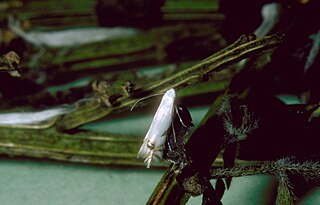
Leucoptera is a genus of moths in the family Lyonetiidae. Its members are leaf borers many of which can cause severe damage to plant crops, such as coffee or apples.
Cuphodes is a genus of moths in the family Gracillariidae.

Xyloryctidae is a family of moths contained within the superfamily Gelechioidea described by Edward Meyrick in 1890. Most genera are found in the Indo-Australian region. While many of these moths are tiny, some members of the family grow to a wingspan of up to 66 mm, making them giants among the micromoths.

Heterallactis euchrysa is a moth of the family Erebidae. It was described by Edward Meyrick in 1886. It is found in the Australian states of Queensland and New South Wales.
Heterallactis microchrysa is a moth of the family Erebidae. It was described by Alfred Jefferis Turner in 1940. It is found in Queensland, Australia.
Heterallactis niphocephala is a moth of the family Erebidae. It was described by Alfred Jefferis Turner in 1940. It is found in Australia.
Heterallactis trigonochrysa is a moth of the family Erebidae. It was described by Alfred Jefferis Turner in 1940. It is found in Australia.
Heterallactis aroa is a moth of the family Erebidae. It was described by George Thomas Bethune-Baker in 1904. It is found in New Guinea.
Heterallactis semiconstricta is a moth of the family Erebidae. It was described by George Hampson in 1914. It is found on New Guinea.
Musotiminae is a subfamily of the lepidopteran family Crambidae. It was described by Edward Meyrick in 1884

Anacampsinae is a subfamily of moths in the family Gelechiidae.

Stathmopodidae is a family of moths in the moth superfamily Gelechioidea described by Edward Meyrick in 1913.

Antipterna is a genus of moths of the family Oecophoridae, first described by Edward Meyrick in 1916.
