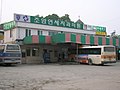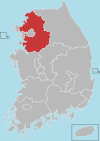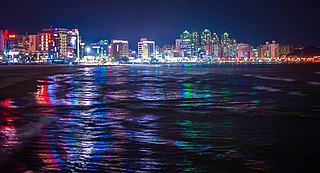
Pohang, formerly spelled Po-Hang, is the largest city in North Gyeongsang Province, South Korea, with a population of 499,363 as of 2022, bordering the Sea of Japan to the east, Yeongcheon to the west, Gyeongju to the south, and Cheongsong and Yeongdeok to the north.

Gunsan, also romanized as Kunsan, is a city in Jeonbuk State, South Korea. It is on the south bank of the Geum River just upstream from its exit into the Yellow Sea. It has emerged as a high-tech manufacturing industrial city and an international trade seaport that is approximately 200 km (120 mi) southwest of Seoul on the midwest coast of the Korean Peninsula.

Eumseong County is a county in North Chungcheong Province, South Korea, best known for being the birthplace of former UN Secretary-General Ban Ki-moon.

Gurye (Gurye-gun) is a county in the province of Jeollanam-do, South Korea. Gurye is a small, picturesque farming town situated between Jirisan and the Seomjin River. In the northeastern part of unwavering efforts at the Mt. Jiri. Gurye is the sole designated special tourism and leisure zone in all of Jeollanam-do. The total size of Gurye County is 443.02 square km, with a modest population of approximately 30,000.

Gochang County is a county in Jeonbuk State, South Korea. It is a rural area, and is home to only one institution of higher education: Gochang Polytechnic College.

Gyeongju, historically known as Seorabeol, is a coastal city in the far southeastern corner of North Gyeongsang Province, South Korea. It is the second largest city by area in the province after Andong, covering 1,324 km2 (511 sq mi) with a population of 264,091 people as of December 2012. Gyeongju is 370 km (230 mi) southeast of Seoul, and 55 km (34 mi) east of Daegu. The city borders Cheongdo and Yeongcheon to the west, Ulsan to the south and Pohang to the north, while to the east lies the coast of the Sea of Japan. Numerous low mountains—outliers of the Taebaek range—are scattered around the city.
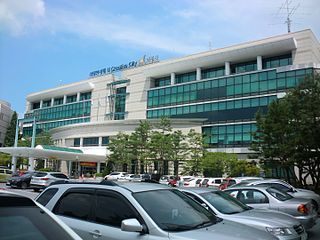
Hwaseong is a city in Gyeonggi Province, South Korea. It has the largest area of farmland of any city or county in Gyeonggi Province. Seoul Subway Line 1 passes through Hwaseong, stopping at Byeongjeom Station. Suin Bundang Line also passes through Hwaseong, stopping at Eocheon Station.
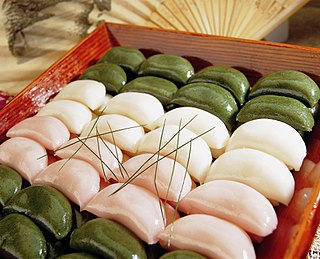
Chuseok, also known as Hangawi, is a major mid-autumn harvest festival and a three-day holiday in South Korea celebrated on the 15th day of the 8th month of the lunisolar calendar on the full moon. In North Korea, they only celebrate for the day of chuseok. Like many other harvest festivals around the world, it is held around the autumn equinox, i.e. at the very end of summer or in early autumn. It is the biggest traditional holiday in South Korea.

Anseong is a city in Gyeonggi Province, South Korea, 80 kilometres (50 mi) south of Seoul. Its geographical location is 37°0′N127°16′E.
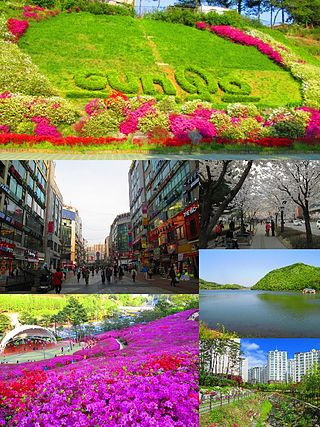
Gunpo, formerly romanized as Kunp'o, is a city in Gyeonggi Province, South Korea. It is south of Seoul and in the Seoul National Capital Area. It borders Anyang to the north, Uiwang to the east, and Ansan to the south and west, and is connected to its neighbors and to Seoul by lines 1 and 4 of the Seoul Metropolitan Subway. Gunpo is also home to three stops on the Gyeongbu Line, a national railway that links it to the rest of the country. Although 73.2% of the city is greenspace, owing largely to Surisan and various smaller mountains, Gunpo is home to over 286,000 residents in several urban areas. The city's downtown core is Sanbon New Town, a commercial hub which centers on a pedestrian "street of culture" that Gunpo has designated as one of its eight scenic locations.

Seosan is a city in South Chungcheong Province, South Korea, with a population of roughly 175,000 according to the 2017 census. Located at the northwestern end of South Chungcheong Province, it is bounded by Dangjin, Naepo New Town, Yesan-gun and Hongseong-gun on the east, Taean-gun and the Yellow Sea on the west, 125 km (78 mi) south of Seoul, 159 km (99 mi) northwest of Daejeon and 34 km (21 mi) northwest of Naepo New Town. Seosan is the hub of transportation on the west coast where the Seohaean Expressway, Daejeon-Dangjin Expressway, and National Highways No. 29, 32, 38, and 45 intersect.

Andong is a city in South Korea, and the capital of North Gyeongsang Province. It is the largest city in the northern part of the province with a population of 167,821 as of October 2010. The Nakdong River flows through the city. Andong is a market centre for the surrounding agricultural areas.

Gimcheon is a city in North Gyeongsang Province, South Korea. It is situated on the major land transportation routes between Seoul and Busan, namely the Gyeongbu Expressway and Gyeongbu Line railway.

Mungyeong is a city in North Gyeongsang Province, South Korea. The local government, economy, and transportation networks are all centered in Jeomchon, the principal town. Mungyeong has a lengthy history, and is known today for its various historic and scenic tourist attractions. The city's name means roughly "hearing good news." Recently, development has been somewhat stagnant with the decline of the coal industry. Since the 1990s, the proportion of people who rely on the tourism industry through Mungyeong Saejae has gradually increased.
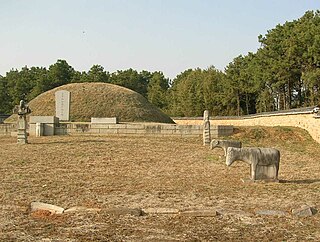
Sangju is a city in North Gyeongsang Province, South Korea. Although Sangju is rather rural, it is very old and was once a key city. Along with Gyeongju, it gives rise to half of the name of the Gyeongsang Provinces. Sangju is nicknamed Sam Baek, or "Three Whites", referring to three prominent agricultural products rice, silkworm cocoons, and dried persimmons from the area.
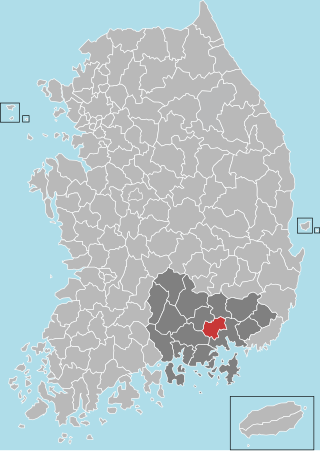
Haman County (Haman-gun) is a county in South Gyeongsang Province, South Korea. The local government is seated in the town of Gaya-eup. The county magistrate is Seok Gyu Jin.

Suji District, or Suji, is one of the three city districts in Yongin, South Korea which is approximately 29 km south of Seoul. Suji became a city district on October 31, 2005, about nine years after Yongin officially became a city. When Yongin was established in 1996, both urban and rural areas were covered to become a part of the city; thus to this day, Yongin's urbanization is varied throughout different regions of the city. Suji is one of the most urbanized areas of Yongin, as it borders Seongnam's Bundang District and Suwon, two more well developed areas. Home to the newly built Shinsegae Department Store and Dankook University in one of its towns, Jukjeon, Suji is rapidly developing as Yongin becomes more and more urbanized. In recent years, the district has attracted upper-class Koreans, with the completion of the Samsung East Palace in 2010.
Bongdam is a town in the city of Hwaseong in South Korea. Covering over 4000 hectares, the town is the focus of a planned community, primarily as a commuter town for the bordering city of Suwon.


 South Korea