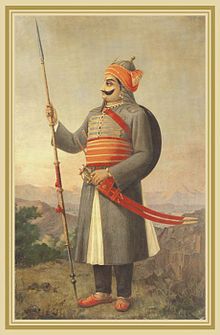
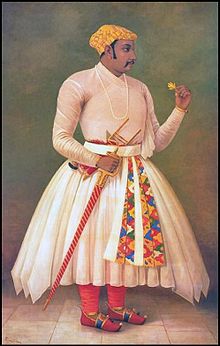
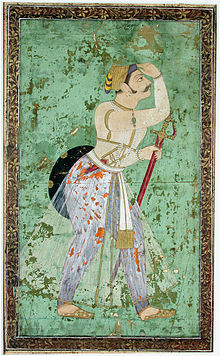
Sangram Singh I, popularly known as Rana Sanga or Maharana Sanga, was an Indian ruler from the Sisodia dynasty. He ruled Mewar, the traditional territory of Guhilas (Sisodias) in present-day north-western India. However, through his capable rule his kingdom turned into one of the greatest power of Northern India in early sixteenth century. He controlled parts of present-day Rajasthan, Gujarat, Madhya Pradesh and Uttar Pradesh with capital at Chittor. His reign was admired by several of contemporaries including Babur, who described him the "greatest Indian king" of that time along with Krishnadevaraya of South India. The Mughal historian Al-Badayuni called Sanga as the bravest of all Rajputs along with Prithviraj Chauhan. Rana Sanga was the last independent Hindu king of Northern India to control a significant territory before the Mughal Era. In some contemporary texts is described as the Hindu Emperor in Northern India.

Pratap Singh I, popularly known as Maharana Pratap, was a king of Mewar from the Sisodia dynasty. Pratap became a folk hero for his military resistance against the expansionism of the Mughal Empire under Akbar through guerrilla warfare which proved inspirational for later rebels against Mughals including Shivaji.

The Kachhwaha is a Rajput clan found primarily in India. Sometimes families within the clan ruled a number of kingdoms and princely states, such as Jaipur, Bihar, Uttar Pradesh, Madhya Pradesh, Alwar and Maihar.

Bappa Rawal was a king of the Mewar kingdom in Rajasthan, India. The bardic chronicles describe him as a member of the Guhila Rajput Clan, and some of them consider him to be the founder of the Guhila dynasty. He is credited with repelling the Arab invasion of India. Different historians have identified him with various rulers of the Guhila dynasty, including Kalabhoja, Shiladitya, and Khumana.
Gahlot is a clan of Rajputs Guhilot Rajputs ruled number of Kingdom's including Mewar, Banswara, Dungarpur, Pratapgarh, Shahpura, Bhavnagar, Palitana, Lathi and Vala, The variations of the name include Gehlot, Guhila, Gohil or Guhilot.

Maharana Hammir (1314–1364), or Hammir, was a 14th-century Hindu Rajput ruler of Mewar in present-day Rajasthan, India. Hammir Singh, was a scion of the cadet branch Rana of the Guhila dynasty, who regained control of the region, re-established the dynasty after defeating the Tughlaq dynasty, and captured present-day Rajasthan from Muslim forces of Delhi and became the first of the 'Rana' branch to become the King of Mewar with title of Maharana. Hammir also became the progenitor of the Sisodia clan, a branch of the Guhila dynasty, to which every succeeding Maharana of Mewar has belonged. Mewar during Rana Hammir's reign, was one of the few ethnic Indian states that had withstood the Turkic invasions. According to John Darwin "Only in Mewar and in Vijaynagar had Hindu states withstood the deluge".

Rao Maldeo Rathore was a king of Marwar from the Rathore dynasty, who ruled the kingdom of Marwar in present day state of Rajasthan. Maldeo ascended the throne in 1531 CE, inheriting a small ancestral principality of Rathore's but after a long period of military actions against his neighbours, Maldeo swept significant territories which included parts of present day Rajasthan, Haryana, Uttar Pradesh, Gujarat and Sindh. He refused to ally with either the Sur Empire or the Mughal Empire.

Kumbhakarna Singh, popularly known as Maharana Kumbha, was the Maharana of Mewar kingdom in India. He belonged to the Sisodia clan of Rajputs. Rana Kumbha is known for his illustrious military career against various sultanates and patronization of art and music and architecture.

Ratnasimha or Ratan Singh was a ruler of the Medapata (Mewar) kingdom in present-day Rajasthan, India. He belonged to the Rawal branch of the Guhila dynasty, which ruled from the Chitrakuta fort. The last ruler of this branch, he was defeated by Alauddin Khalji in the Siege of Chittorgarh in 1303 CE.

The Battle of Haldighati was a battle fought on 18 June 1576 between the Mewar forces led by Maharana Pratap, and the Mughal forces led by Man Singh I of Amber. The Mughals carried the day after inflicting significant casualties on Mewar forces, although they failed to capture Pratap, who reluctantly retreated persuaded by his fellow commanders.

Udai Singh II was the Maharana of Mewar and the founder of the city of Udaipur in the present-day Rajasthan state of India. He was the 12th ruler of the Kingdom of Mewar. He was the fourth son of Rana Sanga and Rani Karnavati, a princess of Bundi.
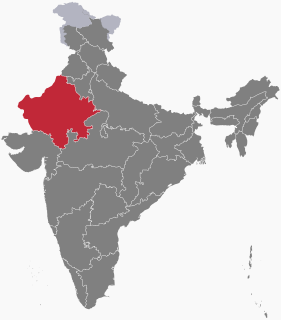
The history of human settlement in the west Indian state of Rajasthan dates back to about 5,000 years ago. This region was inhabited during great floods after the ice age as well. This area was known as Matsya kingdom. It was the site of the Indus Valley Civilization. The early medieval period saw the rise of many Rajput kingdoms like Pratihars, Chauhans of Ajmer, Guhilot and Sisodias of Mewar, Shekhawats of Shekhawati Sikar, Rathores of Marwar.

Kingdom of Mewar, sometimes known as Udaipur State, was ruled by the Sisodia dynasty. It was an independent kingdom in Rajputana region of India. It was established around the 7th century as minor rulers of the Nagada-Ahar region of Udaipur and later in the 10th century, it transformed into an independent state under Rawal Bharttripatta II. In 1303, the kingdom was invaded, its capital fort Chittorgarh was besieged and taken by Alauddin Khalji killing the entire main branch of the family known as the Rawal Branch. A junior branch of the family called the Ranas later regained the control of the kingdom in 1326 and under them, the kingdom became the most powerful kingdom in North India until the Mughal Invasion of India in 1526. The kingdom under Udai Singh II and Maharana Pratap was constantly engaged in a struggle with the Mughals and continued through the kingdom accepting Mughal suzernity in 1615 and ended around 1707 when Aurangzeb died. In 1818, it accepted British suzerainty and in 1947, Bhupal Singh signed the Instrument of Accession to India and join the India.
Raimal Singh Sisodia, also known as Rana Raimal, was a Hindu Rajput ruler of Mewar. Maharana Raimal was the son of Rana Kumbha. He came to power by defeating his patricide predecessor, Udai Singh I in battles at Jawar, Darimpur and Pangarh. Early in Raimal's reign, Ghiyas Shah of Malwa attacked Chittor unsuccessfully. Soon after, Ghiyas Shah's general, Zafar Khan attacked Mewar and was defeated at Mandalgarh and Khairabad. By marrying Sringardevi, Raimal ended the conflict with the Rathores. During Raimal's reign, Godwar, Toda and Ajmer were captured by his son Prithviraj. Raimal also strengthened the state of Mewar and repaired the temple of Eklingji in Chittor.
The Mori or Maurya is a Rajput clan which controlled the Chittor Fort in ancient period. The Mori Rajputs were probably the most powerful power in this region before the rise of Pratiharas. Mori is also considered a sub clan of Parmar Rajputs.

Raj Singh I, was the Maharana of Mewar Kingdom and eldest son of Jagat Singh I by his wife, a princess of Marwar. He rebelled against Mughal Empire and annexed many Mughal territories He later participated in Rajput War (1679–1707) and defeated Mughals
The Guhilas of Medapata colloquially known as Guhilas of Mewar were a Rajput dynasty that ruled the Medapata region in present-day Rajasthan state of India. The Guhila kings initially ruled as Gurjara-Pratihara feudatories between end of 8th and 9th centuries and later were independent in period of the early 10th century and allied themselves with the Rashtrakutas. Their capitals included Nagahrada (Nagda) and Aghata (Ahar). For this reason, they are also known as the Nagda-Ahar branch of the Guhilas.
Banvir, also known as Banbeer was the ruler of Mewar Kingdom between 1536 and 1540. He was nephew of Rana Sanga, born to his brother Prithviraj and his cocunbine.
In 1303, the Delhi Sultanate ruler Alauddin Khalji captured the Chittor Fort from the Guhila king Ratnasimha, after an eight-month-long siege. The conflict has been described in several legendary accounts, including the historical epic poem Padmavat, which claims that Alauddin's motive was to obtain Ratnasimha's beautiful wife Padmavati; this legend is considered historically inaccurate by most historians.
Rawal Allata or just Allata was a ruler of the Guhila dynasty. He was the son and successor of Rawal Bharttripatta II. He ruled from 951 to 971 CE.