Markt Erlbach

Last updated
Markt Erlbach
St. Kilian D-5-75-145-1 02.jpg
St. Kilian Church, Markt Erlbach
DEU Markt Erlbach COA.svg
Location of Markt Erlbach within Neustadt a.d.Aisch-Bad Windsheim district
Markt Erlbach in NEA.svgErgersheimLangenfeldOsing (unincorporated area)Wilhelmsdorf
Markt Erlbach
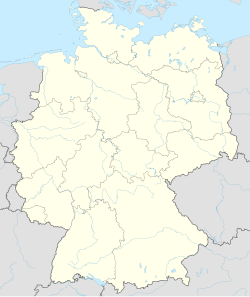
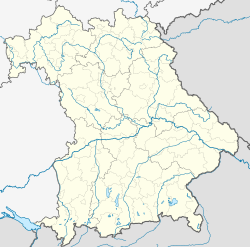
Location of Markt Erlbach
Germany adm location map.svg
Red pog.svg
Markt Erlbach
Bavaria location map.svg
Red pog.svg
Markt Erlbach
Coordinates: 49°29′N10°39′E / 49.483°N 10.650°E / 49.483; 10.650
Country Germany
State Bavaria
Admin. region Mittelfranken
District Neustadt a.d.Aisch-Bad Windsheim
Subdivisions22 Ortsteile
Government
   Mayor (202026) Birgit Kreß [1] (FW)
Area
  Total
60.90 km2 (23.51 sq mi)
Elevation
385 m (1,263 ft)
Population
 (2023-12-31) [2]
  Total
5,727
  Density94.04/km2 (243.6/sq mi)
Time zone UTC+01:00 (CET)
  Summer (DST) UTC+02:00 (CEST)
Postal codes
91459
Dialling codes 09106
Vehicle registration NEA
Website www.markt-erlbach.de

Markt Erlbach is a municipality in the district of Neustadt (Aisch)-Bad Windsheim in Bavaria, Germany.

Contents

While "Markt" is a title given since the Middle Ages to towns that are allowed to hold a market (see Marktrecht), in the case of Markt Erlbach, "Markt" is part of the name, so with its title the town is called "Markt Markt Erlbach".

Geography

Geographical Location

Markt Erlbach, with an area of ​​almost 61 km² (23.5 mi²), is the fifth largest municipality in the district Neustadt (Aisch)-Bad Windsheim. The town lies on the high plateau of the Franconian Heights, approximately 30 km (20 mi) west of Nuremberg. [3]

Neighboring Municipalities

Neighboring municipalities are (starting from the north and proceeding clockwise):

Municipal Subdivisions

The municipality consists of 33 subdivisions (the settlement type is indicated in parentheses): [4] [5]

History

Origin of Name

The village was first mentioned in writing in 1132 as "Erlehe". The former royal estate had already separated from the royal estate of Riedfeld before 800. [6] The village name is derived from a field name of the same name. It consists of Erle with the collective suffix -(e)he and means alder grove. The original village name was last documented as "Erlahe" in 1169. As early as 1136, the village was called "Erlebach", i.e., with reference to the stream. The form "Markterlbach" has been documented since 1350. [7] In 1911, the official name of the municipality was changed from Erlbach to Markt Erlbach. [8]

Middle Ages

An early church foundation, from which many branch churches originated, and its location on the military road between the imperial cities of Nuremberg, Bad Windsheim, and Rothenburg ob der Tauber led Markt Erlbach through a turbulent history, but were also prerequisites for its development into a center for crafts, trade, and jurisdiction. The first documented mention dates back to a charter of foundation for Heilsbronn Monastery from 1132. [9] By 1144, a church in Erlbach was already mentioned, which, according to tradition, was consecrated as early as 750 by Burkard, Würzburg's first bishop, and was replaced by a new building before 815 by Abbot Ratger of Fulda, in whose sphere of influence Erlbach belonged. [10] From 1282, Erlbach was ruled by the Burgraves of Nuremberg, who administered it from the vice-dom seat of Neustadt. In 1384, Erlbach was described as an "oppidum," a fortified town, and its seal bore the Hohenzollern coat of arms (a hound's head on a black and white shield). See also the depiction in the church window of St. Kilian's Church from 1380. During the time of the stem duchies, the town lay within the Duchy of Franconia.

Modern Era

The Reformation was introduced in Markt Erlbach under the patronage of the local pastor, Hans Röschlein, and the patronage of Heilsbronn Abbey, whose prior and later abbot, Johann Schopper, was a member of the Ansbach visitation committee. The reformer Caspar Löner, who was born there, likely exerted his influence within the deanery. [11]

After the devastation of the Thirty Years' War, particularly from the autumn of 1631 onward by marauding mercenaries, [12] numerous Austrian religious refugees settled in and around Markt Erlbach, contributing to the town's economic recovery. [13]

Toward the end of the 18th century, there were 101 properties in Markt Erlbach. High jurisdiction was exercised by the Brandenburg-Bayreuth town bailiwick of Markt Erlbach. Village and municipal authority was held by the Markt Erlbach council. All properties had the Principality of Bayreuth as their landlord.

Politics

Mayor

Birgit Kreß was elected in 2008 as the new mayor.

References

  1. Liste der ersten Bürgermeister/Oberbürgermeister in kreisangehörigen Gemeinden, Bayerisches Landesamt für Statistik, 15 July 2021.
  2. "Alle politisch selbständigen Gemeinden mit ausgewählten Merkmalen am 31.12.2023" (in German). Federal Statistical Office of Germany. 28 October 2024. Retrieved 16 November 2024.
  3. "Topographische Karte 1:50.000". BayernAtlas (in German). Landesamt für Digitalisierung, Breitband und Vermessung Bayern. Retrieved 2023-07-19.
  4. "Markt Erlbach". bavarikon (in German). 2011-05-09. Retrieved 2026-01-18.
  5. "Markt Markt Erlbach, Landkreis Neustadt a.d.Aisch-Bad Windsheim". BayernPortal (in German). Retrieved 2026-01-18.
  6. Döllner, Max (1950). ENTWICKLUNGSGESCHICHTE DER STADT NEUSTADT AN DER AISCH BIS 1933. VON MAX DOELLNER. SCHMIDT. p. 102. Retrieved 2026-01-18.
  7. Reitzenstein, Wolf-Armin Freiherr von (2013-08-27). Lexikon fränkischer Ortsnamen: Herkunft und Bedeutung. Oberfranken, Mittelfranken, Unterfranken (in German). C.H.Beck. p. 140. ISBN   978-3-406-65803-7 . Retrieved 2026-01-18.
  8. Bauer, Richard (1983). Handbuch der bayerischen Ämter, Gemeinden und Gerichte 1799-1980 (in German). München: C.H.Beck. p. 536. ISBN   3-406-09669-7.
  9. Muck, Georg (1879). Geschichte von Kloster Heilsbronn von der Urzeit bis zur Neuzeit (in German). Vol. 1. Beck. p. 15. Retrieved 2026-01-18.
  10. Döllner, Max (1950). ENTWICKLUNGSGESCHICHTE DER STADT NEUSTADT AN DER AISCH BIS 1933. VON MAX DOELLNER. SCHMIDT. pp. 69, 93. Retrieved 2026-01-18.
  11. Döllner, Max (1950). ENTWICKLUNGSGESCHICHTE DER STADT NEUSTADT AN DER AISCH BIS 1933. VON MAX DOELLNER. SCHMIDT. p. 194. Retrieved 2026-01-18.
  12. Döllner, Max (1950). ENTWICKLUNGSGESCHICHTE DER STADT NEUSTADT AN DER AISCH BIS 1933. VON MAX DOELLNER. SCHMIDT. pp. 234–238. Retrieved 2026-01-18.
  13. Krauß, Eberhard (2011). Exulanten im früheren Evang.-Luth. Dekanat Markt Erlbach im 17. Jahrhundert (in German). Nürnberg: Gesellschaft für Familienforschung in Franken. ISBN   978-3-929865-35-6.