Morokweng | |
|---|---|
  Morokweng 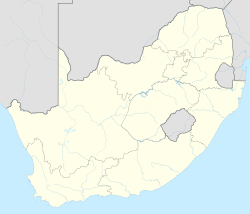 Morokweng | |
| Coordinates: 26°07′37″S23°46′30″E / 26.127°S 23.775°E | |
| Country | South Africa |
| Province | North West |
| District | Dr Ruth Segomotsi Mompati |
| Municipality | Kagisano/Molopo |
| Area | |
• Total | 24.17 km2 (9.33 sq mi) |
| Population (2011) [1] | |
• Total | 14,260 |
| • Density | 590.0/km2 (1,528/sq mi) |
| Racial makeup (2011) | |
| • Black African | 97.4% |
| • Coloured | 1.8% |
| • Indian/Asian | 0.3% |
| • Other | 0.5% |
| First languages (2011) | |
| • Tswana | 93.4% |
| • Afrikaans | 2.3% |
| • English | 1.6% |
| • Other | 2.8% |
| Time zone | UTC+2 (SAST) |
| Postal code (street) | 8614 |
| PO box | 8614 |
| Area code | 053 |
Morokweng is a town in Kagisano-Molopo Local Municipality in the North West province of South Africa.
The village, which lies 140 kilometres north-west of Vryburg, was first occupied by Kgosi Maiketso in the 1790s after he broke away from the main Barolong faction at Kuruman. [2]
When Bechuanaland came under British control in 1886, Morokweng was designated a Native Reserve, with an area that by the late 1950s was estimated to be 160,000 morgen in extent. [2]
In 1994, a large impact structure, the Morokweng impact structure, was discovered in the ground near the village. [2]

