
The Lauxaniidae are a family of acalyptrate flies. They generally are small flies with large compound eyes that often are brightly coloured in life, sometimes with characteristic horizontal stripes, such as in Cestrotus species. Many species have variegated patterns on their wings, but in contrast they generally do not have variegated bodies, except for genera such as Cestrotus, whose camouflage mimics lichens or the texture of granitic rocks.

The Pyrgotidae are an unusual family of flies (Diptera), one of only two families of Cyclorrhapha that lack ocelli. Most species are "picture-winged", as is typical among the Tephritoidea, but unlike other tephritoids, they are endoparasitoids; the females pursue scarab beetles in flight, laying an egg on the beetle's back under the elytra where the beetle cannot reach it. The egg hatches and the fly larva enters the body cavity of the beetle, feeding and eventually killing the host before pupating. In the United States, some species of Pyrgota and Sphecomyiella can be quite common in areas where their host beetles are abundant. Like their host beetles, these flies are primarily nocturnal, and are often attracted to artificial lights.
Lixophaga is a genus of flies in the family Tachinidae.

Tomoplagia is a genus of tephritid or fruit flies in the family Tephritidae.

Urophora is a genus of tephritid or fruit flies in the family Tephritidae.

Euaresta is a genus of flies in the family Tephritidae that live in plants of the closely related genera Ambrosia, Xanthium, and Dicoria, and feed on their flowers and seeds.

Trupanea is a genus of tephritid or fruit flies in the family Tephritidae.
Sciasminettia is a genus of small Palearctic flies of the family Lauxaniidae.
The broad-headed flies is a subfamily of flies. Until 2010, they were known from only one species based on four specimens and placed in the family Eurychoromyiidae.
Sarcofahrtiopsis is a genus of small flesh flies. Most are known from the Antilles and Central America. Many species feed on semiterrestrial crabs of the genus Cardisoma or are associated with bats.

Cestrotus is a genus of brachyceran flies in the family Lauxaniidae.

Tephritini is a tribe of fruit flies in the family Tephritidae. There are about 80 genera and some 1000 described species in Tephritini.

Xenochaetina is a genus of flies in the family Lauxaniidae. There are about 11 described species in Xenochaetina.
Dimecoenia is a genus of shore flies in the family Ephydridae.

Mesembrinellidae is a family of Neotropical flies in the order Diptera, and formerly included in the Calliphoridae. There are 36 described species.
Mesembrinella is a genus of Neotropical flies in the family Mesembrinellidae, and formerly placed in the Calliphoridae.
Eurystratiomyia is a genus of flies in the family Lauxaniidae.
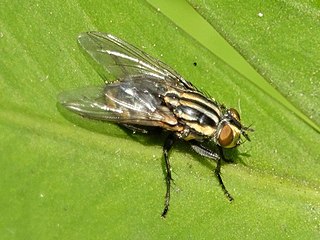
Oxysarcodexia is a genus of flies belonging to the family Sarcophagidae.

Physegenua is a neotropical genus of flies in the family Lauxaniidae.
Asilostoma is a neotropical genus of flies in the family Lauxaniidae.


