
Blattidae is a cockroach family in the order Blattodea containing several of the most common household cockroaches. Notable species include:

Pyrrhocoridae is a family of insects with more than 300 species world-wide. Many are red coloured and are known as red bugs and some species are called cotton stainers because their feeding activities leave an indelible yellow-brownish stain on cotton crops. A common species in parts of Europe is the firebug, and its genus name Pyrrhocoris and the family name are derived from the Greek roots for fire "pyrrho-" and bug "coris". Members of this family are often confused with, but can be quickly separated from, Lygaeidae by the lack of ocelli on the top of the head.
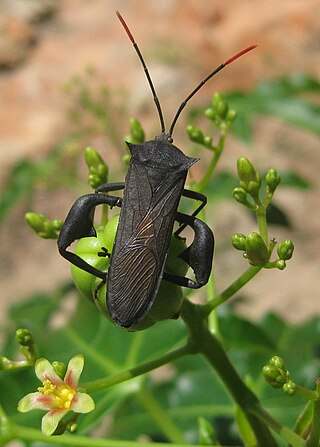
Coreidae is a large family of predominantly sap-sucking insects in the Hemipteran suborder Heteroptera. The name "Coreidae" derives from the genus Coreus, which derives from the Ancient Greek κόρις (kóris) meaning bedbug.

Eremiaphilidae is a small Old World family of praying mantids, based on the type genus Eremiaphila. As part of a major revision of mantid taxonomy, this family now contains the subfamily Tarachodinae, which includes tribes and genera previously placed in the now obsolete Tarachodidae.

Bandwings, or band-winged grasshoppers, are the subfamily Oedipodinae of grasshoppers classified under the family Acrididae. They have a worldwide distribution and were originally elevated to full family status as the Oedipodidae. Many species primarily inhabit xeric weedy fields, and some are considered to be important locusts:

The family Fulgoridae is a large group of hemipteran insects, especially abundant and diverse in the tropics, containing over 125 genera worldwide. They are mostly of moderate to large size, many with a superficial resemblance to Lepidoptera due to their brilliant and varied coloration. Various genera and species are sometimes referred to as lanternflies or lanthorn flies, though they do not emit light.

Delphacidae is a family of planthoppers containing about 2000 species, distributed worldwide. Delphacids are separated from other "hoppers" by the prominent spur on the tibia of the hindleg.

Eurybrachidae is a small family of planthoppers with species occurring in parts of Asia, Australia and Africa. They are remarkable for the sophistication of their automimicry.
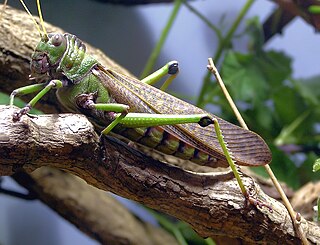
The Romaleidae or lubber grasshoppers are a family of grasshoppers, based on the type genus Romalea. The species in this family can be found in the Americas.

Ricaniidae is a family of planthopper insects, containing over 400 species worldwide. The highest diversity is in tropical Africa and Asia and in Australia, with a few species occurring in the Palearctic and Neotropical realms. It is one of the smaller families in the planthopper superfamily Fulgoroidea.
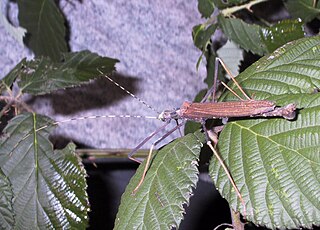
Pseudophasmatidae is a family of stick insect, in the suborder Verophasmatodea, commonly called the "striped walkingsticks". An important identifying characteristic is its mesothorax, which is never more than three times as long as the prothorax.

The Phaneropterinae, the sickle-bearing bush crickets or leaf katydids, are a subfamily of insects within the family Tettigoniidae. Nearly 2,060 species in 85 genera throughout the world are known. They are also known as false katydids or round-headed katydids.

The Harpactorinae are a large subfamily of the Reduviidae. About 300 genera and 2,000 species worldwide have been described. Some of the species of the genera Zelus, Pselliopus, Sinea, and Apiomerus are of interest as biological pest control agents.

Issidae is a family of planthoppers described by Spinola in 1839, belonging to the order Hemiptera, suborder Auchenorrhyncha superfamily Fulgoroidea.

Nogodinidae is a family of planthoppers. They have membranous wings with delicate venation and can be confused with members of other Fulgoroid families such as the Issidae and Tropiduchidae. Some authors treat it as a subfamily of the Issidae.

Dinidoridae is a small family of hemipteran "true bugs" comprising about sixteen genera and a hundred species the Hemiptera suborder Heteroptera. As a group the family does not have any common name. Until the late 19th century they were generally regarded as a subfamily of Pentatomidae.

The Blissidae are a family in the Hemiptera, comprising nearly 50 genera and 400 species. The group has often been treated as a subfamily of the Lygaeidae but was resurrected as a full family by Thomas Henry (1997).
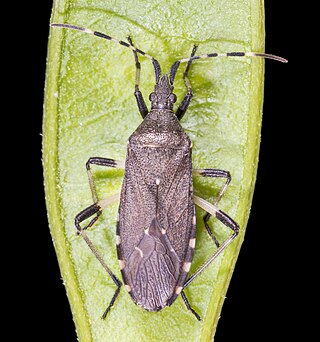
Dicranocephalus is the sole genus of true bugs in the family Stenocephalidae. There are about 30 described species in the genus Dicranocephalus.
The Gengidae are a family of Fulgoromorpha (planthoppers), with species found in South Africa.

The Micrelytrinae are a subfamily of true bugs in the family Alydidae, based on the type genus Micrelytra Laporte, 1833. Genera are recorded from the Americas, Europe and Asia.
